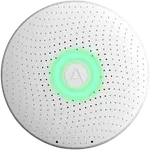
Apollo MSR-2 with CO2 Review: A Compact Home Assistant Multisensor With CO2 On Board
The Apollo MSR-2 with CO2 is less a classic air quality monitor and more a room-awareness multisensor that happens to include CO2. It combines CO2 with occupancy, ambient light, UV, atmospheric pressure and temperature, runs on USB-C over 2.4 GHz Wi-Fi, and integrates with Home Assistant. What it does not do is particulates: there is no PM2.5, PM10, TVOC or NOx sensing, and no humidity reading either. At its low price it is a strong value for automation-heavy Home Assistant setups, but it is not the device to buy if you want to track dust, smoke or pollen.
- Home Assistant users
- Room automation and presence
- CO2 and ventilation tracking
- Budget multisensor setups
Pros
- CO2 sensing at a low price
- Occupancy detection for presence-based automations
- Ambient light and UV sensing, useful for daylight-driven rules
- Atmospheric pressure and temperature included
- Native Home Assistant integration
- Temperature and air quality alerts, with history records
- Simple USB-C power
Cons
- No particulate sensing at all: no PM0.3, PM1, PM2.5 or PM10
- No TVOC, NOx, carbon monoxide or radon sensing
- No humidity sensor, so no humidity alerts
- Home Assistant only: no Alexa, Google Home, HomeKit, SmartThings or Matter
- No screen on the device
- Wired USB-C power with no battery option
- Indoor only, with no weather resistance rating
Who is the Apollo MSR-2 with CO2 for?
It suits someone building room-level automations in Home Assistant who wants several signals from one small device instead of scattering four sensors around. Occupancy tells the room whether anyone is there, ambient light and UV describe how much daylight is coming in, and CO2 tells you when the air has gone stale. Because it is Home Assistant only, this is a device for that ecosystem specifically, not a general-purpose monitor for an Alexa or Google Home setup.
What the MSR-2 senses
CO2 is the air quality headline: at high indoor levels it is the pollutant most associated with poor sleep and trouble concentrating, so it is the reading that tells you a closed room needs ventilating. Around it sit occupancy detection for presence-driven automations, ambient light for brightness-based rules, a UV sensor that indicates how much sun is coming through the window, atmospheric pressure, which shifts with weather changes, and temperature. Temperature and air quality alerts are both supported, and readings are recorded over time so trends stay visible.
What to know before you buy
The sensor gaps matter more than usual on this one. There is no particulate sensing at all (no PM0.3, PM1, PM2.5 or PM10), no TVOC, no NOx, no carbon monoxide and no radon, so it will not tell you about smoke, cooking particles, pollen or off-gassing from cleaners and furniture. It also has no humidity sensor, which means no humidity alerts and no mold-risk signal. On the platform side, Home Assistant is the only supported integration: Google Home, Alexa, Apple HomeKit, SmartThings, IFTTT and Matter are all unsupported. There is no screen, so every reading lives in your dashboard, and power is wired USB-C with no battery option. It carries no weather resistance rating, so keep it indoors.
Is the Apollo MSR-2 with CO2 worth it?
For the money it is one of the cheaper ways to get a real CO2 reading plus presence and light sensing into Home Assistant, and it supports the automations and history that make those readings useful. Judge it as a multisensor rather than an air quality monitor: if your goal is ventilation and room automation, it delivers; if your goal is tracking particulates or humidity, you need a different device, or this one alongside a dedicated particulate monitor.
Frequently asked questions
Does the Apollo MSR-2 measure PM2.5 or other particulates?
No. It has no particulate sensor of any size, and no TVOC or NOx sensing either. Its air quality reading is CO2.
Does the MSR-2 with CO2 work with Alexa, Google Home or HomeKit?
No. Home Assistant is the only supported platform.
Does it measure humidity?
No. It reads temperature, CO2, atmospheric pressure, ambient light, UV and occupancy, but there is no humidity sensor.
What can the occupancy sensor be used for?
It detects whether the room is occupied, which is the trigger most people use for lighting, climate and energy-saving automations in Home Assistant.
How is the Apollo MSR-2 powered?
Over USB-C. There is no battery option, and it connects over 2.4 GHz Wi-Fi.