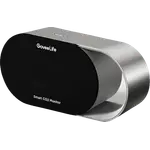



GoveeLife Smart Air Quality Monitor CO2 H5140 Review: The Desk Monitor That Explains Your Afternoon Slump
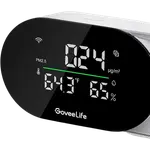
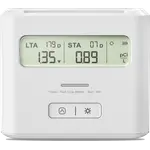
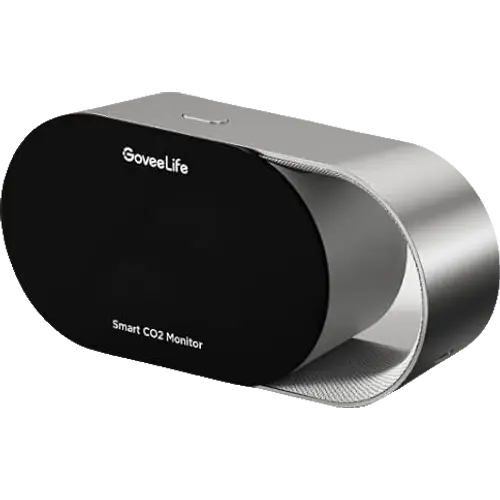
The H5140 does one job well: it shows how fast carbon dioxide builds up in a closed room and warns you before it makes you drowsy. It uses a Sensirion SCD4x photoacoustic sensor with altitude compensation, refreshes every five seconds, and puts CO2, temperature, humidity and a clock on a large LED panel that owners can read from across the room. Threshold alarms fire through a buzzer, a push notification and an email, and it can trigger a compatible fan or humidifier automatically. Be clear on what it is not: this measures carbon dioxide, not carbon monoxide, and unlike the PM2.5 model in the same range it does not measure particulates.
- Home office and study rooms
- Bedrooms and nurseries
- Anyone tracking ventilation habits
- Govee Home users automating fans or humidifiers
Pros
- Accurate photoacoustic NDIR CO2 sensor with a 5 second refresh and altitude compensation
- Large LED display readable across a room, showing CO2, temperature, humidity and clock
- Alarms on a custom threshold through buzzer, app push and email
- Day and night brightness scheduling so it does not disturb sleep
- Trend charts, long-term history and CSV export in the Govee Home app
- Automates compatible humidifiers and tower fans on rising CO2
- Mains powered over USB-C for uninterrupted monitoring
Cons
- Measures carbon dioxide only, it is not a carbon monoxide safety alarm
- No particulate, VOC or radon sensing
- 2.4GHz Wi-Fi only, and several owners report pairing or range problems
- In-app history is tied to the device, so replacing a failed unit loses it
- Considered expensive for a single-gas monitor by some buyers
- No Apple Home, SmartThings or Matter support
- Needs a mains outlet, there is no battery option
Who is the GoveeLife H5140 for?
This is a CO2-first monitor for closed rooms. It plugs into mains power over USB-C for continuous monitoring, connects on 2.4GHz Wi-Fi and Bluetooth, and shows four readings at once on a 4.82 inch LED panel: live CO2 in ppm, temperature, humidity and a clock. A three-colour indicator bar splits readings into good, moderate and poor bands, and the screen brightness follows a day and night schedule set in the app so it does not light up a bedroom. It suits people who spend hours in one room with the door closed, and Govee Home users who want the reading to actually do something by triggering a linked fan or humidifier.
What buyers love
The recurring story in reviews is discovery: owners who felt tired or headachy in a closed home office found CO2 climbing well past 1000 ppm during long meetings, changed how they ventilate, and report feeling noticeably more alert. That makes the readout itself the most praised feature, described as easy to read at a distance and from wide angles, with the desk-friendly size drawing repeat mentions. The app gets strong marks for how much it exposes: continuous trend charts, control over what appears on screen, day and night brightness schedules and configurable alarm thresholds that fire a buzzer plus a push notification. Owners also value the automation links to compatible fans and humidifiers, and several report the readings tracking closer to reality than other meters they own.
What to know before you buy
The single most repeated warning from buyers is that this measures carbon dioxide, not carbon monoxide, and it is not a safety alarm. It also does not measure particulates, so it is not a replacement for the PM2.5 model in the same range. Wi-Fi is 2.4GHz only, and a meaningful share of owners hit connection trouble, either during the initial pairing or when the unit sits far from the router. A Canadian owner points out that historical data lives with the device in the app, so replacing a failed unit loses the in-app history and only the CSV export survives. Several buyers also consider it expensive for a single-gas monitor, and the sensor benefits from an outdoor calibration in the app settings when readings drift.
Is the GoveeLife H5140 worth it?
If you spend your day in a room with the door shut, owner feedback suggests it pays for itself in awareness alone, and the combination of a readable display, configurable alarms and automation links makes it more useful than a passive meter. It is harder to justify if you want a broad air quality picture, since particulates, VOCs and carbon monoxide are all outside its scope, or if the spot you want to use it has weak 2.4GHz coverage. As a focused CO2 and ventilation tool with a good app behind it, it lands well.
Frequently asked questions
Is the GoveeLife H5140 a carbon monoxide detector?
No. It measures carbon dioxide (CO2), which is about ventilation and air freshness, not the poisonous carbon monoxide that a safety alarm detects. You still need a separate CO alarm.
Does it measure PM2.5 or VOCs?
No. This model is CO2, temperature and humidity only. The particulate readings are on the PM2.5 model in the same GoveeLife range.
Does it work with Alexa or Google Home?
Yes, you can ask Alexa or Google Assistant for the current CO2 concentration. There is no Apple Home, SmartThings or Matter support.
Can it trigger a fan or purifier automatically?
It can link to compatible humidifiers and tower fans in the Govee Home app so they react to rising CO2. Air purifiers are excluded, since filtering does not remove CO2, only ventilation does.
Does it run on batteries?
No, it is powered from a mains outlet over USB-C for continuous 24/7 monitoring, and there is no internal battery.
Can I export the data?
Yes. The app keeps trend charts and long-term history and exports CSV reports. Note that the in-app history belongs to that specific device, so a replacement unit starts fresh.