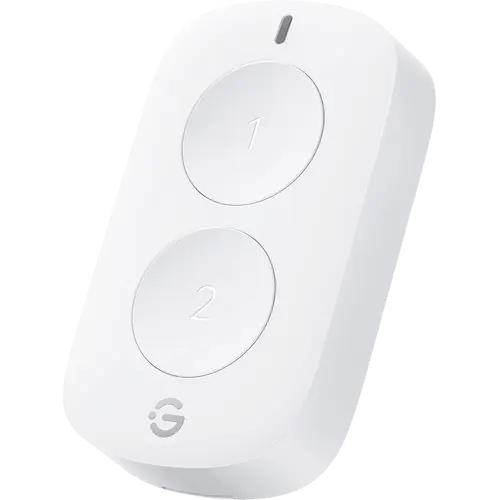


GoveeLife Smart Mini Double Button Switch Review: Two Keys for a Govee Room
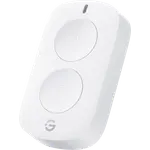
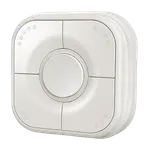
The GoveeLife Smart Mini Double Button Switch gives a Govee room two physical keys, each running its own command or scene on nearby Govee lights, plugs and appliances. It runs on a single CR2032 coin cell, sticks to a wall or any indoor surface with the included adhesive tape, and talks Bluetooth to the Govee Wi-Fi and Bluetooth devices around it, which act as its gateway; Home Assistant can also read both keys through its Govee Bluetooth integration. Each key only answers a single click, and Alexa, Google Home, Apple Home, SmartThings and Matter cannot use it. For a home already built on Govee it is a cheap, wire-free light switch; outside that ecosystem it has little to offer.
- Govee smart home owners
- Rooms without a wired switch
- Budget buyers
- Home Assistant tinkerers
Pros
- Two keys, each running its own Govee Home command or scene
- Talks Bluetooth to nearby Govee devices, no dedicated Govee hub
- Works in Home Assistant through the official Govee Bluetooth integration, both keys reported
- Indicator light confirms each press
- Low battery notifications in the Govee Home app
- Sticks to a wall or flat surface with the included adhesive tape, no wiring
- 1 year warranty
Cons
- Single click only: no double press, long press or dimming
- Needs a Govee Wi-Fi and Bluetooth device nearby to work
- No Alexa, Google Home, Apple Home, SmartThings or Matter support
- Battery life rated at about four months on a coin cell
- Indoor use only
Who is the GoveeLife Smart Mini Double Button Switch for?
It is made for homes that already run Govee or GoveeLife lights, plugs and appliances and want a physical control next to the bed, the sofa or a door. The switch cannot work on its own: each click goes over Bluetooth to the Govee devices nearby that support both Wi-Fi and Bluetooth, up to 55 m (180 ft) away, which Govee calls a distributed gateway, and the commands are set up in the Govee Home app. Two keys suit a simple pairing such as one scene and one light, or on and off for the same group.
What the GoveeLife Smart Mini Double Button Switch offers
Two physical keys, each a separate trigger for a command or a scene in the Govee Home app, and Govee describes an alternate mode where the next press of a key turns off the devices its command switched on. A red indicator light flashes once to confirm that a press was sent, and the app sends a low battery notification. It runs on one CR2032 coin cell, pre-installed in the box, which Govee rates at about four months, and it comes with two adhesive tapes to fix it on a wall or a flat indoor surface with no wiring at all. Outside the Govee app, Home Assistant's official Govee Bluetooth integration reports each key as its own press event, straight from the switch's Bluetooth broadcasts. Govee covers it with a 1 year warranty.
What to know before you buy
Each key reports a single click only: there is no double press, long press or hold-to-dim, and holding Button 1 for 5 seconds only puts the switch in pairing mode. A key can run a command that sets a brightness level, but cannot raise or lower it step by step. It needs at least one Govee device with both Wi-Fi and Bluetooth in range, and Govee states those gateway devices must be connected to the network for automations to run. Govee also states it cannot connect to Alexa or Google Assistant, and it has no Apple Home, SmartThings or Matter support. The manual limits it to indoor use, and cold below 0°C can shorten the coin cell's life.
Does the GoveeLife Smart Mini Double Button Switch work with Home Assistant?
Yes. The official Govee Bluetooth integration in Home Assistant supports the H5126 and fires a press event for each of its two keys, so a Home Assistant server with Bluetooth in range can use it as a trigger for any automation, Govee devices or not. That integration's documentation swaps the names of the H5126 and the six-key H5125, but the library behind it defines the H5126 as the two-key model.
Is the GoveeLife Smart Mini Double Button Switch worth it?
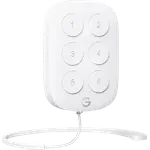
For a Govee household that wants a light switch where no wired one exists, yes: two commands on a budget-friendly, battery-powered remote that sticks anywhere indoors. Anyone who needs more actions per key, dimming or support for Matter, Zigbee, Alexa or Google Home should pick a scene controller built for that platform instead, and a room with more devices to control may be better served by Govee's six-key H5125.
Frequently asked questions
Does the GoveeLife Smart Mini Double Button Switch need a hub?
It needs no dedicated Govee hub, but it cannot work alone. Each press goes over Bluetooth to nearby Govee devices that support both Wi-Fi and Bluetooth, which act as a distributed gateway within about 55 m (180 ft), and Govee states those devices must be connected to the network for automations.
Does it work with Alexa or Google Home?
No. Govee states the switch cannot connect to Alexa or Google Assistant, and it has no Apple Home, SmartThings or Matter support either. It controls Govee devices through the Govee Home app, and Home Assistant can read it through its Govee Bluetooth integration.
Is the H5126 the 2 button or the 6 button model?
The H5126 is the two-key switch. The six-key GoveeLife remote is the H5125, a separate product. Home Assistant's supported devices list swaps the two names, but Govee's own page and manual, and the library the integration uses, define the H5126 with two keys.
Can each button do a double press or a long press?
No. The manual describes a single click of Button 1 or Button 2 as the trigger, and asks for a 1.5-second gap between two clicks of the same key. Holding Button 1 for 5 seconds puts the switch in pairing mode.
What battery does it use and how long does it last?
One CR2032 coin cell, pre-installed in the box. Govee rates it at about four months, the manual warns that temperatures below 0°C can shorten it, and the Govee Home app sends a notification when the battery is low.
How do I mount it?
Two adhesive tapes come in the box: stick one to the back of the switch and fix it to a clean, dry indoor surface such as a wall. There is no wall plate, magnet or wiring.