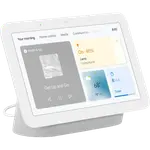


Google Nest Hub (2nd Gen) Review: The Compact Google Smart Display With Sleep Sensing
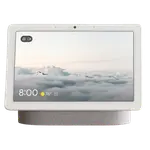
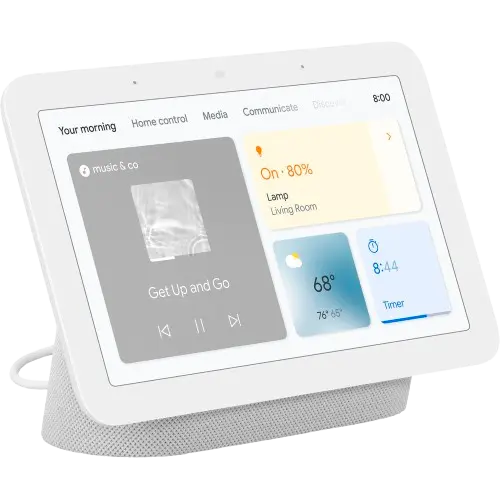
The Google Nest Hub (2nd Gen) is a compact, camera-free 7-inch smart display for Google households. It shines as a digital photo frame (via Google Photos), a kitchen helper for recipes and YouTube, a music speaker with surprisingly good sound for its size, and a bedside clock with Sleep Sensing (using radar, no camera). It controls smart home devices, shows camera feeds, and works as a Thread border router and Matter bridge. The catches are that it does less than the Google Home phone app, only supports major languages well, and it is Google-only with no camera or Zigbee.
- Google smart-home households
- Bedside / sleep tracking
- Digital photo frame
- Kitchen recipes & music
Pros
- Compact 7-inch Google Assistant display with no camera (privacy-friendly)
- Great digital photo frame via Google Photos
- Sleep Sensing using radar for bedside sleep tracking
- Surprisingly good sound for its size; handy in the kitchen for recipes and video
- Reliable smart-home control and camera feeds; Thread border router and Matter bridge
- Easy setup and good long-term reliability
Cons
- Offers less control than the Google Home phone app
- Only major languages are fully supported by the on-device assistant
- Limited customization (no custom home screen, no app store)
- Automations are weaker than rivals like SmartThings
- No camera, no Zigbee hub; Google-only (no Alexa or HomeKit)
- Sound-based safety alerts require a Nest Aware subscription
Who is the Google Nest Hub (2nd Gen) for?
This is a small, affordable smart display for people in the Google ecosystem who want a screen for the kitchen, bedside or living room. The 7-inch touchscreen runs Google Assistant (with Gemini features rolling out), has no camera, and is great as a digital photo frame through Google Photos. A key feature is Sleep Sensing, which uses a Soli radar sensor (not a camera) to track sleep when used as a bedside clock. It controls lights, thermostats, IR devices, sensors and smart switches, shows camera feeds, and acts as a Thread border router and Matter bridge (but not a Zigbee hub). It is Google-only (no Alexa or HomeKit), with partial Home Assistant support via Google Assistant, so it suits Google-centric homes.
What buyers love
Owners praise its versatility and value. It is widely loved as a photo frame, with Google Photos integration showing family memories, and as a kitchen companion for following recipes, watching YouTube or Netflix and playing Spotify or Pandora, with sound that reviewers repeatedly call surprisingly good for its size. As a bedside device it replaces a traditional alarm clock and adds Sleep Sensing. Smart-home control is a highlight: it manages lights, thermostats, switches and TVs (including Roku) and shows entry cameras with simple voice commands. Setup is quick and easy, the touchscreen is responsive, and several owners report theirs running well for three or more years, making it a dependable, long-lived hub.
What to know before you buy
The recurring frustration is software. As a 'hub' it actually offers less control than the Google Home phone app, you cannot customize the home screen much, there is no app store, and its automations are widely seen as weaker than rivals like SmartThings. Voice recognition only handles major languages well, the on-device assistant stops short of finishing answers in less-supported languages (Portuguese users in particular note it is reduced to a photo frame), even though the phone app understands more. Natural-language conversation is limited, and a few owners found the display or sound merely adequate. It has no camera, is not a Zigbee hub, is Google-only (no Alexa or HomeKit), and sound-based safety alerts require a Nest Aware subscription. As with any product, a few units arrived faulty or damaged.
Is the Google Nest Hub (2nd Gen) worth it?
For Google households wanting an inexpensive, camera-free display, yes, it earns a solid average rating and is a genuinely useful photo frame, kitchen helper, music speaker and bedside sleep tracker, with reliable smart-home control and good longevity. Just go in knowing the software is more limited than the Google Home app, language support is uneven, and it is Google-only with no camera or Zigbee. If those fit your setup, it is a handy, good-value smart display.
Frequently asked questions
Does the Google Nest Hub (2nd Gen) have a camera?
No. It is camera-free, which makes it a more privacy-friendly choice for bedrooms. Its Sleep Sensing feature uses a Soli radar sensor rather than a camera to track sleep when used as a bedside clock.
Does it work as a smart home hub?
Yes, within the Google ecosystem. It controls lights, thermostats, switches, IR devices and cameras through Google Assistant, and it acts as a Thread border router and Matter bridge. It is not a Zigbee hub.
Does it work with Alexa or Apple HomeKit?
No. It is a Google device and works with Google Home/Assistant only. It does not support Amazon Alexa or Apple HomeKit, and Home Assistant integration is partial (via Google Assistant).
What languages does it support?
The on-device assistant fully supports major languages but is limited in less common ones (for example it does not respond well in Portuguese), even though the Google Home phone app understands more languages. Check your language is supported before buying.
Can it be used as a photo frame and alarm clock?
Yes, both are popular uses. It displays photos from Google Photos as a digital frame, and works well as a bedside clock and alarm, adding Sleep Sensing to track your sleep without a camera.