

Aeotec Zi-Stick Review: A Tiny +20 dBm Zigbee Coordinator for Home Assistant
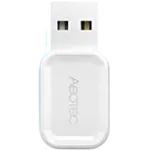
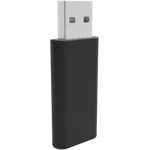
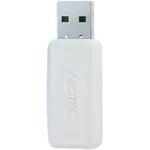
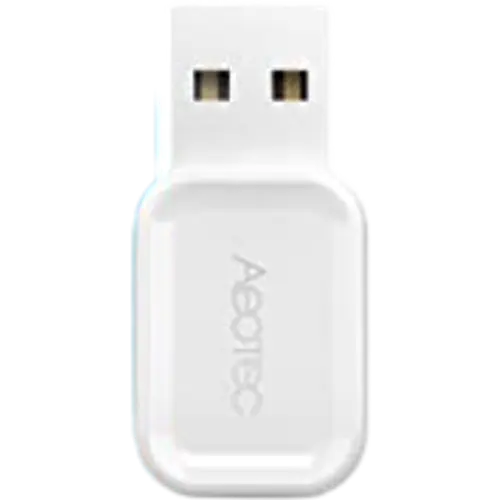
The Aeotec Zi-Stick is a compact USB Zigbee 3.0 coordinator built on the Silicon Labs EFR32MG21, with +20 dBm of transmit power that gives it more reach than a bare stick with a trace antenna. It exists to let you run your own Zigbee network on Home Assistant or Zigbee2MQTT instead of depending on a vendor hub, and at 37 mm long and 21.5 g it takes up almost nothing. Keep expectations narrow: it is a coordinator only, with no Thread, no Matter bridging, no Bluetooth proxy and no Z-Wave, and it does not act as a Zigbee router.
- Home Assistant users
- Zigbee2MQTT setups
- Replacing a vendor hub
- Small, tidy installs
Pros
- Zigbee 3.0 on a well-supported Silicon Labs EFR32MG21
- +20 dBm transmit power for better range than a plain stick
- Explicit Home Assistant and Zigbee2MQTT support
- Very small and light at 37 x 17 x 8.5 mm and 21.5 g
- Powered straight from USB, no separate supply
Cons
- USB only: no Ethernet, PoE or Wi-Fi, so it must sit at the host
- Zigbee only: no Thread, Matter bridge or Z-Wave
- No Bluetooth proxy for relaying BLE sensors
- Does not act as a Zigbee router, so it cannot extend an existing mesh
- No external antenna
- One year warranty
Who is the Zi-Stick for?
It is for someone building a local Zigbee network: plug it into the machine running Home Assistant, pair your sensors, lights and plugs directly, and drop the manufacturer hubs. Both Home Assistant and Zigbee2MQTT are explicitly supported, which covers the two standard ways of doing this. The tiny body suits a mini PC or a server where a large stick would block adjacent ports, though as with any coordinator a short USB extension cable is the standard advice to keep the radio away from USB 3 interference.
What it offers
Zigbee 3.0 on a Silicon Labs EFR32MG21, which is a well-supported chip in the open-source Zigbee world, so firmware and integration are mature rather than experimental. The +20 dBm transmit power is the differentiator against cheap coordinators: better reception at the hub end is what keeps distant battery devices from dropping off the mesh. As the coordinator it creates and secures the network, sets the channel and manages joins.
What to know before you buy
It is Zigbee and nothing else: no Thread border router, no Matter bridge, no Z-Wave and no Bluetooth proxy, so it will not relay BLE sensors to Home Assistant or expose your Zigbee devices to a Matter controller. It does not work as a Zigbee router, so it cannot be used to extend an existing mesh, only to run one. Connectivity is USB only, with no Ethernet or PoE option, so it must sit at the host machine rather than in a better radio location elsewhere in the house. There is no external antenna, only the internal one with the amplifier. Warranty is one year.
Is the Aeotec Zi-Stick worth it?
It is a mid-priced coordinator, more than the cheapest generic sticks and less than a LAN-connected one, and the amplified radio is what you are paying for. If your Home Assistant machine sits somewhere reasonably central, that is a sensible trade. If the server lives in a basement or a metal rack, no amount of transmit power fixes the position, and an Ethernet-connected coordinator is the better purchase. For a straightforward local Zigbee setup, it does exactly one job and does it in almost no space.
Frequently asked questions
Does the Aeotec Zi-Stick work with Home Assistant?
Yes. Home Assistant and Zigbee2MQTT are both supported, which are the two usual ways to run a self-hosted Zigbee network.
Can it handle Thread or Matter devices?
No. It is a Zigbee 3.0 coordinator only, with no Thread border router function and no Matter bridging.
Can I use it to extend my Zigbee network?
No. It works as a coordinator but not as a Zigbee router, so it cannot be added to an existing mesh as a repeater.
Does it need to be plugged into the server?
Yes. It is USB only, with no Ethernet or Wi-Fi option, so it lives wherever your Home Assistant machine lives.
What is the +20 dBm transmit power for?
It is how strongly the radio transmits, which extends the coordinator's reach and is what keeps distant battery-powered Zigbee devices reliably connected.