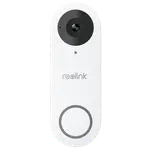
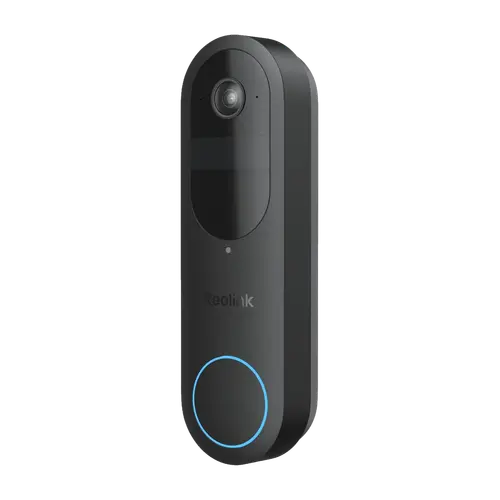



Reolink Battery Video Doorbell (2nd Gen) Review: Subscription-Free Local Storage With A Divisive Lens
The Reolink Battery Video Doorbell (2nd Gen) pairs a 4MP square sensor and a 1:1 head-to-toe view with the thing Reolink buyers actually come for: AI person, vehicle, animal and package detection with no subscription, recorded locally to microSD, an NVR, FTP or a Reolink Home Hub. Battery life is rated at 300 days and wiring it to 8-24VAC unlocks 24/7 recording and pre-recording. The catches are real though, and they are why opinion splits: several owners find the resulting image looks circular and distorted rather than the clean square the marketing shows, the unit is noticeably bigger than the first generation, and there is no RTSP or ONVIF, so anything outside the Reolink app needs a Home Hub or NVR.
- No-subscription buyers
- Existing Reolink NVR and Home Hub owners
- Package and porch monitoring
- Wire-free installs
Pros
- AI person, vehicle, animal and package detection with no subscription
- Local recording to microSD up to 512GB, NVR, FTP or Reolink Home Hub
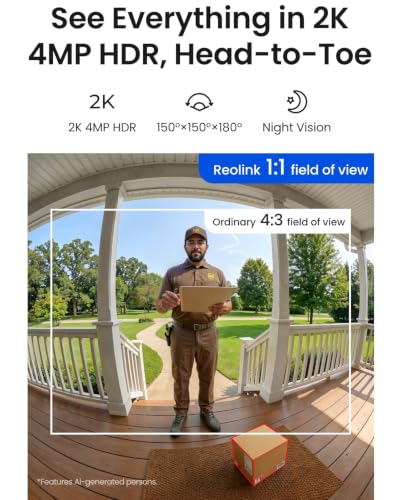
- Sharp 2K 4MP video with HDR praised in high-contrast doorways
- 1:1 head-to-toe view shows packages and full bodies, not just faces
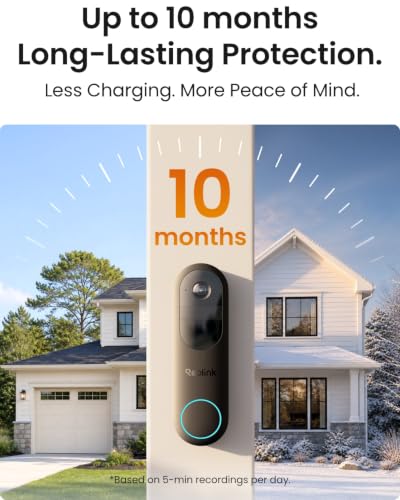
- Rated 300 days of battery life, with optional 8-24VAC wiring to top it up
- Wired Power Mode unlocks 24/7 recording and pre-recording
- Keeps working on battery during a power outage
- IP65 weatherproof with dual-band 2.4 and 5GHz Wi-Fi
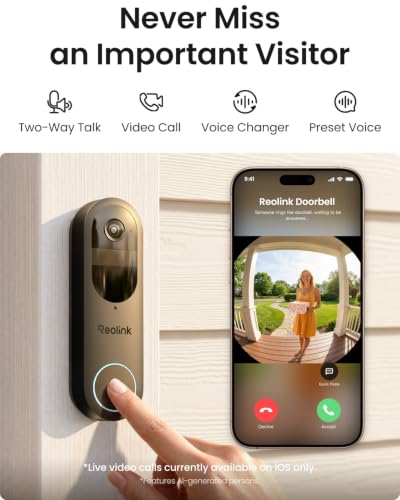
- Voice changer and preset quick replies for two-way talk
- Backed by a 2 year warranty
Cons
- Several owners report a circular, fisheye-looking image unlike the square marketing shots
- Wide view can waste frame on ceiling and hallway, showing less of the doorstep
- Physically large, roughly twice the size of the first generation
- No RTSP and no ONVIF, so third-party streaming needs a Reolink Home Hub or NVR
- Home Assistant only via a Reolink Home Hub, and owners call the integration weak
- Reports of battery drain in Full Surveillance mode and only partial event recordings
- 24/7 recording and pre-recording require wired power, not available on battery
- No chime in the box, and not compatible with the older Reolink Chime
Who is the Reolink Battery Video Doorbell (2nd Gen) for?
This is aimed at people who resent monthly fees. Every AI detection feature, person, vehicle, animal and package, runs without a plan, and recordings go to a microSD card of up to 512GB, an NVR, FTP or a Reolink Home Hub rather than to someone's cloud. Owners consistently mention that as the deciding factor, with several saying a memory card is the only extra purchase they needed. It also suits people who cannot or will not run wiring: it installs wire-free on its internal battery, rated at 300 days on five minutes of recording a day, and wiring it into an existing 8-24VAC doorbell circuit is optional and mainly keeps the battery topped up. It is IP65 rated, does dual-band 2.4 and 5GHz Wi-Fi, and works with Alexa, Google Assistant and IFTTT, with one owner using Alexa to hear the door from a separate annexe.
What buyers love
The image quality and the head-to-toe framing get the most praise. Owners describe the 2K footage as crisp, single out HDR as genuinely useful in high-contrast doorways, and repeatedly note that a 1:1 view shows things a face-height doorbell never does, whether a visitor has their hands full and whether a package is actually sitting on the porch. Night vision draws positive comment for staying clear without the washed-out ghosting some rivals show. Smart detection is fast and accurate for most, with alerts arriving within seconds, and one owner recounts it catching a delivery driver throwing a parcel onto the porch, giving them video evidence when the contents turned out damaged. Installation is described as straightforward in both battery and wired modes, and the two-way talk is clear, with the voice changer treated as a genuinely fun extra rather than a gimmick.
What to know before you buy
The most repeated complaint is the lens. Several owners say the live image looks circular and fisheye-distorted rather than the clean square shown in the product photography, with one calling it like looking through a fishbowl and returning the unit, and another finding that despite the wide numbers it showed less of the doorstep than the Nest doorbell it replaced because so much of the frame goes to ceiling and hallway. Size is the second theme: it is described as almost twice the first generation, dominating a door frame, and one owner reports it not sitting flush in its mount. Integration is the third: there is no RTSP and no ONVIF, so pulling a stream into third-party software or Home Assistant needs a Reolink Home Hub or NVR, and one owner reports the built-in webhooks not working and being undocumented. Others report battery drain in Full Surveillance mode forcing a battery-saving setting, events recorded only partially, package detection never triggering, occasional Wi-Fi drops at short range, and five to ten second delays loading video. Note too that 24/7 recording and pre-recording only work in wired mode, no chime is included, and it is not compatible with the older Reolink Chime.
Is the Reolink Battery Video Doorbell (2nd Gen) worth it?
It depends heavily on how much the lens character bothers you and how deep you already are in Reolink. If you own a Reolink NVR or Home Hub and want subscription-free local recording with credible AI detection, this is a strong, well-built addition and owners in that position rate it highly. If you are coming from another ecosystem, want RTSP or a clean Home Assistant integration, or care about a rectangular undistorted image, the reviews suggest looking closely at sample footage first, because that is where the low ratings cluster. The mixed average is not a quality-control story so much as a product whose main design choice, a square sensor with a very wide 1:1 view, either solves your problem or actively works against it.
Frequently asked questions
Does the Reolink Battery Video Doorbell (2nd Gen) need a subscription?
No. Person, vehicle, animal and package detection all work without a plan, and video is stored locally on a microSD card of up to 512GB, a Reolink NVR, FTP or a Reolink Home Hub. Reolink Cloud exists as an option in selected countries but is not required.
Does it support RTSP or Home Assistant?
There is no RTSP or ONVIF on the doorbell itself, which owners confirm even when it is hardwired. Home Assistant integration is possible but requires a Reolink Home Hub, and reviewers describe the resulting integration as limited compared with Reolink's wired cameras.
Why do some reviewers say the picture looks like a fisheye?
The camera uses a square 2048 by 2048 sensor with a very wide 150 degree horizontal and vertical view to achieve its head-to-toe framing. Several owners report the live image reads as circular and distorted rather than the rectangular view shown in the product photos, and at least one found it showed less of the immediate doorstep than their previous doorbell.
How long does the battery last, and can it be hardwired?
Reolink rates it at up to 300 days based on five minutes of recording per day. It can also be connected to 8-24VAC doorbell wiring to keep the battery topped up, or run in Wired Power Mode on 16-24VAC for continuous power, 24/7 recording and pre-recording. During an outage it falls back to battery automatically.
Does it come with a chime?
No. The doorbell is sold on its own. It works with the Reolink Chime Plus, a Reolink Home Hub, Google Assistant or Alexa, and it is not compatible with the older Reolink Chime. Driving an existing mechanical chime needs the RLA-PK1 kit, sold separately.
Does it work with Alexa, Google Home or HomeKit?
It works with Amazon Alexa, Google Assistant and IFTTT. It does not support Apple HomeKit, Samsung SmartThings or Matter.