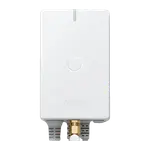
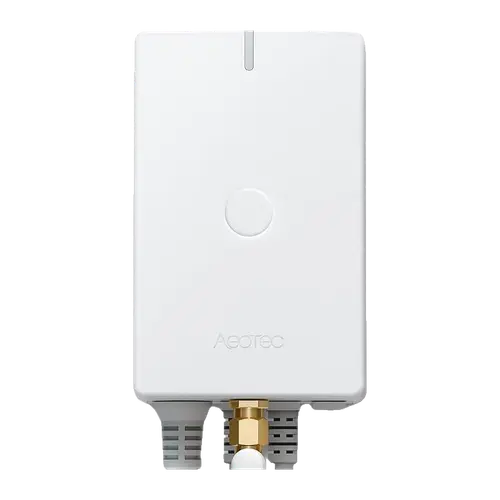


Aeotec Home Energy Meter 8 Review: Whole-Home Metering That Reports Over Z-Wave
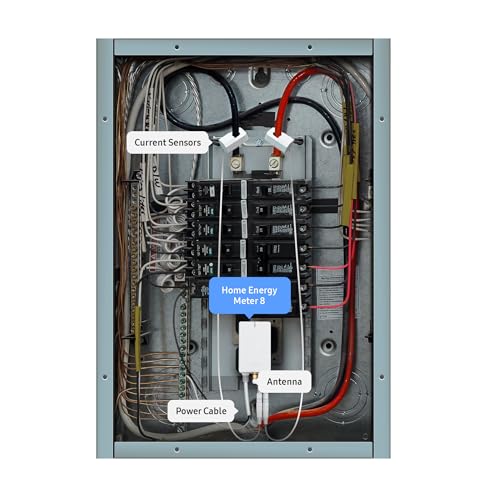
The Home Energy Meter 8 measures the service mains and hands the numbers to whatever Z-Wave hub already runs the house, which is exactly what a SmartThings, Home Assistant or Hubitat setup wants and useless without one. Two 200 A clamps cover a split-phase panel bi-directionally, so grid import and solar export are reported separately along with voltage, current, power factor and reactive power. What it does not do is per-circuit detail: there are no branch sensors, no app of its own and no local API, and the Z-Wave 800 radio with Long Range is the reason to pick it over a Wi-Fi monitor.
- Z-Wave homes
- SmartThings and Hubitat
- Solar export tracking
- Panels far from Wi-Fi
Pros
- Z-Wave 800 with Long Range, no Wi-Fi or cloud account needed
- Bi-directional metering separates grid import from solar export
- Reports voltage, current, power factor and reactive power, not just kWh
- Better than 99% measurement accuracy above 0.05 A
- IP44 rated enclosure for meter bases and outdoor panels
- Acts as a Z-Wave repeater and strengthens the mesh
Cons
- Requires a Z-Wave hub, it does nothing standalone
- Only 2 clamps for the mains, no branch-circuit sensors
- No app, no cost tracking, no data history of its own
- No local HTTP API or MQTT
- US model is split-phase only, three-phase is a separate variant
- Only a 1 year warranty
Who is the Aeotec Home Energy Meter 8 for?
This is a component, not a product with a dashboard. It joins an existing Z-Wave network as an always-on node and publishes its readings there, so the value depends entirely on the hub: SmartThings shows it in its energy view, Home Assistant picks it up through Z-Wave JS, and Hubitat or any other certified controller can use the same reports. The payoff over a Wi-Fi monitor is range and independence from the internet. Z-Wave 800 with Long Range reaches far further than Wi-Fi does through a metal panel or across a property, which matters when the meter base is nowhere near the router.
What the Home Energy Meter 8 offers
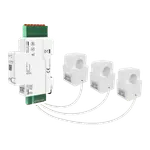
The metering side is complete for a whole-home device: two clamp-on 200 A current transformers cover both legs of a split-phase service, measurement is specified as better than 99% accurate above 0.05 A, and readings are bi-directional, so a solar system's export is separated from grid consumption rather than folded into one number. Beyond kilowatt-hours it reports voltage, current, wattage, power factor and reactive power, which is more electrical detail than most consumer monitors expose. The radio is a Z-Wave 800 series chip with S2 security, Long Range support and repeater behaviour, so adding the meter also strengthens the mesh. The enclosure is IP44 rated, which is unusual in this category and useful for a meter base or an outdoor panel.
What to know before you buy
A Z-Wave hub is mandatory: on its own the meter shows nothing. There is no Wi-Fi, no Ethernet, no app, no cloud history, no cost tracking and no local HTTP API or MQTT, because every one of those jobs belongs to the hub. Coverage stops at the mains, since the package has no branch sensors, so this is a house-total device rather than a per-circuit one. The US model is the two-phase / split-phase variant; three-phase installations need the separate EU version. Warranty is one year, and the price sits above simpler Wi-Fi monitors that include sixteen branch clamps, so the Z-Wave radio and the electrical detail are what you are paying for.
Is the Aeotec Home Energy Meter 8 worth it?
Inside a Z-Wave house, yes. It is the tidiest way to get whole-home import and export into the same system that already runs the automations, with no extra account, no vendor app and no dependence on the internet. Outside one, it is the wrong purchase: a Wi-Fi monitor at a similar price gives sixteen branch circuits, a phone app and cost tracking. Pick this when the hub is the point, and pick a clamp-per-breaker monitor when the detail is.
Frequently asked questions
Does the Aeotec Home Energy Meter 8 need a hub?
Yes. It is an always-on Z-Wave slave device and needs a Z-Wave network coordinator to report to, such as a SmartThings hub, Home Assistant with a Z-Wave stick, or Hubitat. There is no Wi-Fi, no app and no cloud service of its own.
How many circuits can it monitor?
Two, using the pair of 200 A clamps that cover both legs of a split-phase service. There are no branch-circuit sensors, so it reports the house total rather than per-appliance detail.
Does it work with solar?
Yes. Measurement is bi-directional, so consumption drawn from the grid and production exported to it are reported as separate values, which is what makes solar self-consumption automations possible from the hub.
Does it support three-phase power?
Not in this model. The version sold in the US is the two-phase / split-phase variant with two clamps. Aeotec sells a three-phase configuration of the same ZWA046 family for 230 V markets.
What data does it report?
Kilowatt-hours, wattage, voltage, amperage, power factor and reactive power, per clamp and as a total, sent to the hub over Z-Wave with S2 security.
Can it be installed outdoors or in a meter base?
The enclosure carries an IP44 rating, so it tolerates splashing water, and the Z-Wave Long Range radio helps reach a hub that is far from the panel. It still needs a mains connection and the usual precautions for work inside an electrical enclosure.