

Emporia Vue 3 Review: Circuit-Level Energy Monitoring Without a Subscription
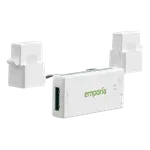
The Vue 3 is the default choice for homeowners who want to see every breaker rather than one house total. It clamps onto the mains plus up to sixteen branch circuits, reports second by second, handles solar net metering, and charges nothing for the app or the cloud history that goes with it. The trade-offs are real: installation happens inside a live breaker panel, and there is no local API, MQTT or local web interface, so the device is useless without an internet connection.
- Circuit-level monitoring
- Solar owners
- Landlords and rentals
- No-subscription seekers
Pros
- Up to 19 measurement channels: the mains plus 16 branch circuits
- Second-by-second readings with cost tracking and time-of-use rates
- Solar net metering with bi-directional sensor configuration
- Ethernet as well as 2.4 GHz Wi-Fi, useful inside a metal panel
- No subscription, with unlimited hourly history and data export
- Well-documented DIY installation and a polished app
Cons
- Cloud-only: no local API, MQTT or local web interface
- Requires working inside a live breaker panel
- Bulky CT clamps are a tight fit in full or non-US panels
- No power factor readings and +/- 2% accuracy
- No HomeKit, SmartThings, IFTTT or Matter support
- Only a 1 year warranty
Who is the Emporia Vue 3 for?
This is a whole-panel monitor, not a plug-in meter. It suits someone who already suspects where the money goes (the water heater, the dryer, a pump that never stops) and wants proof per circuit instead of a monthly bill. Owners describe using it to settle exactly that: an over-running humidifier, a broken water-heater thermostat, an electric dryer replaced by a heat pump model after the numbers made the case. Landlords and electricians in the reviews use it to split usage between rental suites, pool and hot tub panels, and solar production, which the bi-directional sensors handle natively. If you only need the house total and have a modern utility meter, a meter-port device is far less work.
What buyers love
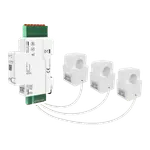
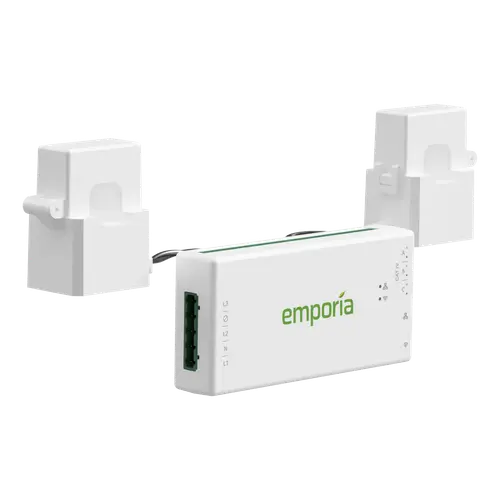
Two things dominate: the granularity and the app. The monitor covers up to nineteen measurement channels (the mains plus sixteen 50 A branch sensors) and pushes readings every second, so owners watch an appliance switch on and see the spike appear. The app gets consistent praise for letting you name each circuit, move between one-minute and yearly views, set your own rate for cost tracking, and export the data. A clever detail owners keep mentioning is the multiplier, which lets a balanced 240 V appliance be measured with a single clamp instead of two. Several report merging two monitors in one account to cover a panel with more than sixteen circuits, and installation is repeatedly called straightforward for anyone comfortable inside a panel, helped by clear documentation. Ethernet alongside 2.4 GHz Wi-Fi is a welcome addition for panels where a metal enclosure kills the signal.
What to know before you buy
The platform is cloud-first by design: Emporia states the device has no local data storage and needs an internet connection to work, and there is no local API, MQTT or local web interface, so self-hosted setups get whatever the cloud hands back rather than raw local data. Physically, the CT clamps are chunky, and reviewers with full panels, or with non-US consumer units, report a tight fit. Wi-Fi inside a steel panel is the other recurring friction point: the external antenna solves it, but more than one owner wishes the antenna cable were longer. Accuracy is specified at +/- 2%, which is fine for finding waste and comparing months but is not a certified revenue meter, and the device does not report power factor. Three-phase installations are supported, though a 4-wire Wye panel needs an extra 200 A sensor sold separately. Voice support stops at Alexa and Google Home: there is no HomeKit, SmartThings, IFTTT or Matter. Warranty is one year.
Is the Emporia Vue 3 worth it?
For per-circuit visibility at this price tier, it is hard to argue against. Sixteen branch sensors in the box, no subscription, unlimited hourly history and solar net metering is a combination the alternatives usually charge more for or split across models, and the ratings are consistently high across a large number of buyers. Owners routinely describe it paying for itself within a few billing cycles once the data points at something fixable. The one buyer it does not suit is the local-control purist: if the readings must live on your own network with no cloud in the middle, a monitor with a documented local API is the better spend.
Frequently asked questions
Does the Emporia Vue 3 require a subscription?
No. The app, the cloud history and the automations are included. Second-resolution data is kept for three hours, minute data for seven days, and hourly data indefinitely, and you can export it from the app at any time.
How many circuits can the Emporia Vue 3 monitor?
Up to nineteen channels: three 200 A inputs for the service mains and sixteen 50 A sensors for individual breakers. Owners with larger panels install a second monitor and merge both in the same account for more coverage.
Does it work with solar panels?
Yes. It does bi-directional net metering, so imported and exported energy are reported separately, and individual sensors can be marked as bi-directional for a solar circuit.
Does the Emporia Vue 3 work without an internet connection?
No. Emporia states the monitor has no local data storage and needs an active internet connection for real-time monitoring, cloud history and firmware updates. There is no local API, MQTT or local web interface.
Do I need an electrician to install it?
It installs inside the breaker panel, with the clamps closed around live conductors. Plenty of owners fit it themselves in under two hours, but reviewers who are electricians recommend hiring one if you are not comfortable working in a panel.
Does it support three-phase power?
Yes. It covers single-phase 2-wire, split-phase 3-wire and 3-phase 4-wire Wye systems with an earthed neutral. The three-phase configuration needs an additional 200 A sensor, which is sold separately.