






Emporia Vue 3 3-Phase Review: Nineteen Channels for Commercial Panels at a Consumer Price
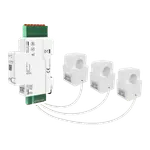
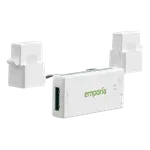
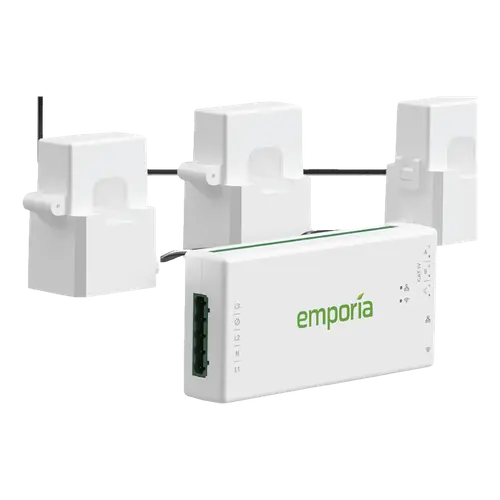
This is the Vue 3 with the third 200 A sensor in the box, which turns it from a split-phase home monitor into a three-phase one: 3-phase 4-wire Wye services are supported directly, and the sixteen 50 A branch clamps still map the rest of the panel. Owners use it in offices, workshops and multi-floor homes to find what a facility is actually spending power on, and report near-instant reporting and strong Wi-Fi range. The trade-offs carry over from the standard Vue: it is a cloud platform with no local API, and the CT clamps are bulky enough to be a real constraint in a crowded panel.
- Three-phase services
- Small businesses and workshops
- Circuit-level monitoring
- Solar owners
Pros
- Nineteen channels: three 200 A mains plus sixteen 50 A branch sensors
- Supports 3-phase 4-wire Wye as well as split-phase and single-phase
- Second-by-second reporting with unlimited hourly history
- Ethernet as well as 2.4 GHz Wi-Fi
- No subscription, with cost tracking and time-of-use rates
- Can be flashed with ESPHome for fully local Home Assistant use
Cons
- Bulky CT clamps are hard to fit in crowded panels
- Cloud-only as shipped, no local API, MQTT or web interface
- ±2% accuracy and no power factor reading
- Only a 1 year warranty
- More expensive than the standard Vue 3 for single-phase homes
Who is the Emporia Vue 3 3-Phase for?
Anyone metering a three-phase supply who still wants per-circuit detail rather than a single total. In the reviews it shows up in an office building, a large facility where the owner used it to work out what unlabelled circuits actually fed, a multi-floor home in India tracking the car charger and the lift, and an off-grid solar installation where two units cover twenty-four circuits. If your supply is single-phase, the standard Vue 3 costs less; a UK owner points out that on single-phase you can repurpose the spare 200 A channel to meter one more circuit, ending up with seventeen.
What buyers love
The value is the recurring theme: a German reviewer puts it at roughly a third of the price of comparable systems, and several owners call the per-circuit visibility transformative, with one measuring a 15% cut in consumption after acting on what it showed. Installation is described as straightforward for anyone comfortable in a panel, with clear instructions and helpful support, and the reporting is effectively instant in both the phone and web apps. The external antenna gets specific praise for reaching a router on the far side of an office building. For tinkerers there is a second life: multiple owners flash the unit with ESPHome to run it entirely inside Home Assistant.
What to know before you buy
The CT clamps are large. It is the single most repeated criticism: they are hard to fit in small or crowded panels, one owner warns the final cost might include a bigger panel, and another is still hunting for the flexible CTs as an alternative. Out of the box the platform is cloud-only, which the German review flags as the reason it is only conditionally suitable for Home Assistant unless you flash custom firmware, and there is no local API, MQTT or web interface. Accuracy is +/- 2%, described by one owner as fine for a homeowner but not laboratory grade, and warranty is one year.
Is the Emporia Vue 3 3-Phase worth it?
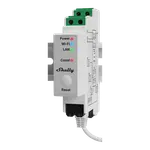
For a three-phase panel it is the cheapest way to get nineteen channels of monitoring with a polished app and no subscription, and the ESPHome route means it does not have to stay cloud-bound. Skip it if your service is single-phase (buy the standard Vue 3), if your panel is too tight for the clamps, or if you want Class B accuracy and a documented local API, which is where the Shelly Pro 3EM family takes over.
Frequently asked questions
What does the 3-Phase version add over the standard Vue 3?
The third 200 A main sensor, which is what makes a 3-phase 4-wire Wye service work out of the box. On the standard Vue 3 that sensor is sold separately. The rest of the hardware, including the sixteen 50 A branch clamps, is the same.
Can it be used on a single-phase supply?
Yes, and one owner repurposes the unused third 200 A channel to monitor an extra circuit, giving seventeen monitored circuits in total.
Does it work with Home Assistant?
Not natively: the platform is cloud-based. Several owners flash the device with ESPHome, which is fiddly but possible without soldering, and that gives fully local operation inside Home Assistant.
Will the clamps fit my panel?
That is the main practical risk. Owners repeatedly describe the transformers as large and difficult to fit in small or crowded panels, so check the space around your busbars and breakers before ordering.
How fast does it report?
Effectively in real time: owners describe the app updating as fast as their internet connection allows, with one second resolution available while the app is open.
Does it need a subscription?
No. The app, the cloud history and the automations are included, with hourly data kept indefinitely and export available from the app.