Shelly 3EM-63W Gen3 Review: Three-Phase Metering That Hides Behind the Breakers
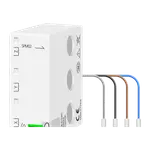
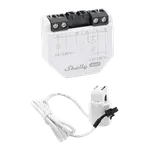
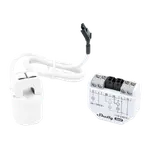
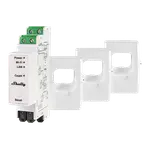
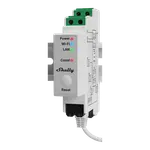
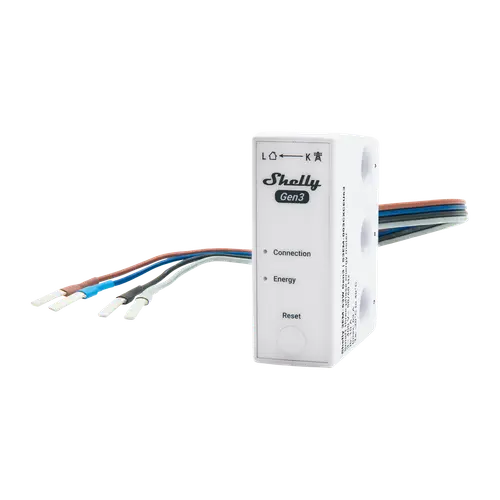
The 3EM-63W Gen3 is the retrofit answer to three-phase metering: the current transformers are inside the body, so instead of finding room for clamps you slide the conductors through it and tuck the unit above or below the circuit breakers. It measures three phases or three separate single-phase circuits up to 63 A each, with Class B accuracy, power factor and four quadrant measurement, and it keeps seven days of minute data on board. It is 220-240 V only and has no relay, so it is a European retrofit meter rather than a universal one.
- Three-phase retrofits
- Crowded consumer units
- Solar monitoring
- Home Assistant users
Pros
- Transformers built in, no clamps to fit around conductors
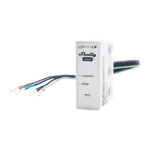
- Small enough to sit above or below the circuit breakers
- Three phases or three independent single-phase circuits
- Class B accuracy with power factor and four quadrant measurement
- Measuring direction can be reversed per phase in software
- Local API, MQTT, web interface and CSV export
- 3 year warranty
Cons
- 220-240 V only, not suitable for North America
- No relay output and no Ethernet
- No Zigbee or Matter on this Gen3 model
- Only 7 days of on-device history
- Conductors must be routed through the body, so installation is fiddlier than a clamp
Who is the Shelly 3EM-63W Gen3 for?
Anyone adding metering to a panel that has no spare DIN modules. Owners describe it as the retrofit meter that fits almost anywhere thanks to its size, sitting behind or above the breakers with the conductors passing through it. Beyond whole-supply metering, reviewers use it for the loads a smart plug cannot handle: one switched to it after a plug gave up on an oven, another meters a three-phase water heater and gets both the total and the per-phase breakdown. It also works as three independent single-phase channels, which makes it useful in single-phase homes with several circuits worth watching.
What buyers love
Size and software. The compact body is the most repeated compliment, along with clearly labelled connections and an install that owners describe as straightforward, if fiddly in tight panels. Setup over Wi-Fi and pairing with the Shelly app takes minutes, and Home Assistant integration is called effortless. The measurement side gets specific praise for the amount of data exposed per phase, and one owner highlights the software option to reverse the measuring direction per phase, which fixes a transformer installed the wrong way round without touching the wiring. A Swedish owner switching from another brand sums it up as getting far more values out of it than the system it replaced.
What to know before you buy
It is a 220-240 V device: a US buyer bluntly asks whether it was built for the USA, and the answer is no, both for voltage and for the lack of a split-phase mode. Installation is more involved than clipping a clamp, since the conductors have to be routed through the body and the mounting orientation is fixed by the terminals and the reset button. There is no relay, no Ethernet, and no Zigbee or Matter on this Gen3 model. Reports are not uniformly glowing either: one owner found measurements error-prone and compatibility with third-party systems limiting, and another received defective units, though support resolved it.
Is the Shelly 3EM-63W Gen3 worth it?
In a European panel with no room to spare, it is the easiest three-phase meter to fit and among the cheapest, with the same local stack as the Pro range: RPC, MQTT, an embedded web interface and CSV export. Choose the Pro 3EM 3CT63 instead if you want Ethernet, Modbus and sixty days of history in a proper DIN module, and look elsewhere entirely if you are in North America.
Frequently asked questions
Does the Shelly 3EM-63W Gen3 need external clamps?
No. The current transformers are integrated, with an 8 mm conductor aperture, so the phase wires pass through the device itself. That is what keeps it small enough to fit behind the breakers.
Can it be used in North America?
No. It is specified for 220-240 V and has no split-phase mode, which a US buyer found out the hard way. For a 120/240 V service, pick a monitor designed for split-phase panels.
What is the difference between the 63W and the 63T?
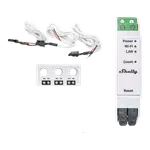
The form factor of the wiring: the 63W is the version with wires that mounts above or below the breakers, while the 63T is slightly deeper with a single terminal lead. The metering, accuracy and firmware are the same.
What if a phase reads negative?
The Shelly app has a per-phase option to reverse the measuring direction in software, so a transformer installed the wrong way round is fixed without rewiring.
Does it work without the cloud?
Yes. It runs on the local Wi-Fi network with an embedded web interface, RPC over HTTP and WebSocket, MQTT and webhooks, and it keeps at least seven days of minute-level data in non-volatile memory.
Can it switch a load?
No. It has no relay output at all, not even an add-on, so it only measures. Pair it with a Shelly relay if you need switching.