
Updated November 2026
Data from the official Shelly site.
2026 verdict
For a DIN rail install with wired networking, the Shelly Pro EM-50 is the better of these two Shelly energy monitors, winning on connectivity and on accuracy.
It adds Ethernet and Modbus TCP on top of Wi-Fi and Bluetooth, includes both 50 A clamps, measures to a tighter plus or minus one percent with Class B certification, keeps sixty days of minute data on the device and mounts in a consumer unit. The Shelly EM Gen3 is the value pick: it covers the same two single-phase channels, the same bi-directional solar metering, power factor readings, local API, MQTT and dry-contact relay, in a smaller module that hides inside a wall box or appliance enclosure, and it accepts 80 A transformers for a main feed. Neither supports split-phase or three-phase. Choose the Shelly Pro EM-50 for a panel or a SCADA link, and the Shelly EM Gen3 for metering one or two appliances at the lowest cost.
News by email
Still comparing? Get what's new by email
New releases and the smart home news worth knowing, in your inbox.
No spam. Unsubscribe in one click.
| Feature | Shelly EM Gen3 | Shelly Pro EM-50 | Winner |
|---|---|---|---|
| Price | $69.99 | $119.99 | Shelly EM Gen3 |
| Connectivity | 2.4 GHz WiFi, Bluetooth | 2.4 GHz WiFi, Ethernet, Bluetooth, Other | Shelly Pro EM-50 |
| Rating | 4.6 | 4.6 | Tie |
| Warranty | 3 years | 3 years | Tie |
| Metering | Solar Net Metering, Power Factor Readings | Solar Net Metering, Power Factor Readings | Tie |
| Breaker Panel Install | YES | YES | Tie |
| Smart Meter Port | NO | NO | Tie |
| Integrations | Google Home, Alexa, Samsung SmartThings, Home Assistant | Google Home, Alexa, Samsung SmartThings, Home Assistant | Tie |
| Data & Monitoring | Energy Cost Tracking, Time-of-Use Rates, Data Export, Usage Alerts | Energy Cost Tracking, Time-of-Use Rates, Data Export, Usage Alerts | Tie |
| Local Control | Local API, MQTT, Local Web Interface | Local API, MQTT, Local Web Interface | Tie |
| Relay Output | YES | YES | Tie |
| Load Management | YES | YES | Tie |
What the differences mean
Wired networking
The Shelly Pro EM-50 adds wired Ethernet and Modbus TCP alongside Wi-Fi and Bluetooth, while the Shelly EM Gen3 connects over Wi-Fi and Bluetooth only. For a meter inside a metal panel or one feeding a SCADA system, that wired link is the difference between steady data and gaps.
Clamps in the box
The Shelly Pro EM-50 includes two 50 A current transformers, so both of its channels work out of the box. The Shelly EM Gen3 ships with one 50 A clamp and needs a second CT bought separately, though it also accepts 80 A transformers for a main feed.
Accuracy
The Shelly Pro EM-50 measures to plus or minus one percent with Class B certification for active energy, against plus or minus two percent on the Shelly EM Gen3. Both are fine for spotting heavy loads, but the tighter figure matters more if you compare readings across circuits.
On-device history
The Shelly Pro EM-50 keeps at least sixty days of one-minute data on the device; the Shelly EM Gen3 keeps ten days. Longer on-board retention means the history survives a dropped router and reduces how much you depend on the Shelly cloud.
Mounting and size
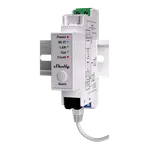
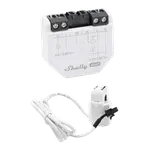
The Shelly Pro EM-50 is one DIN module wide for a consumer unit, where the Shelly EM Gen3 is a 37 x 42 x 16 mm module meant to hide inside a wall box or an appliance enclosure. The right shape depends on where you can legally and physically mount the meter.
Cost
The Shelly EM Gen3 is the cheaper of the two by a wide margin and covers the same two single-phase channels, the same local API and the same relay output. The Shelly Pro EM-50 earns its premium through Ethernet, Modbus, better accuracy, more clamps and more local storage.
Which one to buy if
- the meter goes on DIN rail inside a consumer unit
The Shelly Pro EM-50 is built as a one-module DIN device for a panel, where the Shelly EM Gen3 is a loose module for a wall box.
- it has to feed a SCADA or industrial system
Only the Shelly Pro EM-50 offers Modbus TCP and wired Ethernet for that kind of integration.
- you are metering one or two appliances at the lowest cost
The Shelly EM Gen3 covers the same channels and local control for much less.
- the space is a tight wall box or appliance enclosure
The Shelly EM Gen3 is small enough to fit inside, while the Shelly Pro EM-50 expects a DIN rail.
- you want both channels running without buying an extra clamp
The Shelly Pro EM-50 includes two 50 A clamps, while the Shelly EM Gen3 includes one.
$69.99
- + Price: $69.99
- - Connectivity: 2.4 GHz WiFi, Bluetooth vs 2.4 GHz WiFi, Ethernet, Bluetooth, Other
Winner
$119.99
- + Connectivity: 2.4 GHz WiFi, Ethernet, Bluetooth, Other
- - Price: $119.99 vs $69.99
What owners say
Owners of both Shelly meters agree on the fundamentals: readings that hold up against their own instruments, a Home Assistant integration that picks the unit up on the LAN with almost no configuration, and an app that works well even for people who mostly stay in Home Assistant. Shelly EM Gen3 owners talk about the relay above all, replacing mechanical timers on pumps and heaters and even shutting a well pump off when a leak sensor trips, and they flag the single-phase limit, the second clamp they had to buy, and the rule that the module has to be powered from the same phase it measures. Shelly Pro EM-50 owners single out the two clamps in the box, the sixty days of on-device history and the Modbus path into SCADA, while noting small, fiddly terminals and clamps that read negative if they are installed the wrong way round.
Frequently Asked Questions
Which is better overall, the Shelly EM Gen3 or the Shelly Pro EM-50?
For a DIN rail install or one that needs wired networking, the Shelly Pro EM-50 is the better meter: it adds Ethernet and Modbus TCP, includes both clamps, measures more accurately and keeps sixty days of data. The Shelly EM Gen3 is the better value for metering one or two appliances, with the same two single-phase channels and the same local control.
What is the biggest difference between the Shelly EM Gen3 and the Shelly Pro EM-50?
Form factor and networking. The Shelly EM Gen3 is a 37 x 42 x 16 mm module that fits inside a wall box or appliance enclosure and connects over Wi-Fi and Bluetooth only. The Shelly Pro EM-50 is a one-module-wide DIN device for a consumer unit, with wired Ethernet and Modbus TCP alongside Wi-Fi and Bluetooth.
Do both measure solar export and power factor?
Yes. Both the Shelly EM Gen3 and the Shelly Pro EM-50 measure bi-directionally, so grid import and export are tracked separately, and both report active and apparent power, power factor, voltage and current.
Which one stores more data on the device?
The Shelly Pro EM-50 keeps at least sixty days of one-minute records locally, while the Shelly EM Gen3 keeps ten days. Both also push longer history to the Shelly cloud and allow CSV export of the consumption chart.
Can both switch a load, not just measure it?
Yes. Both the Shelly EM Gen3 and the Shelly Pro EM-50 carry potential-free contacts rated 2 A at 240 V, meant to drive an external contactor rather than the load directly.
Do either of them support split-phase or three-phase power?
No. Both the Shelly EM Gen3 and the Shelly Pro EM-50 are single-phase devices with two current channels, so a North American split-phase panel or a three-phase supply needs a different model.
Spotted something wrong on this page? Tell us and we will fix it.
 Our store on AmazonShop our ideas on AmazonLists of the smart home setups we would put together ourselves, ready to add to your Amazon cart.Shop on Amazon
Full comparison table
Compare all 25 Energy Monitors side by side
You are looking at two of them. The full table lines up all Energy Monitors in the catalog with the same specs, so you can filter by what you need and sort by price or rating.
- 25 Energy Monitors
- 47 specs compared
- 44 filters
- Energy Monitors

MINI PM Matter Over WiFi Power Meter (Non-Switch)
- Energy Monitors

EM Gen4
- Energy Monitors

Zigbee Smart Energy Monitor
- Energy Monitors

Vue 3
- Energy Monitors
Pro 3EM v2
- Energy Monitors
Vue 3 3-Phase
- Energy Monitors
POWCT
- Energy Monitors
3EM-63W Gen3
- Energy Monitors
EM Mini Gen4
- Energy Monitors
Pro 3EM 3CT63
- Energy Monitors

EM16P
- Energy Monitors
Pro 3EM-400
- Energy Monitors

EM06P
- Energy Monitors

Home Energy Meter 8
- Energy Monitors

EM06P
- Energy Monitors
EM16P
- Energy Monitors

MINI PM Zigbee Power Meter (Non-Switch)
- Energy Monitors
Vue Utility Connect
- Energy Monitors
3CT Zigbee Energy Meter
- Energy Monitors
EM01P
- Buttons

BLU Button Tough 1 ZB
- Buttons
BLU RC Button 4 ZB
- Cameras

Camera
- Displays

Wall Display X1i
- Displays
Wall Display XL
- Displays
Wall Display
- Door & Window Sensors
BLU Door/Window Outdoor ZB
- Door & Window Sensors
BLU Door/Window ZB
- Energy Monitors
3EM-63W Gen3
- Energy Monitors
EM Gen4
- Energy Monitors
EM Mini Gen4
- Energy Monitors
Pro 3EM 3CT63
- Energy Monitors
Pro 3EM-400
- Energy Monitors
Pro 3EM v2
- Gas Detectors
GAS (CNG)
- Gas Detectors
GAS (LPG)
- LED Bulbs

Multicolor Bulb E27 Gen3
- Motion Sensors

BLU Motion ZB
- Motion Sensors

Blu Motion
- Plugs
Plug M Gen3