

Shelly EM Mini Gen4 Review: A Thumb-Sized Meter for One Appliance
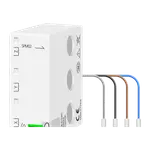
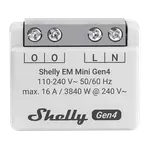
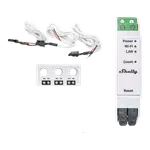
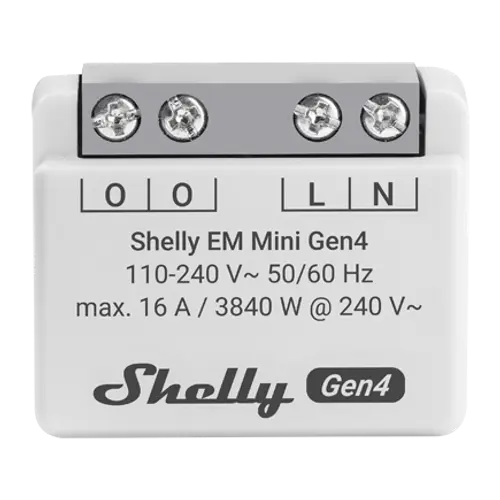
The EM Mini Gen4 is the smallest and cheapest way into this comparison: 29 x 34 x 16 mm, inline measurement up to 16 A with no clamp involved, +/- 1% accuracy, and Wi-Fi 6, Bluetooth, Zigbee and Matter all in the same module. It is a pure meter, with no relay, so it watches a single appliance or circuit and reports it, and owners hide it inside an air conditioner, behind a socket or in a power strip. Ten days of on-device history, a local API and MQTT keep it useful without any cloud.
- Single appliances
- Matter and Zigbee homes
- Tight spaces
- Budget buyers
Pros
- Tiny, fits inside an appliance or behind a socket
- Wi-Fi 6, Bluetooth 5, Zigbee and Matter in one module
- ±1% accuracy on voltage and current
- Local API, MQTT, scripting and embedded web interface
- 10 days of 1-minute history on the device
- Cheapest device in this comparison
Cons
- No relay, it cannot switch the load it measures
- Inline measurement capped at 16 A, single phase only
- Zigbee repeater function reported as unreliable
- Short back boxes may not fit it alongside a socket
- Screw terminals rather than push-in clamps
Who is the Shelly EM Mini Gen4 for?
People who want to know what one thing costs. Owners describe fitting it inside an air conditioner, on a washing machine and dryer, on heating elements driven through MQTT and scripts, and on a cabin's incoming line to watch for low voltage. Because it measures inline rather than with a clamp there is nothing to fit around a conductor, but it also means the load has to pass through it, capped at 16 A. It is the complement to a panel monitor, not a replacement: one channel, single phase, no relay.
What buyers love
Size and setup. Reviewers call it tiny enough to disappear into an appliance or a power strip, and repeatedly describe configuration as a five minute job, with the device joining the network and appearing in Home Assistant or Zigbee2MQTT without fuss. The measurements are described as accurate, including by an owner who verified the current reading independently. Having Wi-Fi 6, Bluetooth, Zigbee and Matter in a device at this price is the other draw, and the usual Shelly local stack (RPC, MQTT, scripting, embedded web UI) is all present, which is how one owner wired it into a heating control loop.
What to know before you buy
It only measures. There is no relay, so it cannot switch what it monitors, something an owner points out explicitly. The 16 A ceiling and single-phase design also rule out a whole-home role, and one buyer's electrician could not get it working on a 240 V split-phase circuit in the US. Despite the small size, fitting is not always trivial: owners report that short back boxes do not leave room for both the module and a socket. Zigbee has rough edges too, with one owner finding the repeater function unreliable enough that they switched the device to Wi-Fi. Screw terminals rather than push-in clamps are a minor gripe, and a few reviewers find the price high for what is, after all, a meter without a switch.
Is the Shelly EM Mini Gen4 worth it?
For per-appliance metering, yes, and it undercuts almost everything else here. Buy it when you want to instrument the dryer, the heat pump or the office circuit and feed that into Home Assistant. Do not buy it expecting whole-home coverage, a clamp install or the ability to switch the load: the EM Gen3 and EM Gen4 add a relay and clamp-based measurement for not much more money.
Frequently asked questions
Does the Shelly EM Mini Gen4 use a clamp?
No. It measures inline, with the load wired through the module, so there is no current transformer to fit. That keeps it small but caps it at 16 A, or 3840 W at 240 V.
Can it switch the appliance it measures?
No. It is a meter only, with no relay output. If you need to switch as well as measure, the EM Gen3 or EM Gen4 add a dry contact for a contactor.
Does it work with Matter and Zigbee?
Yes, both, alongside Wi-Fi 6 and Bluetooth. Matter brings it into Apple Home, SmartThings and Google Home directly. One owner reports the Zigbee repeater behaviour being weak in current firmware.
Where do owners install it?
Inside appliances such as an air conditioner, behind a socket, in a power strip, or on a single circuit in the panel. Check the depth of your back box first, since a short one may not fit the module and a socket together.
Does it need the cloud?
No. It exposes RPC over HTTP and WebSocket, MQTT, webhooks and scripting on the local network, has an embedded web interface, and stores at least 10 days of minute-level data on board.