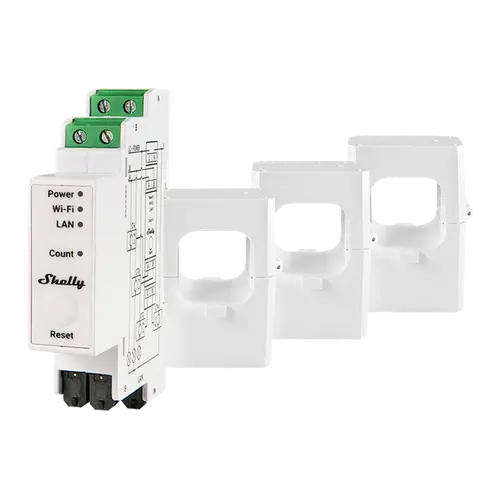


Shelly Pro 3EM-400 Review: The Version for Services a Home Meter Cannot Reach
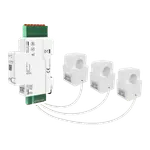
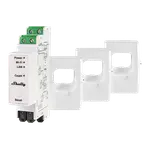
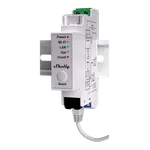
The Pro 3EM-400 is the heavy-current member of Shelly's three-phase family: identical meter body, identical firmware, identical Class B accuracy and sixty days of on-device logging, but with 400 A current transformers instead of the 120 A or 63 A sets. That makes it the right choice for a service, a workshop or a small industrial panel where the other models would saturate, and the wrong choice for a normal house, where the huge clamps rarely fit and cost far more than needed.
- Heavy three-phase services
- Workshops and small industry
- Solar and generation sites
- Modbus and SCADA
Pros
- 400 A per phase, the widest current range in this comparison
- Class B accuracy with four quadrant measurement and power factor
- Wi-Fi and Ethernet, plus MQTT, Modbus, HTTP and WebSocket
- 60 days of 1-minute data stored on the device
- Single DIN module despite the current rating
- Doubles as a Bluetooth gateway for other Shelly devices
Cons
- 400 A clamps are bulky and often will not fit a domestic panel
- By far the most expensive option here
- No built-in relay, contactor control needs the add-on
- No Zigbee or Matter support
- Same accuracy and features as the cheaper 63 A and 120 A versions
Who is the Shelly Pro 3EM-400 for?
Installations where current runs past what a consumer meter handles: a three-phase supply feeding machinery, a farm, a commercial unit, or a generation site where the inverter output has to be metered. Everything else about it is the standard Pro 3EM proposition, so it also suits integrators who already deploy Shelly and want one platform across sites of different sizes. In a normal home it is over-specified: the 120 A version covers a typical service and the 63 A version fits a consumer unit far more comfortably.
What the Pro 3EM-400 offers
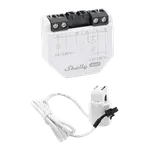
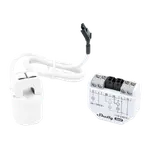
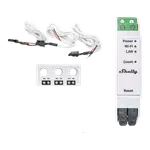
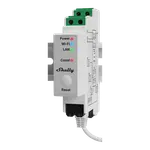
Metering runs to 400 A per phase with four quadrant measurement, so imported and exported energy are tracked separately for each of the three phases, alongside voltage, current, active and apparent power and power factor. Accuracy is the same Class B specification as the rest of the Pro line. The module takes one DIN slot, runs from 110 to 240 V and draws under 3 W, and the data comes out over Wi-Fi or wired Ethernet through RPC on HTTP and WebSocket, MQTT, Modbus and webhooks, with an embedded web interface and sixty days of one-minute records held in non-volatile memory. It also acts as a Bluetooth gateway for other Shelly devices.
What to know before you buy
The clamps are the deciding factor. At 400 A they are physically large, which is exactly why several installers pick the 120 A version for domestic panels where space around the busbars is tight. There is no built-in relay, so switching a load needs the 3EM Switch Add-on, and there is no Zigbee or Matter support on this model. It is also the most expensive device in this comparison by a wide margin, and the accuracy and feature set are the same as its cheaper siblings: you are paying for current range, not for capability.
Is the Shelly Pro 3EM-400 worth it?
Only if you actually need the range. For a service above 120 A per phase it is a comparatively cheap way to get professional-grade three-phase metering with a documented local API, Modbus and long on-device history. For a house, the same money buys a 120 A Pro 3EM plus a second meter for another panel, or an entire sixteen-clamp monitor with per-breaker coverage.
Frequently asked questions
How is the Pro 3EM-400 different from the Pro 3EM 120A?
Only the current transformers. The meter, firmware, accuracy class, connectivity and data logging are the same; the 400 model ships 400 A clamps for services that would saturate a 120 A set.
Will it fit in a home consumer unit?
The meter itself takes a single DIN module, but the 400 A transformers are large and often will not fit around the busbars of a domestic panel. For a house, the 120 A or 63 A versions are the practical choice.
Can it measure solar production?
Yes. Four quadrant measurement reports produced and consumed energy separately for each phase, which is what generation sites and solar installations need.
Can it switch a load?
Not on its own. It has no built-in relay; contactor control requires the Shelly 3EM Switch Add-on. Scripts and webhooks can still drive other devices on the network.
Does it work without the cloud?
Yes. It runs on a local LAN or Wi-Fi network with an embedded web interface, RPC over HTTP and WebSocket, MQTT and Modbus, and it keeps 60 days of minute-level data on board.