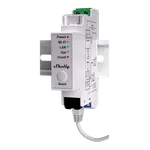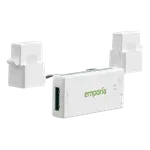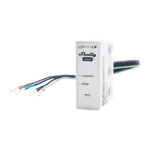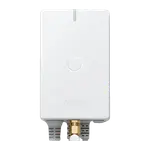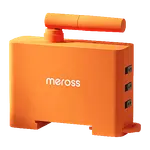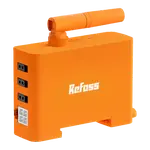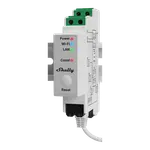


Shelly Pro EM-50 Review: A DIN Meter That Measures Two Circuits and Switches Them
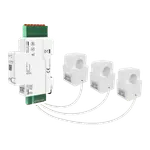
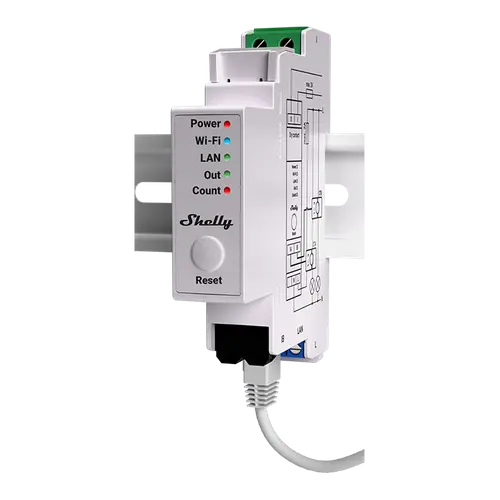
The Pro EM-50 is the practical middle of Shelly's metering range: single-phase, two channels, both clamps included, and an integrated potential-free contact so it can drive a contactor instead of only reporting. Where it separates itself is the plumbing, with wired Ethernet alongside Wi-Fi, an embedded web interface, RPC, MQTT and Modbus TCP, plus sixty days of minute data on the device. Owners repeatedly confirm the readings against their own instruments and describe Home Assistant picking it up on the LAN without configuration.
- Single circuits and sub-panels
- Home Assistant and SCADA
- Solar surplus diversion
- DIN rail installs
Pros
- Integrated potential-free contact drives a contactor directly
- Wired Ethernet as well as Wi-Fi and Bluetooth
- Local web interface, RPC, MQTT and Modbus TCP
- 60 days of 1-minute data stored on the device
- Class B accuracy, confirmed by owners against their own meters
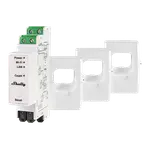
- Both 50 A clamps included, DIN rail mounting
- 3 year warranty
Cons
- Single-phase, two channels only, no three-phase mode
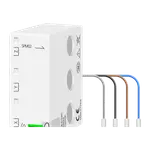
- Small terminals, the voltage input is fiddly to wire
- Clamps are directional, wrong orientation reads negative
- No calibration or offset adjustment
- No Matter support
Who is the Shelly Pro EM-50 for?
It suits people metering something specific rather than a whole panel: a garage shop feed, a workshop machine, a marine 120/240 V panel, branches of an inverter output, or a solar system where surplus should be diverted. Two channels and 50 A clamps set the ceiling, and the DIN format means it belongs in a consumer unit or an enclosure rather than taped inside a breaker box. Business users show up in the reviews too, using it to switch off equipment that would otherwise idle all day.
What buyers love
Accuracy and integration. Owners compare its current and voltage readings against a Fluke meter or their own quality metering and report them matching closely. Home Assistant identifies the device on the LAN by itself and exposes the full set of entities, including power, apparent power, current, power factor, total active energy, returned energy, frequency and voltage, plus control of the dry contact and firmware updates. Beyond the smart home, the Modbus TCP interface gets it into SCADA systems, and the built-in access point and web interface mean it can be configured with no app at all. Build quality gets the usual Shelly praise, and having both Wi-Fi and wired Ethernet is called out as the reason it stays online.
What to know before you buy
It is single-phase with two channels, so it is not a whole-panel monitor and there is no three-phase mode. The terminals are small: several owners mention that the voltage input in particular is fiddly to wire, and you need a short piece of DIN rail to mount it. Clamp direction matters, and one owner had to call the electrician back because the mains clamps are directional in a way that showed negative values when installed the other way around. A few people wish for a calibration or offset option, since readings are very close but not perfect, and integration outside the mainstream is not guaranteed: one owner notes it is not supported by a Sense monitor without converting the data. Matter is not part of this model.
Is the Shelly Pro EM-50 worth it?
For two circuits, yes, and it is the cheapest way here to get metering, wired networking and a switching contact in the same device. The comparison to make is internal: the EM Gen3 does similar metering for roughly half the price if you can live without Ethernet and DIN mounting, while the Pro 3EM adds a third channel and three-phase support but drops the built-in relay. Pick the Pro EM-50 when the install is in a consumer unit and you want the meter to act on what it measures.
Frequently asked questions
Can the Shelly Pro EM-50 switch a load?
Yes. It has an integrated switch with potential-free contacts rated 2 A at 240 V, meant to drive an external contactor. That is what lets it shut off idle equipment or divert surplus solar to a chosen appliance.
How many circuits can it measure?
Two, on a single phase, using the two 50 A current transformers included in the box. For a three-phase supply or for whole-panel coverage you need a different model.
Does it work with Home Assistant?
Yes, and owners describe it being detected on the local network automatically. The integration exposes power, apparent power, current, power factor, total and returned energy, frequency and voltage, plus control of the relay and firmware updates.
Does it support Modbus?
Yes, Modbus TCP is supported alongside MQTT, WebSocket, HTTPS, UDP and webhooks, which is how owners bring it into SCADA and industrial systems rather than a consumer app.
Does it measure solar export?
Yes. It does four quadrant measurement and keeps a returned-energy counter, so grid import and export to the grid are reported separately, and the load control feature can act on the surplus.
Does it need the cloud?
No. It has an embedded web interface and its own access point for setup, keeps sixty days of minute data locally, and can be read entirely over the LAN through RPC, MQTT or Modbus TCP.