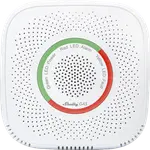
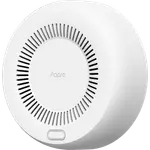
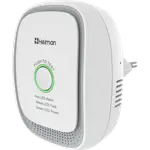
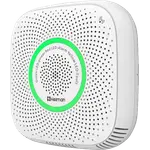
A gas detector watches for fuel escaping before it burns: methane from the pipeline, propane or butane from a bottle. That makes it a different device from the alarm most homes already have. A smoke alarm reacts to a fire that has started, a carbon monoxide alarm reacts to fuel that is burning badly, and a gas detector reacts to fuel that is not burning at all. The three protect against three different accidents, and a good detector is precise about which one it covers.
The smart part changes what happens next. An unconnected alarm sounds in an empty kitchen. A connected one sends a push notification while you are at work, logs the reading, and in the best case closes the gas supply on its own. Everything below is about telling those levels apart.
Match the detector to your gas
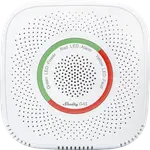
This is the first filter, and it is not a preference. Natural Gas is mostly methane, it is lighter than air, and it collects at ceiling level. LPG & Propane is heavier than air and pools on the floor. A unit calibrated for one is not a reliable alarm for the other, which is why brands such as Shelly sell the same housing as a CNG version and an LPG version, and why the mounting height in the manual is part of the specification rather than a suggestion. Piped supply in a flat or a house means natural gas at high level. Bottled gas for a cooker, a caravan, a boat or a patio heater means LPG at low level. A workshop with both needs two detectors.
Carbon Monoxide is a separate line in the table for the same reason. Combination units exist and are convenient, but CO belongs near sleeping areas while a combustible gas sensor belongs near the appliance. If your priority is CO rather than leaks, look at Smoke & CO Detectors instead, where every model is built around that hazard.
Sensor type, threshold and lifespan
Sensor Type explains most of the behaviour differences between two detectors that look identical. Semiconductor cells are cheap and very sensitive, which is why nearly every low-cost smart detector uses one, and they are also the ones that react to hairspray, alcohol and frying oil. Catalytic bead sensors burn a sample on a heated element and read the heat, which is stable across the whole explosive range and is the technology behind most certified combustible gas alarms. Electrochemical cells are the standard for carbon monoxide and are not used for methane.
Alarm Threshold is normally expressed as a percentage of the Lower Explosive Limit, the concentration at which the gas becomes flammable. Home detectors typically fire between 5% and 10% LEL, so at one tenth or one twentieth of a dangerous mixture. A lower threshold buys time and costs nuisance alarms, and the European standard for these devices requires the alarm well below the explosive point.
Sensor Life is the specification people forget. The cell ages whether or not it ever sees gas, and a detector kept past its replacement date can read low with nothing on the outside to show it. Five years is normal for combustible gas cells. Pair that with Certification: UL 1484 in North America, EN 50194 in Europe, and the certifying body's name rather than a bare CE mark, which for this product category is often self-declared.
Power, and what happens when it fails
A combustible gas sensor is a heated element, so it draws real current and cannot run for years on a coin cell. Almost every fixed detector is therefore Wired, either plugged into a socket or wired in place. That makes Battery Backup the specification to check next, because leaks and power cuts arrive together more often than you would expect, when a storm takes down the supply or when someone trips a breaker while working on an appliance. Without backup, the detector is simply off for those hours.
A battery-only model exists, and it trades sampling frequency or sensitivity for that runtime. If the room has no socket, look at the Battery Life figure carefully and check whether it refers to continuous sensing or to backup operation only.
Connectivity decides who hears the alarm
A WiFi detector needs nothing else and is the simplest way to cover one kitchen or boiler room. A Zigbee detector needs a hub, joins a mesh, and usually acts as a router for the battery sensors around it, which is worth something if you already run a Zigbee network from one of our Hubs. Either way, check Home Assistant support if you care about local control, because a device that can only reach you through a manufacturer's cloud goes quiet the moment that cloud or your internet connection does. Matter support is still rare here and is the thing to watch if you want the detector to survive a change of ecosystem.
Alerts, and the features that make one act
App Notifications are the reason to buy a connected model at all. Alarm Volume still matters for whoever is at home: 70 dB is audible in the same room, 85 dB carries through a closed door. Voice Alerts tell a real leak apart from a low battery chirp, and Fault Alerts cover the failure mode specific to this category, since a dead sensor never alarms and looks exactly like a quiet house.
Valve Shut-off is the feature that separates a warning from a fix. Some detectors have a dedicated output for a valve manipulator, others trigger a smart gas valve through the app, in the same way a leak sensor closes a water valve in our Water Valves category. Interconnect is the multi-storey version of the same idea: when the basement unit alarms, the one upstairs sounds too.
The rest are conveniences worth having. Concentration Reading turns a binary alarm into a number you can trend, and lets you automate on a rising level rather than on the threshold, which is the same reasoning that makes Air Quality Monitors useful. Digital Display helps during installation, Self-test confirms the unit is still alive, and Mute & Silence keeps people from unplugging a detector that will not stop sounding while the room ventilates. That last one prevents more permanently disabled alarms than any feature on this list.