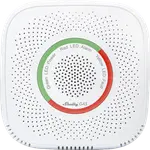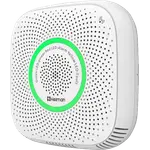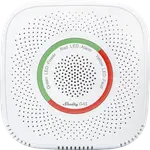
Shelly GAS (CNG) Review: The Methane Detector That Can Close the Valve Itself
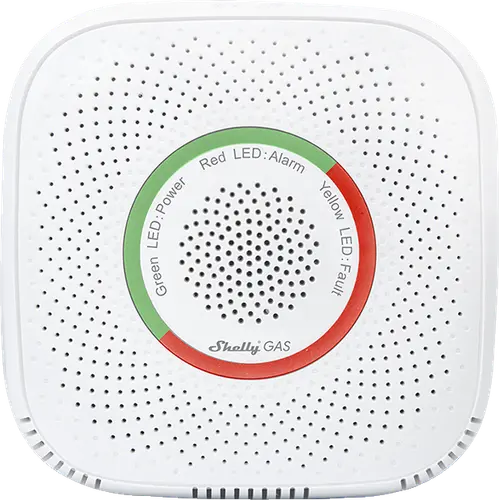
The Shelly GAS (CNG) is the natural gas detector to buy if you run a smart home you actually control. It plugs into a socket, joins WiFi without a hub, and exposes everything that matters locally: the measured concentration, the alarm state, a self-test, the mute switch and, with the separate add-on actuator, the valve itself. Owners consistently single out the Home Assistant integration and the fact that the valve still closes on alarm even with no network at all. The trade-offs are a fiddly first setup with thin documentation, and the socket dependency, which matters because methane rises and the unit has to sit high on the wall.
- Home Assistant users
- Homes with a gas boiler
- Local-control fans
- Automatic shut-off seekers
Pros
- Local HTTP, MQTT and CoAP APIs, no cloud account required
- Reports the measured concentration in ppm, not just an alarm state
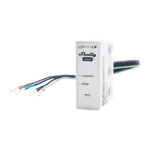
- Closes the gas valve with the add-on actuator, even without WiFi
- Remote self-test and mute from the app or Home Assistant
- Works with Alexa, Google Home, SmartThings and Home Assistant
- Plug-in installation with a flame-resistant housing
Cons
- First-time setup and pairing are fiddly, and the documentation is thin
- Mains powered with no battery backup, so a power cut leaves it offline
- Needs a socket high on the wall, since methane collects at ceiling level
- The valve manipulator is sold separately
- 70 dB sounder is quieter than the 85 dB units in the category
- No display on the device itself
Who is the Shelly GAS (CNG) for?
This is a detector for piped natural gas, so it belongs in a home with a gas boiler, a gas cooker or a gas meter indoors. It is calibrated for methane only, and Shelly sells a separate LPG version for bottled propane and butane, so pick the right one before ordering. It suits people who already run Home Assistant, Alexa, Google Home or SmartThings and want the alarm to do more than beep: the device speaks HTTP, MQTT and CoAP locally, which is why it ends up in so many self-hosted setups. Owners repeatedly describe wiring it into wider automations, from flashing smart bulbs on alarm to grouping it with their smoke alarms so a basement leak is audible upstairs.
What buyers love
Two things dominate the feedback. The first is the Home Assistant integration, where the live gas concentration, the alarm state, the self-test and the mute control all appear as entities without any cloud account. The second is the valve control: paired with the Shelly Gas Add-on manipulator, the detector closes the gas supply by itself, and several owners point out that this happens even if the WiFi is down, since the shut-off is wired rather than cloud-driven. Physical installation gets consistent praise for being quick, and the cloud side is optional but useful, since remote alerts and manual valve control from the app are what people want when they are away from home.
What to know before you buy
The initial setup is the recurring complaint. The documentation is thin, and while most owners get there, more than one describes the pairing flow as awkward and one gave up on it entirely. The unit is mains powered with no battery backup, which drew a low rating from a buyer who wanted a battery model, and it is worth planning the socket position in advance: because methane is lighter than air, the detector needs to sit high on the wall, so a ceiling-level outlet is often part of the job. The sounder is a 70 dB local alarm rather than the 85 dB found on some rivals, and it is genuinely loud during the three-minute warm-up. There is no screen, so concentration readings live in the app or in your automation platform, and the valve actuator is an accessory you buy separately.
Is the Shelly GAS (CNG) worth it?
It costs more than the generic plug-in alarms sold alongside it, and owners say so, but they also say a safety device is the wrong place to save money. What the extra buys is real: a documented local API, an alarm threshold at 6% LEL, a live concentration reading instead of a simple on/off contact, a proper self-test, remote muting and a wired output that can close the gas line. If you only want something that screams when it smells gas, cheaper units do that. If you want the leak to trigger a shut-off, a notification and the rest of your house, this is the one that integrates without a fight.
Frequently asked questions
Does the Shelly GAS (CNG) detect propane or LPG?
No. This version is calibrated for compressed natural gas, which is mostly methane. Shelly sells a separate LPG model for propane and butane, and the two are not interchangeable because the gases behave differently and collect at opposite ends of the room.
Can it shut off the gas automatically?
Yes, with the Shelly Gas Add-on valve manipulator, which is sold separately. The detector has an 11-13V 500mA jack output that drives the actuator, and because the link is wired, the valve still closes on alarm when the network or the cloud is unavailable.
Does it need a hub?
No. It connects straight to a 2.4 GHz WiFi network and runs an embedded web server, so it works with the Shelly app or with any platform that can talk to its local API.
Does it work with Home Assistant?
Yes, and this is what owners highlight most. Home Assistant exposes the gas concentration, the alarm state, the self-test and the mute control, plus the valve position when the add-on actuator is fitted, all over the local API without a cloud account.
Where should the detector be installed?
High on the wall or near the ceiling, within a few metres of the boiler, cooker or gas meter, because natural gas is lighter than air and rises. Keep it away from windows, extractor fans and the burner itself, where draughts and steam cause nuisance alarms.
What happens during a power cut?
The detector stops sensing. It is mains powered with no battery backup, so if you want coverage during outages it has to sit on a circuit you keep alive, or be paired with a second detector that has its own power.