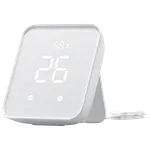



TP-Link Tapo H100 Review: The Cheap Little Hub That Turns Tapo Sensors Into a Home Alarm
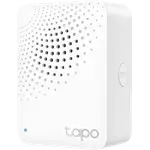
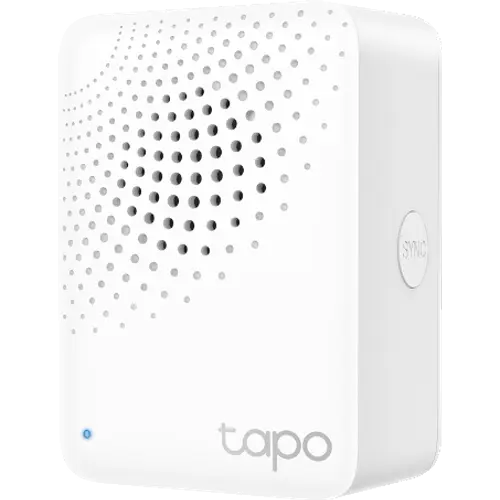
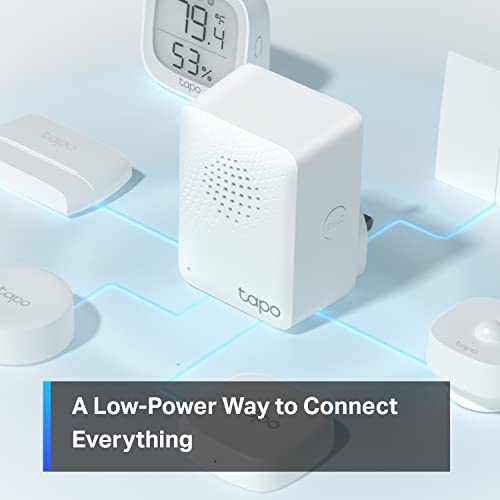
The Tapo H100 is the piece that makes the cheap Tapo sensors work at all, and at its price it is close to an impulse buy. It plugs into a mains socket, pairs with up to 64 Tapo motion, contact, temperature and water sensors over an 868 / 922 MHz Sub-1G radio that reaches further than Wi-Fi and lets those sensors run for a year or more on a coin cell, and its built-in 90 dB speaker turns any of them into an alarm or a doorbell chime. It also acts as a Matter bridge, so the compatible sensors show up in Alexa, Google Home, Apple Home, SmartThings and Home Assistant. The catch is scope: it only manages Tapo accessories, it cannot take cameras or video doorbells as sub-devices, and the Sub-1G band is region specific, so a hub bought for one region will not pair with sensors sold in another.
- Tapo ecosystem owners
- DIY alarm setups
- Budget buyers
- Extra doorbell chime
- Sensor automations
Pros
- Plug-and-play setup that takes minutes in the Tapo app
- Built-in 90 dB siren with 19 ringtones, so it works as both an alarm and a doorbell chime
- Connects up to 64 Tapo sensors, buttons and switches
- Sub-1G radio reaches across the house and stretches sensor battery life
- Acts as a Matter bridge, so compatible sensors appear in Alexa, Google Home, Apple Home, SmartThings and Home Assistant
- Supported by the official Home Assistant TP-Link integration
- Rock-bottom price for a hub
- Small enough to disappear into a mains socket, no wiring needed
Cons
- Region locked: a hub bought for one region will not pair with Tapo sensors from another
- Cannot take Tapo cameras or video doorbells as sub-devices, which needs the H200 or above
- Matter bridging does not yet cover the water leak sensor or the smart buttons
- 2.4 GHz Wi-Fi only, with no Ethernet port
- No Zigbee, Z-Wave, Thread or Bluetooth, so it only manages Tapo accessories
- No temperature, humidity, light or motion sensing of its own
- Some owners wish the siren were louder
- One year warranty in the US
Who is the TP-Link Tapo H100 for?
It is for anyone who already owns, or is about to buy, Tapo sensors and accessories. The T100 motion sensor, the T110 contact sensor, the T310 and T315 temperature and humidity sensors, the T300 water leak sensor and the S200 buttons are all battery devices that do not speak Wi-Fi, and the H100 is what they talk to. Because it does not need wiring, it goes wherever there is a free socket: a hallway, a garage, a bedroom next to the bed so the siren is audible at night. The 64-device ceiling means a normal house will never outgrow it, and adding a second hub is cheap enough that people put one at each end of a large home.
What buyers love
Setup is the single most repeated compliment: plug it in, open the Tapo app, follow three screens, done in five minutes, and non-technical owners say so as often as enthusiasts. After that it is the reliability, with several owners reporting a year of uninterrupted operation with the hub sitting a long way from the router, and quick reaction to triggers. The chime is the other favourite, because it does double duty: an extra doorbell ring deeper in the house where the doorbell's own chime does not reach, and a siren that fires when a door, a window or a mailbox sensor trips. Common setups people describe are mailbox motion alerts, fridge-door-left-open alarms, garage door monitoring overnight and a DIY armed-when-away routine. Owners of other TP-Link gear also like that everything lands in one app, and one reports it working with Home Assistant.
What to know before you buy
Two limits account for almost every unhappy review. The first is the region lock: the Sub-1G band differs between the US and Europe, so a hub bought in one region simply will not see sensors bought in another, and the listings do not make that obvious. The second is that this hub does not adopt Tapo cameras or video doorbells as sub-devices; that is what the H200 and above are for, and more than one buyer returned an H100 after discovering it. Beyond that, the hardware is deliberately basic: 2.4 GHz Wi-Fi only with no Ethernet port, no Zigbee, Z-Wave, Thread or Bluetooth radios, no built-in temperature, humidity, light or motion sensing, no microphone and no storage. Matter bridging covers the motion, contact and temperature and humidity sensors but not the water leak sensor or the buttons yet. A handful of owners also wish the siren went louder, and the US warranty is one year.
Is the TP-Link Tapo H100 worth it?
For a Tapo household, yes, and it is barely a decision at this price. You are not buying a universal hub, you are buying the radio that makes a set of very cheap sensors usable, plus a siren and a chime you would otherwise pay for separately. Judged that way it does everything asked of it and the average rating reflects that. If you want one box to run Zigbee bulbs, Z-Wave locks and Tapo sensors together, or you need it to handle a video doorbell, this is the wrong model and no firmware update will change that: step up to the H200 or the H500 instead.
Frequently asked questions
Does the Tapo H100 work with Alexa and Google Home?
Yes. TP-Link lists the H100 among the Tapo devices you can link to Amazon Alexa and to Google Home from the Tapo app. It also binds to Apple Home and SmartThings as a Matter bridge, which is how its sensors show up in those apps.
Can the Tapo H100 connect Tapo cameras or a video doorbell?
No. It only takes low-power Tapo accessories such as motion, contact, temperature, humidity and water leak sensors, buttons and switches. For cameras and video doorbells you need the Tapo H200 or above. It can still be used as an extra chime for a Tapo doorbell through the hub's smart actions.
Does the Tapo H100 work with Home Assistant?
Yes. The official TP-Link Smart Home integration in Home Assistant lists the H100 as a supported hub, along with the S200B, S200D, T100, T110, T300, T310 and T315 accessories connected to it.
How many devices can the Tapo H100 connect?
Up to 64 Tapo sub-devices, though TP-Link notes the real limit can vary with the mix of device types.
Why will my Tapo sensor not pair with the hub?
Most often it is a region mismatch. The hub and its sensors talk over a Sub-1G band (868 / 922 MHz) that differs by region, so a US hub cannot see UK or EU sensors and the other way round. Both pieces have to be the version sold for the same region.
Does the Tapo H100 need a hub or a wired connection?
Neither. It is the hub itself, it plugs directly into a mains socket with no wiring, and it joins your network over 2.4 GHz Wi-Fi. There is no Ethernet port, so a 2.4 GHz band has to be available on your router.