
X-Sense SBS50 Base Station Review: The Hub That Turns X-Sense Alarms Into One Connected Safety Net
The SBS50 is the gateway that turns a pile of separate X-Sense alarms into one interconnected system: up to 50 smoke, CO, heat, water leak and thermo-hygrometer devices join it over a long-range sub-GHz radio, and it carries their alerts to the X-Sense app, to Alexa and to Home Assistant over 2.4 GHz Wi-Fi. Its own 100 dB sounder means the whole house hears an alarm that goes off in the garage. What it is not is a general purpose smart home hub: it speaks no Zigbee, Z-Wave, Thread or Matter, so it only ever manages X-Sense hardware. For anyone already committed to that ecosystem it is an inexpensive and near-essential piece; for anyone shopping for a hub to unify devices from several brands, it is the wrong shape entirely.
- X-Sense alarm owners
- Whole-home fire and leak alerting
- Home Assistant users
- Budget buyers
Pros
- Connects up to 50 X-Sense alarms and sensors to a single system
- Long sub-GHz link, up to 1,700 ft (500 m) in open air
- Built-in 100 dB sounder, adjustable, that fires alongside every paired alarm
- Works with Alexa, and it is the device Home Assistant support runs through
- 5 year warranty, the same term as X-Sense's smoke and CO alarms
- Small 90 x 90 x 30 mm mains-powered unit with no batteries to change
Cons
- Pairs with X-Sense devices only: no Zigbee, Z-Wave, Thread or Matter bridging
- No Google Home, Apple Home or SmartThings support
- 2.4 GHz Wi-Fi only, with no 5 GHz band and no Ethernet port
- No local storage or card slot, so history depends on the cloud
- Takes no readings of its own: every sensor value comes from a separate device
Who is the X-Sense SBS50 Base Station for?
This is a single-ecosystem gateway, and that decides everything about who should buy it. Several X-Sense devices, including the STH51 thermo-hygrometer, the SWS51 water leak alarm and the SMA11 mailbox alarm, will not work normally without a base station at all, and the interconnected M-series alarms such as the XS01-M and XC01-M only reach the app through one. If you own or plan to own any of those, the SBS50 is not an accessory but the missing half of the product. It suits a house where alarms sit far apart, since the link between the base station and its devices reaches up to 1,700 ft (500 m) in open air, well beyond what a single Wi-Fi alarm covers. It is the wrong purchase for a mixed-brand smart home: nothing that is not X-Sense can join it.
What the X-Sense SBS50 Base Station offers
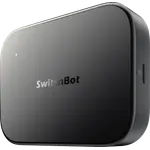
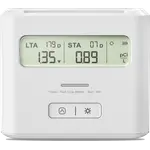
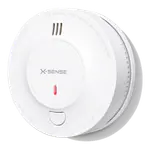
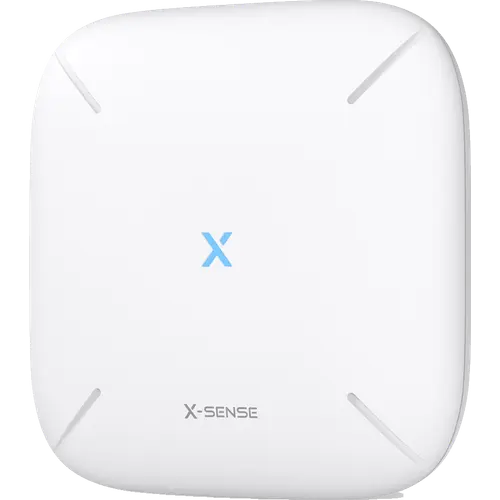
One base station manages up to 50 devices, with a cap of 10 thermo-hygrometers among them, which is a generous ceiling for a whole-house safety layer. Rather than a mesh standard, it uses X-Sense's own Link+ Pro radio at 915 MHz in the US and 868 MHz in Europe, which is what buys the range and the battery life on the alarms it talks to. The unit has a built-in sounder rated at 100 dB and adjustable, so a heat alarm triggering in a detached garage also sounds in the hallway where the base station sits, and a three-colour LED reports power, Wi-Fi and alarm state at a glance. It is small enough to disappear on a shelf at 90 x 90 x 30 mm and 150 g, and it runs from a 5 V mains adapter with no batteries to replace. On the software side it reaches Alexa, and Home Assistant support runs through this base station specifically, with the community integration mapping the SBS50 as its own entity. X-Sense backs it with a 5 year warranty, the same period it gives its smoke and CO alarms rather than the shorter term it gives its accessories.
What to know before you buy
The single biggest limitation is the closed radio. There is no Zigbee coordinator, no Z-Wave, no Thread border router and no Matter bridging, so the SBS50 cannot pull in a sensor from any other brand and cannot republish its X-Sense devices to another platform. That also caps the ecosystem reach: Google Home, Apple Home and SmartThings are all absent, and since the hub carries no Matter certification there is no indirect route into them either. The network side is equally basic: 2.4 GHz Wi-Fi only, with no 5 GHz support and no Ethernet port, so there is no wired fallback if the Wi-Fi is unreliable where the unit has to live. It holds no local storage and has no card slot, meaning event history lives in the X-Sense cloud rather than on the device. And despite sitting at the centre of a sensor network, the base station measures nothing itself: temperature, humidity, light and motion all come from separate devices paired to it.
Is the X-Sense SBS50 Base Station worth it?
Judged as a general smart home hub it looks thin next to the Zigbee and Matter gateways it shares a comparison table with, most of which bridge several protocols and several platforms. Judged as what it actually is, the required controller for an X-Sense safety system, it is easy to justify: it costs a fraction of the alarms it connects, it unlocks interconnection and app alerts across the whole set, its own siren is loud enough to matter, and the 5 year warranty is unusually long for a gateway. The honest test is whether your alarms are already X-Sense. If they are, this is the piece that makes them a system instead of a collection. If they are not, no amount of value here changes the fact that nothing else can connect to it.
Frequently asked questions
Do I need the SBS50 to use X-Sense alarms?
It depends on the model. X-Sense states that devices such as the STH51, SWS51, SDA51, SMA11, SAL51 and SAL100 need a base station to work normally, and the interconnected XS01-M and XC01-M alarms need one for any app feature. The standalone Wi-Fi models, including the XS01-WX, XC04-WX and SC07-WX, connect straight to the app without it.
How many devices can one X-Sense SBS50 handle?
Up to 50 devices per base station, with a limit of 10 STH51 thermo-hygrometers inside that total. X-Sense also allows one base station per Home in the app.
Does the X-Sense SBS50 work with Alexa and Home Assistant?
Yes to both. X-Sense sells its base station devices as Alexa compatible, and its Home Assistant support is documented as running through the SBS50 specifically, with the community integration recognising the base station and the alarms paired to it.
Does the SBS50 support Matter, Zigbee or Z-Wave?
No. It uses X-Sense's own Link+ Pro radio at 915 MHz in the US and 868 MHz in Europe, and it carries no Matter certification, so it neither joins those networks nor bridges its own devices onto them. X-Sense sells a separate SBS0A model for the Matter path.
How does the SBS50 connect to the internet?
Over 2.4 GHz Wi-Fi using IEEE 802.11b/g/n. It is not compatible with a 5 GHz network and it has no Ethernet port, so the placement has to be somewhere the 2.4 GHz signal is solid.
Does the base station make a sound of its own?
Yes. It has a built-in sounder rated at 100 dB with an adjustable volume, so when any paired alarm triggers, the base station sounds too and every connected alarm sounds together.