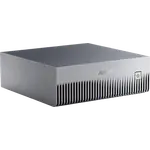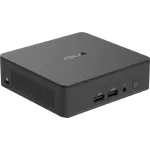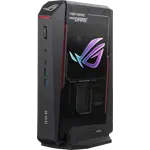






Asus Ascent GX10 Review: 128GB of Unified Memory for Models a Consumer GPU Cannot Hold
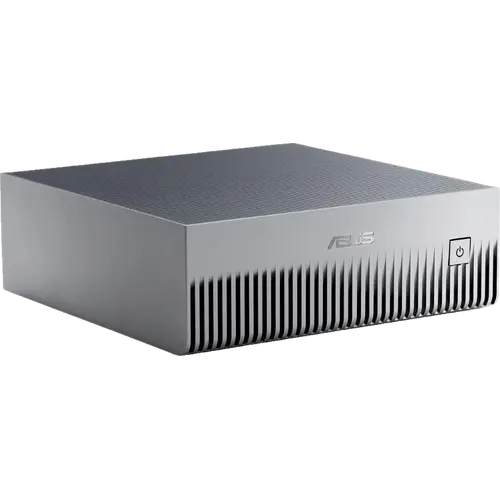
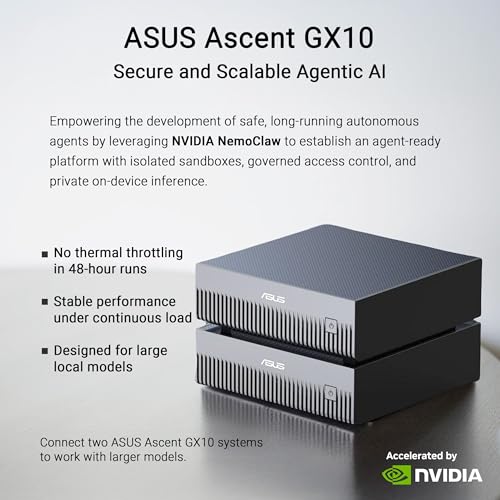
The Asus Ascent GX10 is a desktop AI supercomputer for people who want to run or fine-tune very large models on their own hardware instead of renting cloud GPUs. Its 128GB of unified LPDDR5x memory is the whole point: it holds models that simply will not fit on a consumer graphics card, and the built-in NVIDIA ConnectX-7 SmartNIC lets two units be clustered when one is not enough. The trade-off is memory bandwidth, which caps token generation well below what the raw compute suggests, so it fits researchers, prototyping and agentic workflows far better than single-stream chatbot use. At this tier it is a specialist instrument, not a general desktop upgrade.
- AI researchers
- Local LLM inference
- Homelab AI builders
- Agentic AI development
Pros
- 128GB of unified memory holds models that will not fit on a consumer GPU
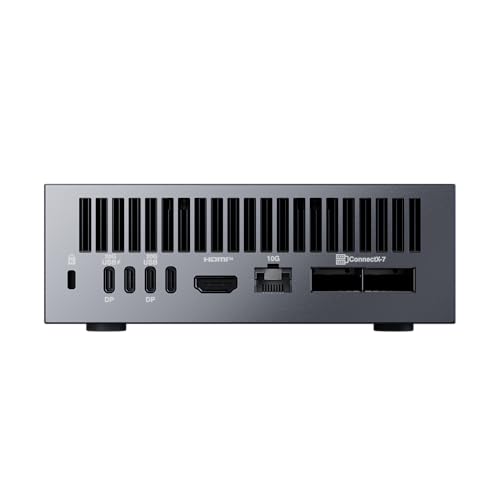
- NVIDIA ConnectX-7 SmartNIC lets two units be clustered for larger workloads
- Very quiet under sustained load, with modest power draw for the compute
- 10G Ethernet plus Wi-Fi 7 and Bluetooth 5.4 for fast dataset and model transfers
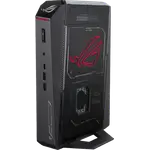
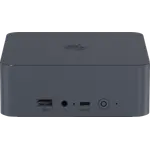
- Compact 150 x 150 x 51 mm chassis at 1.48kg
- Ships on Ubuntu Linux with the NVIDIA DGX software stack preinstalled
- Four USB-C ports, three with DisplayPort 2.1 output, plus HDMI 2.1
Cons
- Memory bandwidth caps token generation well below what the compute suggests
- Small scale fine-tuning can be outpaced by a high-end consumer graphics card
- The DGX software stack is tied to specific CUDA versions and mismatches are common
- Only a one year warranty on a machine at this price tier
- No Thunderbolt, no audio jack, no built-in speakers or microphone
- No VESA mount or HDMI cable included
- Several buyers reported receiving opened or previously used units
Who is the Ascent GX10 for?
This is a purpose-built machine for local AI work, and it makes most sense to anyone whose models keep running out of video memory. The NVIDIA GB10 pairs a 20-core Grace CPU with an integrated Blackwell GPU and, critically, gives them a single 128GB pool of unified LPDDR5x rather than the isolated few gigabytes of a graphics card. Owners describe running mixture-of-experts models well past 100GB and driving large context windows for coding agents, often with a conventional gaming GPU alongside handling the fast, small model while the GX10 holds the big one. Researchers prototyping on Blackwell and homelab builders who want their data to stay on their own network are the natural audience.
What buyers love
Two things come up again and again: capacity and calm. The memory pool lets people load models they previously could not run at all, and the NVIDIA ConnectX-7 SmartNIC turns a pair of units into something larger still, which several owners consider a big part of the value rather than an extra. Just as often praised is how the machine behaves on a desk. Buyers report sustained heavy load with the fan barely audible, temperatures staying moderate, and modest power draw for the compute involved, which is a real change from a tower full of GPUs. Asus specific build quality also earns mentions, and owners note the software situation keeps improving as ready made containers and step by step playbooks arrive, so early impressions written around launch no longer describe the machine you get today.
What to know before you buy
The honest limitation is bandwidth, not power. Several owners found that decoding, meaning the speed at which tokens come out, lags well behind what the compute figures imply, and one reported that small scale fine-tuning was outpaced by a high-end consumer graphics card. If your workload is one person chatting with one model, this is the wrong shape of machine, and it shines instead on batched, agentic and prototyping work. The software stack also demands patience: the DGX environment is tied to particular CUDA versions, and owners have hit mismatch errors that cost them a reinstall, while one buyer running a data centre evaluation was unhappy with how driver updates and support tickets were handled. Two practical points worth weighing: the warranty is only one year on an expensive machine, and multiple buyers reported receiving boxes that arrived opened or had clearly been powered on before, so check the seller and inspect the unit on arrival. Returns may also carry a restocking fee of around ten percent plus insured shipping, which is not trivial on hardware in this class.
Is the Ascent GX10 worth it?
It is worth it if the 128GB pool solves a problem you actually have, and poor value if it does not. Nothing else in this footprint, at 150 x 150 x 51 mm and well under two kilograms, will hold a model of this size while staying quiet enough to sit next to you. Buy it for research, for agentic pipelines, for keeping sensitive data local, or as a pair linked over the SmartNIC. Do not buy it expecting the fastest possible answers from a single prompt, because a much cheaper graphics card will win that specific contest. Judged as a compact, low noise platform for large local models it earns its premium; judged as a general purpose desktop it does not.
Frequently asked questions
Can the Asus Ascent GX10 run large language models locally?
Yes, and that is its main purpose. The 128GB of unified LPDDR5x memory is shared between the 20-core Grace CPU and the integrated Blackwell GPU, so it can hold models far larger than a consumer graphics card can. Owners report running mixture-of-experts models well beyond 100GB. Expect strong capacity rather than the fastest single-stream token speed.
Can two Ascent GX10 units be linked together?
Yes. Alongside its 10G Ethernet port, each unit carries a dedicated NVIDIA ConnectX-7 SmartNIC port intended for connecting two GX10 units directly, so a pair can work on models larger than one machine can hold. Several owners treat buying a second unit as the natural upgrade path.
What operating system does the Asus Ascent GX10 run?
It runs Ubuntu Linux with the NVIDIA DGX software stack preinstalled, so the CUDA toolchain and NVIDIA container images are ready to use out of the box. It is not a Windows machine, and the environment is tied to specific CUDA versions, which is worth planning around if you depend on a particular release.
How much storage does the Asus Ascent GX10 have?
This configuration ships with a 1TB M.2 NVMe PCIe 4.0 SSD. Storage sits in a single M.2 slot, so plan capacity around model sizes, since large model weights consume space quickly.
Is the Asus Ascent GX10 loud?
No. Low noise is one of the most consistent points owners raise, with several reporting the fan being barely audible even after days of heavy load and temperatures staying moderate. Its power draw is also modest relative to the compute, which helps it sit on a desk rather than in a server room.
Does the Asus Ascent GX10 have Thunderbolt?
No. It provides four USB 3.2 Gen 2x2 Type-C ports at 20Gbps, three of which carry DisplayPort 2.1 video output and one of which accepts 180W USB-C power delivery, plus a single HDMI 2.1 port. There is no Thunderbolt port, and there is no SD card slot, audio jack or fingerprint reader.