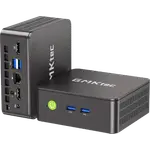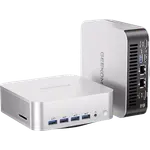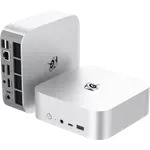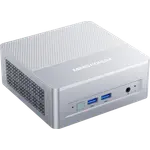
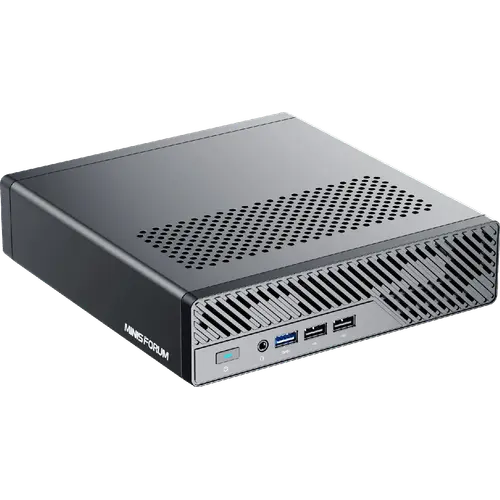
MINISFORUM MS-03 Review: Four Wired Network Ports And A PCIe Slot In A 1.4 kg Box
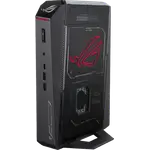
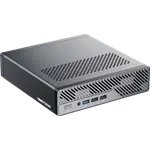
The MS-03 is built for the home lab rather than the desk. Two 10G SFP+ cages, a 10GbE RJ45 and a 2.5GbE port with vPro give it more wired networking than almost anything else its size, and a half-height PCIe x16 slot plus three M.2 NVMe bays, two of them PCIe 5.0 x4, let it grow into a router, a fast NAS head or a virtualisation host. The Core Ultra 9 386H adds 16 cores and a 50 TOPS NPU for local model inference, and this configuration ships 64 GB of DDR5 in two SO-DIMM slots, so memory is replaceable up to 128 GB instead of soldered. The trade-offs are a 1 TB boot drive that looks small next to all that expansion, an external 240W brick rather than an internal supply, and pricing at the premium end of the category. If the job needs ten-gigabit networking and an expansion card in something that weighs 1.4 kg, very little else answers it.
- Home labs
- 10GbE and SFP+ networking
- Local AI inference
- Virtualisation hosts
- Edge and branch deployments
Pros
- Two 10G SFP+ cages plus a 10GbE and a 2.5GbE RJ45 port on one chassis
- 16-core Core Ultra 9 386H with vPro remote management
- 50 TOPS NPU alongside 40 TOPS from the integrated graphics
- Three M.2 NVMe slots, two of them PCIe 5.0 x4, taking up to 8 TB each
- U.2 enterprise SSD support up to 15 TB through the adapter included in the box
- Half-height PCIe x16 physical slot for a network, capture or controller card
- 64 GB of DDR5 in two SO-DIMM slots, replaceable and upgradeable to 128 GB
- Wi-Fi 7 and Bluetooth 6
- Three displays from one HDMI 2.1 FRL output and two USB4 Type-C ports
- 1.4 kg and 48 mm tall, with a Quiet mode measured between 30 and 38 dB
- Two-year warranty
Cons
- External 240W power brick instead of an internal supply
- The PCIe x16 slot is wired at PCIe 4.0 x4 and only takes half-height single-slot cards
- The third M.2 slot runs at PCIe 4.0 x1, far slower than the other two
- The memory shipped in the box runs at 5600 MT/s although the platform supports 7200 MT/s
- No dedicated DisplayPort connector
- USB4 is not certified as Thunderbolt
- No SD card reader, fingerprint sensor or anti-theft lock slot
- No built-in speakers or microphone
- No VESA bracket in the box
Who is the MINISFORUM MS-03 for?
This is a machine bought for its ports and its slots rather than for its desktop speed. The network stack is the headline: two 10G SFP+ cages on an Intel X710, a 10GbE RJ45 on a Realtek RTL8127 and a 2.5GbE RJ45 on an Intel i226-LM with vPro enabled, which is the combination a software router, a ten-gigabit NAS head or a storage node actually needs and which almost no mini PC offers. Inside, a half-height PCIe x16 physical slot takes a network, capture or controller card, and three M.2 NVMe slots take up to 8 TB each. The Core Ultra 9 386H contributes 16 cores and 16 threads at up to 4.9 GHz with a 50 TOPS NPU and 40 TOPS from the integrated graphics, which is what makes local model inference practical on a box this size. vPro means the machine can be managed, diagnosed and recovered remotely, so it suits a branch office or a rack as well as a spare room.
What the MINISFORUM MS-03 offers
Storage is the most flexible part of the specification. Two of the three M.2 slots run at PCIe 5.0 x4, two accept the longer 22110 drives, and the first also takes a U.2 enterprise SSD of up to 15 TB through the M.2-to-U.2 adapter and screw set included in the box, which is an unusual amount of enterprise storage flexibility for a desktop this small. Memory is 64 GB of DDR5 across two SO-DIMM slots, upgradeable to 128 GB, so the capacity is a decision that can be revisited later. Video goes out over one HDMI 2.1 FRL port at up to 4K 120Hz and two USB4 Type-C ports carrying DisplayPort 2.1 Alt Mode, which together drive three independent displays. Wireless is Wi-Fi 7 and Bluetooth 6 from an Intel BE211 module. Cooling is a two-heatpipe heatsink with phase-change material and an 83 mm turbo fan that peaks at 5100 RPM, with a Quiet mode that drops the processor to 45W and the measured noise to between 30 and 38 dB at 50 cm. All of it fits in 196 x 189 x 48 mm and 1.4 kg, and it is covered for two years.
What to know before you buy
The power supply is external. A 19V, 12.63A 240W brick sits on the floor rather than inside the chassis, which is part of how the machine stays 48 mm tall but is one more object on the desk or in the rack. The expansion is real but bounded: the PCIe slot is physically x16 and wired at PCIe 4.0 x4, and it only accepts half-height single-slot cards up to 170 mm long and 20 mm thick, so a full graphics card is out. The third M.2 slot runs at PCIe 4.0 x1, so it belongs to bulk capacity rather than to a matched fast pair. The memory in the box runs at 5600 MT/s even though the platform supports 7200 MT/s, which is worth knowing before assuming the top speed. On the ports side there is no dedicated DisplayPort connector, so a DisplayPort-only monitor needs a USB-C cable or an adapter, and the USB4 ports are not certified as Thunderbolt, which matters for the handful of docks and enclosures that require a certified host. The conveniences a consumer mini PC often includes are absent: no SD card reader, no fingerprint sensor, no anti-theft lock slot, no speakers or microphone, and no VESA bracket in the box.
Is the MINISFORUM MS-03 worth it?
Judged as a desktop computer this configuration is expensive for what a desktop usually does. Judged as the smallest way to get four wired network interfaces, two of them ten-gigabit optical, alongside a PCIe card slot, three NVMe bays and U.2 support, it is close to being in a category of its own, and that is where the outlay pays. The 64 GB of DDR5 and the 1 TB drive are a sensible working configuration rather than a generous one, and both are replaceable, so the parts worth paying for here are the ones that cannot be added later: the network controllers, the slot layout and the vPro management. If the plan is a software router, a ten-gigabit storage node, a virtualisation host or an always-on inference box that has to sit in a rack or on a shelf, the specification is aimed squarely at that. If it is office software and a browser, almost anything else in the category does the job for far less.
Frequently asked questions
How many network ports does the MINISFORUM MS-03 have?
Four wired ports. Two 10G SFP+ cages driven by an Intel X710, one 10GbE RJ45 on a Realtek RTL8127 and one 2.5GbE RJ45 on an Intel i226-LM with vPro enabled. Wireless is Wi-Fi 7 and Bluetooth 6 from an Intel BE211 module.
Can the memory and storage of the MS-03 be upgraded?
Yes to both. Memory sits in two DDR5 SO-DIMM slots and goes up to 128 GB, and there are three M.2 NVMe slots, two at PCIe 5.0 x4 and one at PCIe 4.0 x1, each taking up to 8 TB. This configuration comes with 64 GB of memory and a 1 TB drive fitted.
What kind of card fits in the MS-03 PCIe slot?
A half-height, single-slot card no longer than 170 mm and no thicker than 20 mm. The slot is physically x16 but wired at PCIe 4.0 x4, so it suits network cards, capture cards and storage controllers rather than a full-size graphics card.
Does the MS-03 support U.2 enterprise SSDs?
Yes. The first M.2 slot accepts a 7 mm U.2 drive of up to 15 TB through the M.2-to-U.2 adapter and mounting screws that ship in the box, alongside the HDMI cable, the SSD heatsink and the power adapter.
How many monitors can the MINISFORUM MS-03 drive?
Three independent displays. One HDMI 2.1 FRL output handles up to 4K at 120Hz, and the two USB4 Type-C ports each carry DisplayPort 2.1 Alt Mode at up to 40Gbps. There is no dedicated DisplayPort connector on the chassis.
Does the MINISFORUM MS-03 come with Windows?
MINISFORUM lists Windows 11 Pro as the operating system for the MS-03. The barebone versions of the machine, which ship without memory or storage, are sold without an operating system licence.