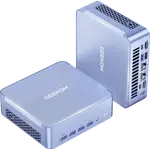
MINISFORUM MS-S1 Max Review: 128GB Of Unified Memory In A 2.8 kg Workstation
The MS-S1 Max is a mini workstation built around one decision: give the Ryzen AI Max+ 395 the full 128 GB of LPDDR5X-8000 unified memory so the CPU, the Radeon 8060S graphics and the 50 TOPS XDNA 2 NPU all draw from the same pool. That is what lets a machine this size hold large language models in memory instead of streaming them off a disk, and the rest of the specification follows the same brief: two 10GbE ports, four USB4 connectors with two at 80Gbps, a full-length PCIe x16 slot and an internal 320W power supply rather than an external brick. The trade-off is that the memory is soldered, so the configuration you buy is the configuration you keep, and the price sits at the premium end of the mini PC market. For local AI inference, heavy content work or a 10-gigabit home lab it is one of the most capable machines in the category; for general desktop use it is far more machine than the job needs.
- Local LLM inference
- AI and machine learning developers
- Creative professionals
- 10GbE home labs
- Rack and cluster deployments
Pros
- 128 GB of LPDDR5X-8000 quad-channel unified memory shared by CPU, GPU and NPU
- 16-core, 32-thread Ryzen AI Max+ 395 with a 50 TOPS XDNA 2 NPU and up to 126 TOPS overall
- Radeon 8060S graphics with 40 RDNA 3.5 compute units
- Two 10GbE RJ45 ports plus Wi-Fi 7 and Bluetooth 5.4
- Four USB4 ports, two of them USB4 V2 at 80Gbps, all with DisplayPort 2.0 Alt Mode
- Five video outputs, each capable of 8K at 60Hz or 4K at 120Hz
- Internal 320W power supply instead of an external brick
- Full-length PCIe x16 slot inside the chassis for an expansion card
- Two M.2 2280 NVMe slots taking up to 8 TB each, with RAID 0 and RAID 1
- Six heat pipes, phase-change material and dual turbine fans with four switchable power modes
- Slide-out chassis, anti-theft lock hole and a two-year warranty
Cons
- Memory is soldered at 128 GB and cannot be expanded later
- The second M.2 slot runs at PCIe 4.0 x1, so it is far slower than the first
- No dedicated DisplayPort connector, so video goes out over HDMI or USB-C
- USB4 is not certified as Thunderbolt
- No built-in speakers, SD card reader or fingerprint sensor
- No wall-mount bracket in the box despite the 100-178.5 mm mounting support
- At 2.8 kg and 222 mm tall it is large and heavy for the category
- Premium pricing that only pays off on memory-bound workloads
Who is the MINISFORUM MS-S1 Max for?
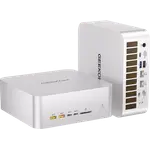
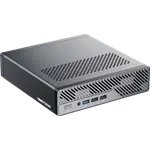
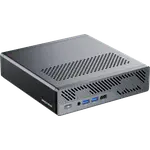
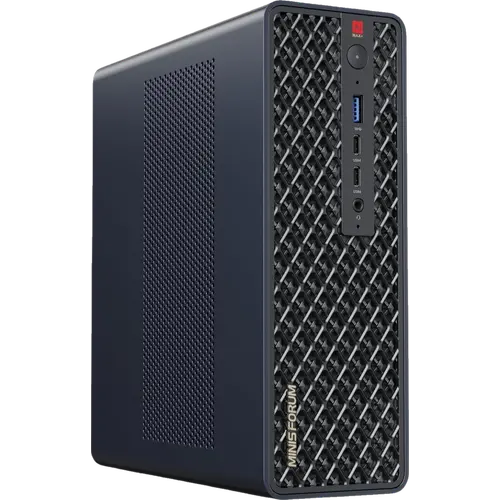
This machine is aimed at the person whose workload is limited by memory rather than by clock speed. The Ryzen AI Max+ 395 brings 16 Zen 5 cores and 32 threads up to 5.1 GHz, but the headline number is the 128 GB of LPDDR5X-8000 running quad-channel across a 256-bit bus and shared by the processor, the 40-compute-unit Radeon 8060S graphics and the XDNA 2 NPU. A model that fits in that pool runs without touching storage, which is the entire argument for a unified-memory design. Around it sits the hardware a workstation buyer expects: two 10GbE RJ45 ports for a fast network share, a full-length PCIe x16 slot inside the chassis, five video outputs capable of 8K and four switchable power modes that include a Rack profile. At 222.1 x 206.3 x 77.1 mm and 2.8 kg it stands on a desk vertically or lies flat in a rack, which is unusual in a category where most machines only do one of the two.
What the MINISFORUM MS-S1 Max offers
Connectivity is where the specification separates itself from a normal mini PC. Four of its USB ports are USB4: two at 40Gbps on the front and two USB4 V2 at 80Gbps on the rear, and all four carry DisplayPort 2.0 Alt Mode plus 15W of power output, so any of them can drive a display or charge a peripheral. Add the HDMI 2.1 FRL output and the machine can feed five screens, each capable of 8K at 60Hz or 4K at 120Hz. Networking is a pair of 10 gigabit Realtek RTL8127 controllers alongside Wi-Fi 7 and Bluetooth 5.4. Storage is two M.2 2280 NVMe slots, each accepting up to 8 TB and configurable as RAID 0 or RAID 1, with a 2 TB drive fitted from the factory. Power comes from an internal 320W supply running straight off mains, which removes the power brick that usually trails behind a machine this fast, and cooling is a copper base with six heat pipes, phase-change material and two turbine fans. The chassis slides out for maintenance, carries an anti-theft lock hole and is covered for two years.
What to know before you buy
The memory is soldered. LPDDR5X at 8000 MT/s is what makes the unified pool fast, and the cost of that is that 128 GB is both the shipping capacity and the ceiling, with no slots to add to later. The two storage slots are not equal either: the first runs at PCIe 4.0 x4 and the second at PCIe 4.0 x1, so a second drive is best treated as bulk capacity rather than a matched pair for RAID 0 throughput. On the ports side there is no dedicated DisplayPort connector, so a monitor that only takes DisplayPort needs a USB-C cable or an adapter, and the USB4 ports are not certified as Thunderbolt, which matters for a small number of Thunderbolt-only docks and enclosures. The convenience features a laptop-style mini PC often includes are absent: no built-in speakers, no SD card reader and no fingerprint sensor. Wall mounting is supported between 100 and 178.5 mm but the bracket is not in the box, and at 2.8 kg this is roughly four times the weight of a compact mini PC, so it is not a machine to hang casually behind a monitor.
Is the MINISFORUM MS-S1 Max worth it?
Judged as a desktop computer it is expensive for what most people do with a desktop. Judged as the smallest practical way to put 128 GB of fast unified memory behind an integrated GPU and an NPU, it is priced against workstations rather than against mini PCs, and it undercuts most of them. What you are paying for is the memory configuration, the two 10GbE ports, the internal power supply and the PCIe slot, four things that are individually rare in this category and almost never found together. What you give up is upgradeability: the memory is fixed, and a discrete graphics card is only an option through the internal x16 slot, which runs at PCIe 4.0 x4. If the workload is local AI inference, video and 3D work, or a fast always-on server that has to sit in a rack, the specification is aimed squarely at it. If the workload is office software and a browser, almost anything else in the category does that job for a fraction of the outlay.
Frequently asked questions
How much memory does the MINISFORUM MS-S1 Max have, and can it be upgraded?
It ships with 128 GB of LPDDR5X-8000 running quad-channel over a 256-bit bus, which is also the maximum the platform supports. The memory is soldered to the board as part of the unified memory architecture, so there are no slots and no upgrade path: the capacity you buy is permanent.
How many monitors can the MS-S1 Max drive at once?
Five. There is one HDMI 2.1 FRL output on the rear, two USB4 Type-C ports on the front and two USB4 V2 Type-C ports on the rear, and every one of them carries video at up to 8K at 60Hz or 4K at 120Hz.
Does the MINISFORUM MS-S1 Max need an external power brick?
No. The 320W power supply is built into the chassis and takes mains power directly at 100-240V, 50/60Hz. The PSU carries CCC, FCC, UL, CE and UKCA certification.
Can you add storage or an expansion card to the MS-S1 Max?
Yes to both. There are two M.2 2280 NVMe slots, one at PCIe 4.0 x4 and one at PCIe 4.0 x1, each taking up to 8 TB and supporting RAID 0 or RAID 1, with a 2 TB drive fitted from the factory. Inside the chassis there is also a full-length PCIe x16 slot wired at PCIe 4.0 x4, and the whole board tray slides out to reach them.
Does the MS-S1 Max support Thunderbolt?
It does not carry Thunderbolt certification. What it has is four USB4 ports, two at 40Gbps and two USB4 V2 at 80Gbps, all with DisplayPort 2.0 Alt Mode and 15W power output, which covers most of the same uses but is not guaranteed to work with hardware that requires a certified Thunderbolt host.
What operating system does the MINISFORUM MS-S1 Max come with?
Windows 11 Pro is pre-installed, and MINISFORUM lists support for Windows 11 24H2 in both Pro and Home editions.