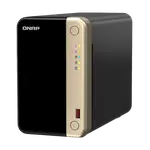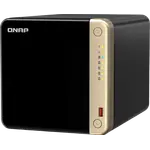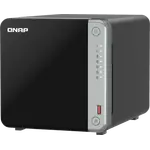



QNAP TS-264-8G-US Review: The Two-Bay NAS That Runs a Small Home Server
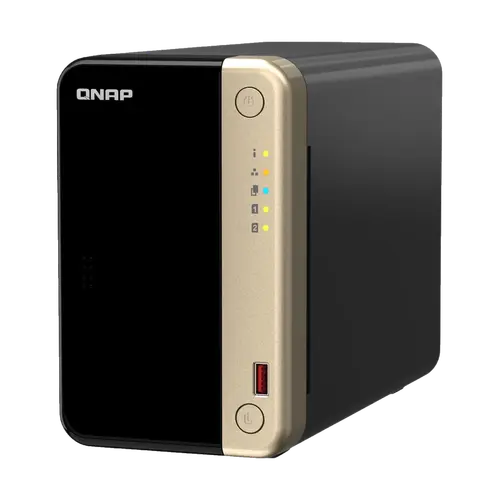
The TS-264-8G-US is a compact two-bay NAS for a home or small office that wants more than a file share. Its Intel quad-core, 8 GB of upgradable DDR4 and two M.2 NVMe slots let it run containers, virtual machines and a media server, while dual 2.5GbE ports remove the usual gigabit bottleneck. The trade-off is bay count: with only two bays it tops out at RAID 1, so capacity grows by swapping in larger drives rather than adding disks. It suits a quiet always-on server in a small footprint, not a large media library that needs RAID 5.
- Small home servers
- Docker and virtual machine hosts
- Plex and Jellyfin users
- Home offices
Pros
- Quad-core Intel Celeron with UHD graphics for hardware transcoding
- Dual 2.5GbE ports with port trunking across seven modes
- Two M.2 NVMe slots usable as cache or as a storage pool
- 8 GB DDR4, upgradeable to 16 GB across two SODIMM slots
- PCIe Gen 3 slot for an optional 10GbE card
- Runs Docker, LXC containers and virtual machines
- HDMI 2.1 output and four USB ports
- Can switch from QTS to QuTS hero for ZFS
Cons
- Two bays limit RAID to 0 and 1
- No ECC memory
- No hybrid RAID for mixing drive sizes
- No USB-C port and no SD card slot
- 10GbE only through an optional PCIe card
- Ships diskless, so drives are extra
Who is the QNAP TS-264-8G-US for?
This is a two-bay desktop enclosure aimed at a household or small office that wants one always-on machine for files, backups and a few services. The Intel Celeron N5095 is a 64-bit x86 quad-core with Intel UHD graphics, which is the part that separates it from cheaper ARM enclosures: it can transcode video in hardware, host Docker and LXC containers and run virtual machines. The two 3.5-inch bays take the bulk storage, and the two M.2 2280 slots take either an SSD cache or a separate fast pool. A buyer whose needs stop at a shared folder and a backup target will find it more machine than necessary, while anyone planning to self-host several services will use the headroom.
What stands out on paper
The strongest specification is the network: two 2.5GbE ports can be trunked across seven modes, and the PCIe Gen 3 x2 slot accepts an optional 5GbE or 10GbE card. The processor is paired with 8 GB of DDR4 in two SODIMM slots, upgradeable to 16 GB, and the two M.2 slots can hold a cache or a storage pool rather than only a cache. QTS brings Container Station for Docker and LXD, Virtualization Station for full guest systems, QVR Surveillance with two free camera channels, QuMagie photo recognition and Hybrid Backup Sync. The unit also carries HDMI 2.1 output at up to 4K 60 Hz, four USB ports, a dedicated USB copy button and a three-year warranty.
What to know before you buy
The two-bay limit is the main constraint. RAID 0, RAID 1 and JBOD are the only array options, so there is no RAID 5 or RAID 6 and no hybrid RAID to reclaim space from mismatched drives. Memory has no ECC, there is no USB-C port and no SD card slot, and 10GbE exists only through an optional PCIe card. QTS formats internal drives as EXT4; ZFS comes from switching the system to QuTS hero, which is supported from QTS 5.2.1 and changes how the storage is managed. The unit is rated at 29.086 W in typical operation and ships diskless, so drives are an extra purchase.
Is the QNAP TS-264-8G-US worth it?
It is worth it when the priority is a small, quiet box that can do more than serve files. A quad-core x86 processor, 8 GB of upgradable memory, two 2.5GbE ports, two M.2 slots, HDMI output and a PCIe expansion slot is a lot of capability for a two-bay desktop, and the option to move to QuTS hero for ZFS extends its life. The value case weakens if the plan is to store a large media library: two bays mean half the raw capacity goes to mirroring, and a four-bay model is the more sensible buy once capacity matters. For a first home server, a Docker host or a compact backup target, the balance is sound.
Frequently asked questions
Does the QNAP TS-264-8G-US come with hard drives?
No. It ships diskless with two 3.5-inch SATA 6Gb/s bays that also accept 2.5-inch SATA drives, plus two M.2 2280 slots. Drives are bought separately.
Can you upgrade the memory?
Yes. It arrives with 8 GB of DDR4 and has two SODIMM slots, with QNAP rating it for up to 16 GB as two 8 GB modules.
Does it support RAID 5?
No. With two bays the supported arrays are RAID 0, RAID 1 and JBOD. RAID 5 and RAID 6 need more drives and are not available on this model.
Can it run Plex, Docker and virtual machines?
Yes. Plex Media Server is available from the QNAP App Center, Container Station runs Docker and LXC/LXD containers, and Virtualization Station runs virtual machines with at least 4 GB of memory.
Does it support ZFS?
Yes, but not by default. QTS formats internal drives as EXT4, and ZFS comes from switching the NAS to the QuTS hero operating system, supported from QTS 5.2.1.
How fast is the network?
It has two 2.5GbE ports that can be trunked together and no built-in 10GbE. The PCIe Gen 3 x2 slot accepts an optional 5GbE or 10GbE expansion card.