

QNAP TS-873A-8G Review: An 8-Bay NAS That Runs QTS or ZFS
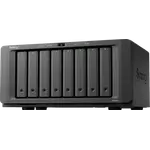
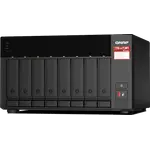
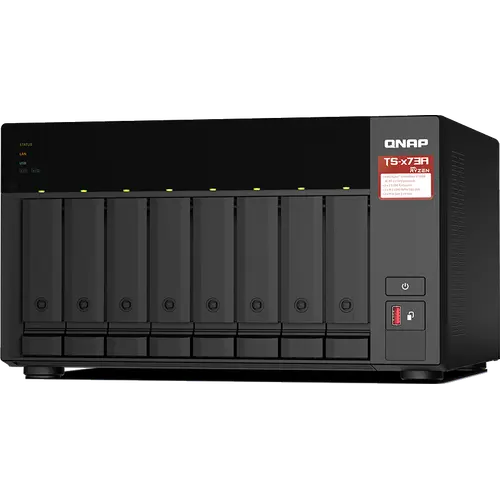
The QNAP TS-873A-8G is an eight-bay tower NAS for buyers who want a lot of local storage and room to grow. An AMD Ryzen Embedded V1500B quad-core, eight hot-swappable bays, two M.2 NVMe slots, two PCIe Gen 3 x4 slots and dual 2.5GbE give it headroom for containers, virtual machines and a media library, and it can switch from QTS to ZFS-based QuTS hero. The main trade-off is that the Ryzen chip has no integrated graphics, so there is no hardware video transcoding without an add-in card, and there is no built-in 10GbE or HDMI.
- Home labs and small offices
- Large media and backup libraries
- Virtualization and containers
- ZFS and expansion seekers
Pros
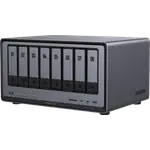
- Eight hot-swappable 3.5-inch bays, enough for RAID 5 or RAID 6
- AMD Ryzen Embedded V1500B quad-core x86 with AES-NI encryption
- Two SO-DIMM DDR4 slots, 8 GB preinstalled and up to 64 GB with ECC support
- Two M.2 2280 NVMe slots for cache, Qtier tiering or an SSD storage pool
- Two PCIe Gen 3 x4 slots for 5GbE/10GbE, QM2 or a graphics card
- Dual 2.5GbE with port trunking across seven modes
- Runs Docker and LXC containers, virtual machines, Plex and QVR surveillance
- Choice of QTS (ext4) or ZFS-based QuTS hero with block-based snapshots
- Three-year warranty and a relatively quiet 23 dB(A) tower
Cons
- No integrated GPU, so no hardware video transcoding without an add-in card
- No built-in 10GbE; the two 2.5GbE ports are the only network ports
- No HDMI, USB4/Thunderbolt or SD card slot
- No hybrid RAID for mixing different drive sizes
- Shipped memory is one 8 GB module, so dual-channel needs a second matching module
- QTS formats internal drives as EXT4; ZFS needs the QuTS hero edition
Who is the QNAP TS-873A-8G for?
This is a tower NAS aimed at the buyer whose storage needs go past a couple of drives. Eight 3.5-inch bays leave plenty of room for a large archive protected by RAID 5 or RAID 6, and because all eight are hot-swappable a failed drive can be swapped without powering the unit down. The x86-64 platform, two memory slots and two PCIe Gen 3 x4 slots make it a reasonable host for containers, virtual machines and a surveillance recorder, while the pair of 2.5GbE ports keeps transfers ahead of Gigabit. If you only need a shared folder and a backup target, this is more machine than the job requires.
What the QNAP TS-873A-8G offers
The headline is expandability. Eight 3.5-inch SATA bays can hold 3.5-inch hard drives or 2.5-inch SATA SSDs, all hot-swappable, and the two M.2 2280 PCIe Gen 3 x1 slots can act as a read or write cache, as Qtier auto-tiering storage, or as an SSD storage pool. Processing comes from an AMD Ryzen Embedded V1500B quad-core with eight threads at 2.2 GHz and the AES-NI encryption engine, paired with 8 GB of DDR4 in one of two SO-DIMM slots that accept up to 64 GB and support ECC memory. Networking is two 2.5GbE RJ45 ports with port trunking across seven modes, and the two PCIe Gen 3 x4 slots take 5GbE or 10GbE network cards, QM2 M.2 cards or a graphics card. On the software side the NAS ships with QTS, which runs Docker and LXC containers through Container Station, virtual machines through Virtualization Station, Plex Media Server and QVR surveillance with eight free camera channels, and it can be switched to ZFS-based QuTS hero for checksums and block-based snapshots. Remote access, DDNS, a VPN server, cloud sync and PC backup are all built in, and the unit carries a three-year warranty.
What to know before you buy
The clearest limitation is video transcoding. The Ryzen Embedded V1500B has no integrated graphics and the chassis has no built-in video output, so the NAS does not convert video in hardware for Plex or Jellyfin unless you add a supported PCIe graphics card. There is also no built-in 10GbE: the two 2.5GbE ports are what you get out of the box, and 10GbE needs a network card in one of the PCIe slots. Rounding out the omissions, there is no HDMI port, no USB4 or Thunderbolt and no SD card slot, and QTS formats internal drives as EXT4, so ZFS requires re-initializing the system with QuTS hero. The single 8 GB module also means memory runs in single-channel until a second matching module is added, and the tower is a large, heavy unit that draws around 54 W with the drives populated.
Is the QNAP TS-873A-8G worth it?
It is worth it if you expect to fill the bays and grow. For the money you get eight hot-swappable drives, a capable x86 processor with hardware encryption, ECC-capable memory up to 64 GB, two NVMe slots, two PCIe slots and dual 2.5GbE, plus the choice of QTS or ZFS-based QuTS hero, containers, virtual machines, Plex and a surveillance recorder on one box. That combination is what keeps a NAS useful for years without a migration. If you want something compact, quiet and cheap, or you rely on hardware video transcoding, a smaller Celeron or Core model will suit you better.
Frequently asked questions
How many drive bays does the QNAP TS-873A-8G have?
Eight 3.5-inch SATA bays that also take 2.5-inch SATA SSDs, all hot-swappable, plus two internal M.2 2280 NVMe slots. It ships without drives.
Does the QNAP TS-873A-8G have 10GbE networking?
No, not built in. It ships with two 2.5GbE RJ45 ports that support port trunking; 5GbE or 10GbE requires a network card in one of the two PCIe Gen 3 x4 slots.
Can you upgrade the memory on the QNAP TS-873A-8G?
Yes. It arrives with 8 GB of DDR4 in one of two SO-DIMM slots and QNAP rates it for up to 64 GB using two 32 GB modules. ECC memory is supported.
Does the QNAP TS-873A-8G support ZFS?
Yes, by switching the system to the QuTS hero operating system, which brings ZFS, end-to-end checksums and block-based snapshots. As shipped it uses QTS, which formats internal drives as EXT4.
Can the QNAP TS-873A-8G transcode video in hardware?
No. The AMD Ryzen Embedded V1500B has no integrated graphics and the unit has no built-in video output, so hardware transcoding for Plex or Jellyfin would need an optional PCIe graphics card.
Can the QNAP TS-873A-8G run Docker and virtual machines?
Yes. Container Station runs Docker and LXC/LXD containers, and Virtualization Station runs Windows, Linux, Unix and Android guests; Virtualization Station needs at least 4 GB of memory, which this model exceeds out of the box.