



UGREEN NASync DXP480T Plus Review: All-Flash, No Spinning Disks
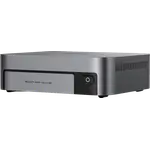
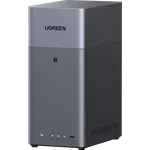
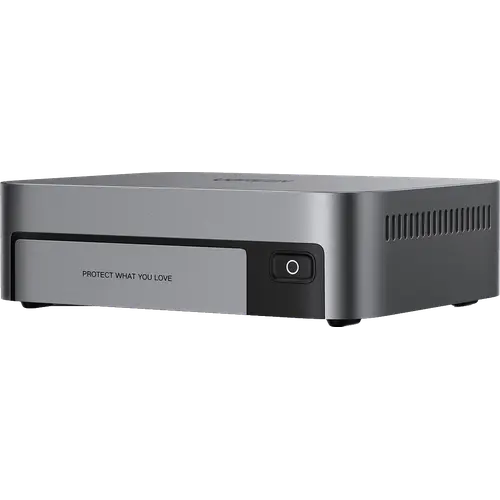
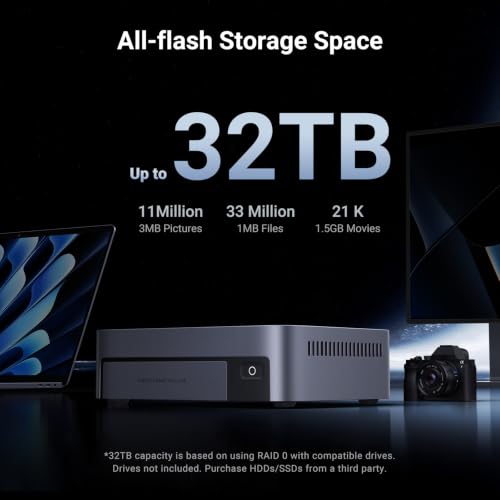
The DXP480T Plus is the odd one out: an all-flash NAS with four M.2 NVMe slots and no hard drive bays at all. A Core i5-1235U, 8 GB DDR5 to 64 GB, a 10 GbE port, two Thunderbolt 4 ports and 8K HDMI, in a box roughly seven inches across. Capacity is the trade: 32 TB maximum, against 144 TB for a four-bay.
- Silent operation
- Video editing
- Thunderbolt workflows
- Small spaces
- Speed over capacity
Pros
- Four M.2 NVMe slots, completely silent
- Two Thunderbolt 4 ports at 40 Gbps
- 10 GbE networking
- Only 23.14 W under access
- Memory to 64 GB DDR5
- RAID 5 and RAID 6 across the flash
Cons
- 32 TB maximum capacity
- No SATA bays at all
- NVMe is far costlier per terabyte
- No SD card slot
- Noise, weight and dimensions not fully published
Who is the DXP480T Plus for?
Editors and anyone who wants a completely silent, very fast NAS on a desk. With no mechanical drives there is no seek noise and no vibration at all.
What the DXP480T Plus offers
Four M.2 NVMe slots to 32 TB, an Intel Core i5-1235U (10 cores), 8 GB DDR5 expandable to 64 GB, one 10 GbE port, two Thunderbolt 4 ports at 40 Gbps, 8K HDMI, RAID 0/1/5/6/10, and UGOS Pro with Docker and virtual machines. It draws only 23.14 W.
What to know before you buy
Thirty-two terabytes is the ceiling, and NVMe costs far more per terabyte than hard drives, so this is an expensive way to store bulk data. There is no SD card slot and no SATA bay to fall back on.
Is the DXP480T Plus worth it?
For a fast scratch and project volume it is genuinely appealing, and the Thunderbolt ports let a laptop bypass the network entirely. As a household archive it is the wrong shape: pair it with a bay-based NAS rather than replacing one.
Frequently asked questions
Why buy an all-flash NAS?
Silence, speed and size. There is nothing to spin up, random access is far quicker than any hard drive array, and the whole unit is smaller than a shoebox. You pay for it in cost per terabyte.
What do the Thunderbolt ports do?
They allow a direct 40 Gbps link from a computer to the NAS, bypassing the network entirely. For moving a large video project that is considerably faster than even 10 GbE.