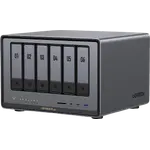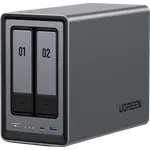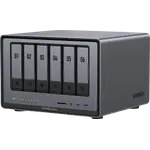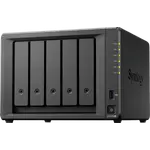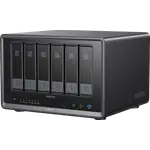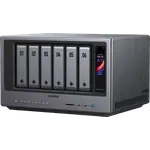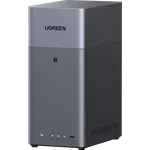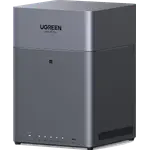





UGREEN NASync DXP6800 Ultra Review: A Ten-Core Six-Bay Built for Small Teams
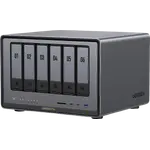
The NASync DXP6800 Ultra is UGREEN's answer to the small studio that has outgrown a four-bay box. Six SATA bays and two M.2 slots reach 208 TB raw, the ten-core Core 5 120U carries Docker containers and virtual machines at the same time, and the pairing of dual 10GbE with two Thunderbolt 4 ports means the network and a directly attached workstation can both run at full speed. It is priced as a premium machine and the software, not the hardware, is where it asks for patience.
- Small teams
- Video editing
- Thunderbolt workflows
- Virtualization
- RAID 6
Pros
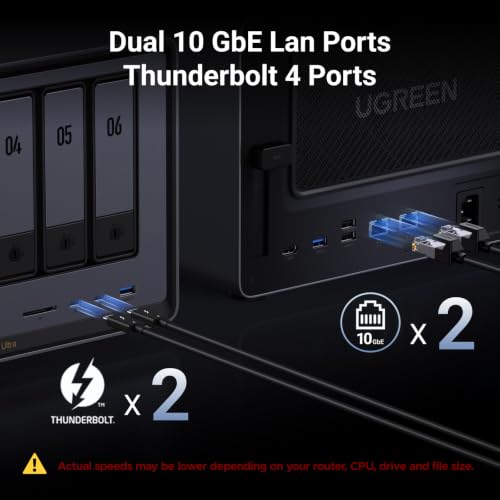
- Two 10GbE ports that aggregate to 20G
- Two Thunderbolt 4 ports at 40Gb/s
- Ten-core processor with Quick Sync hardware transcoding
- Memory expandable to 96 GB across two DDR5 slots
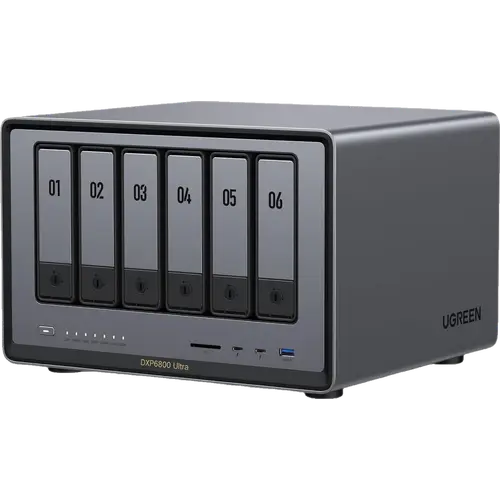
- Six hot-swappable bays plus two M.2 slots, 208 TB raw
- PCIe Gen4 x4 slot, 8K HDMI and an SD 4.0 reader
- RAID 6, Btrfs volumes and snapshots
- Docker, virtual machines and SAN Manager block storage
- Three-year warranty
Cons
- No VPN server in UGOS Pro
- ODECC rather than full ECC with system-level error reporting
- No flexible mixed-drive RAID mode and no ZFS
- No expansion enclosure available
- Plex runs only through Docker
- No one-touch USB copy
- Noise level not published
Who is the NASync DXP6800 Ultra for?
Six bays plus RAID 6 is the point at which a NAS stops being a file share and starts being infrastructure: two drives can fail before the array does. Add the ten-core processor, 96 GB of headroom and a PCIe Gen4 x4 slot, and this is a machine for a production team, a photo or video studio, or a home lab that wants its containers, its virtual machines and its media library on one box instead of three. The dual 10GbE is only worth paying for if there is a 10GbE switch behind it, and the Thunderbolt 4 ports are the escape hatch when there is not.
What the NASync DXP6800 Ultra offers
Storage runs to 208 TB raw across six hot-swappable SATA bays and two M.2 NVMe slots, and UGOS Pro can turn those M.2 slots into their own SSD storage pool rather than only a cache. The Core 5 120U brings Intel Quick Sync, which is what makes hardware transcoding and the 8K HDMI output work, plus AES New Instructions for encryption that does not tax the CPU. Networking is two 10GbE ports that aggregate to 20G, and the front panel adds two Thunderbolt 4 ports at 40Gb/s, an SD 4.0 UHS-II reader and USB-A. On the software side UGOS Pro covers Btrfs volumes with snapshots, SAN Manager for block storage, NFS and rsync, Docker, a Virtual Machine Manager, Surveillance Center, local AI photo recognition, Time Machine backups, UPS handling, Wake on LAN and scheduled power cycles. UGREEN backs it with a three-year warranty.
What to know before you buy
The ECC on the spec sheet is ODECC, on-die ECC, which protects the memory chip internally and does not report corrected errors back to the system the way a Xeon-class NAS does. There is no VPN server in UGOS Pro, so remote access means UGREENlink, DDNS with port forwarding, or running Tailscale or WireGuard yourself in a container. Plex is a Docker install rather than an App Center package. There is no flexible mixed-drive RAID mode and no ZFS, so drives of different sizes waste space, and UGREEN publishes no expansion enclosure: growth beyond six bays goes through the PCIe slot or a second unit. UGREEN also does not publish a noise figure, and two 90 mm fans over six spinning drives is not a bedroom appliance.
Is the NASync DXP6800 Ultra worth it?
On hardware it is hard to argue with: dual 10GbE, Thunderbolt 4, PCIe Gen4 expansion, DDR5 to 96 GB and hardware transcoding in one desktop chassis is a specification list the established NAS brands charge considerably more for, or simply do not offer. The counterweight is UGOS Pro, which is years younger than DSM and still has visible gaps, the VPN server being the clearest. If the plan is to run the machine as a fast file and media server with containers on top, the value is real. If the plan depends on a mature app ecosystem, look at what is missing before committing.
Frequently asked questions
How does the DXP6800 Ultra differ from the DXP6800 Pro?
Same six-bay layout, different platform. The Ultra runs an Intel Core 5 120U and takes up to 96 GB of DDR5, where the Pro uses a Core i5-1235U and stops at 64 GB. Both offer dual 10GbE and Thunderbolt 4, so the Ultra is the one to pick when memory headroom and processor generation matter.
Can the DXP6800 Ultra run Plex?
Yes, through Docker. UGREEN documents Plex Media Server on all DXP series models as a container, and the Core 5 120U provides Intel Quick Sync for hardware transcoding inside it. There is no dedicated Plex package in the UGOS Pro App Center.
Does it support virtual machines and containers?
Both. UGOS Pro ships a Virtual Machine Manager and Docker is installed from the App Center, and the ten-core processor plus up to 96 GB of memory is enough to run several of each alongside the file services.
Is there a built-in VPN server?
No. UGOS Pro publishes no VPN server app. UGREEN's own remote access guidance covers UGREENlink, its built-in relay reached through a ug.link address, and DDNS with router-side port forwarding; anything beyond that means running Tailscale or WireGuard yourself in a container.
How much storage can it actually hold?
UGREEN rates it at 208 TB raw, counting six 32 TB SATA drives plus two 8 TB M.2 SSDs. That is before redundancy: in RAID 6 across the six bays you give up two drives' worth of capacity to parity.
Is the ECC support the same as on a business NAS?
Not quite. The spec sheet lists ODECC, which is on-die ECC built into the DDR5 chips themselves. It corrects errors inside the memory module but does not report them to the operating system, so it is a lesser protection than the registered ECC found on Xeon-based enclosures.