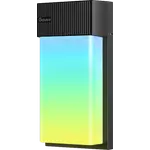
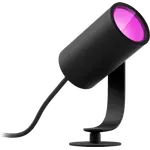
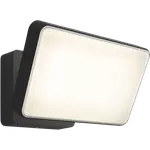
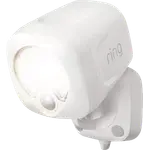
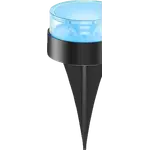
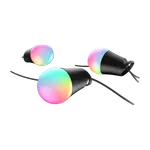
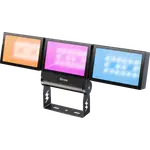
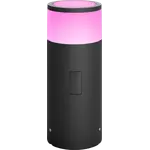
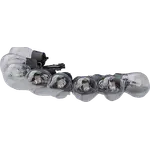
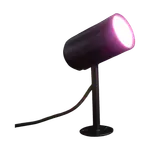
Smart outdoor lights cover six very different jobs under one name: a spotlight aimed up at a tree or a facade, a pathway or bollard light that marks a safe walk after dark, a floodlight bought for coverage and motion sensing, a wall-mounted sconce by a door, a deck or ground light set flush into a surface people actually step on, and a string or globe light strung over a patio for ambience. Picking the right one starts with naming the job, because a fixture built for one of these six reads as either overkill or underpowered on any of the others.
Match the fixture to the job
A Fixture Type built for security (a floodlight or a motion-triggered spotlight) is judged on coverage and on how reliably its sensor catches movement. A Fixture Type built for ambience (string lights, colour spotlights, deck lights) is judged on how good it looks, not on lumens. Buying a 4,500-lumen floodlight to light a patio for dinner is as wrong as buying a decorative string to watch a driveway: check the job before the spec sheet.
Brightness and colour
Maximum Brightness is stated in lumens, for the whole fixture or the whole kit when it ships several heads. As a rough guide: a security floodlight wants 1,500 lumens or more to light a driveway or a backyard; a pathway or bollard light does its job well under 600; a decorative spotlight or string of bulbs can run far dimmer, since it is not meant to be looked at directly. Color (full RGB, not just white) and Dedicated White LEDs mostly separate fixtures bought for a look from fixtures bought to be plain and reliable: a security light that only needs to turn on, full white, every night, gains little from RGB and loses the steadier, cheaper white output of a dedicated-white design. Color Temperature matters even on white-only fixtures: warm white around 2700K reads as ambience, while a floodlight closer to 5000K reads as a neutral, utilitarian security light. Addressable Zones let a multi-head floodlight or a string of bulbs run a different colour on each lamp or segment instead of washing everything in one flat tone, which is what makes a Govee or LIFX string look animated instead of simply colored.
Power: what the yard allows
Power Source is the decision that limits every other choice, because it decides where a fixture can physically go. A plug-in or hardwired light, the way Philips Hue Discover works, needs an outlet or a line run to the spot, which is non-negotiable for a floodlight that has to stay on for hours. A low-voltage wired kit, the way Philips Hue Lily, Calla and LIFX's garden lights work, runs a buried cable from one transformer to several fixtures, so one purchase can light a whole garden, but it needs that transformer and some digging or a cable channel. Battery fixtures, like Ring's battery Smart Lighting line, go anywhere a stake fits, at the cost of swapping D-cells every few months. Solar fixtures need no wiring at all and are the easiest to install, but their output drops on a run of cloudy days and depends on how exposed the panel is to direct sun. None of these is universally better: a driveway floodlight that cannot afford to go dark belongs on mains power, while a string of lights around a fence that moves every summer belongs on solar or battery.
Tied to power is Power Consumption, in watts, which is what a transformer, an extension cord or a smart plug in front of the fixture has to handle, and Rechargeable Battery, which tells a solar or battery fixture that recharges itself apart from one that needs disposable batteries bought and replaced by hand.
Weatherproofing: the one spec every outdoor fixture states
Every smart outdoor light carries a Weather Resistance rating, but how high it needs to be depends on where it sits. A wall sconce tucked under an eave, out of direct rain, can get by on IP44. A spotlight or pathway light staked into a flower bed, splashed by sprinklers and rained on directly, wants IP65 or better. A deck or ground light set flush into a surface people walk and spill drinks on needs the highest ratings in the category, IP66 or IP67, the same tier a Light Strips buyer looks for in a permanent outdoor track. Read the two digits: the first is dust and solids, the second is water, and a fixture that only states one half of the rating is not fully tested for the other.
Kit size and growing the system later
Many garden spotlight and pathway kits, like the Philips Hue Lily and Calla lines, are sold as a base kit: a transformer plus a handful of fixtures (Fixtures per Kit), meant to be extended later with more heads on the same controller (Extendable). Buying the base kit without checking how many spots the yard actually needs, or whether extension fixtures are sold separately and compatible, is the most common overspend in this category. String and globe lights instead state a String Length, the run of cable as it ships; most cannot be cut to fit, and only some brands sell extension strings, so measure the fence, deck rail or patio perimeter first.
Motion sensing, for the fixtures that need it
A Motion Sensor is what turns a decorative fixture into a security one: the light switches on, or jumps to full brightness, when it detects movement nearby instead of running on a plain schedule. It is the single most reviewed feature on floodlights and spotlights bought for a driveway or a backyard, and the detail that matters is the sensor's real range and field of view, not just that one exists on the spec sheet. A pathway, deck or string light rarely has one, and does not need it.
Smart home fit
The Connectivity and Integrations blocks work the same way they do across the rest of the catalog: check whether a fixture needs its own hub (a Hue Bridge for Philips Hue, a Ring Bridge for Ring's battery Smart Lighting) before assuming it will show up in Google Home, Alexa, Apple HomeKit or Matter out of the box. A fixture that depends on the brand's bridge is still a fair buy, the same way a Door Locks or Cameras purchase often depends on one, as long as that bridge is part of the budget. Outdoor lights sit next to LED Bulbs, Lamps and Light Strips as the catalog's lighting categories; the difference with all three is simply that every fixture here is built, and rated, to live outside.