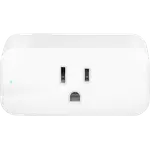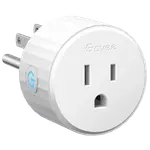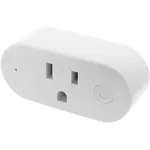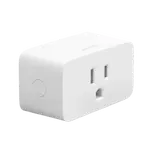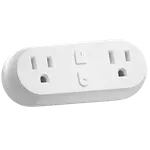
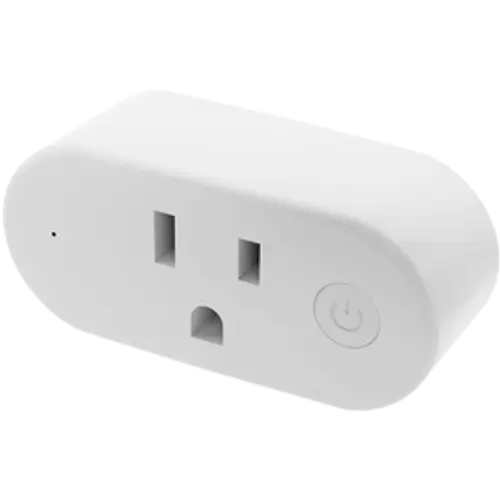



Shelly Smart Plug (US) Review: A Scriptable Power Monitor for Home Labs and Automations
The Shelly Smart Plug (US) is aimed at buyers who want to script and monitor a single high-power outlet, not just flip it on and off. Owners use it to track energy draw on pool pumps and grow lights, integrate it into Home Assistant, and build custom automations through its open API. Feedback is strongly positive on reliability under sustained heavy loads and on how much control the Shelly app and API expose, with a couple of owners flagging measurement drift versus a meter and a networking quirk where it can lose local reachability without an internet route. For hands-on smart home users who want deep integration over Zigbee support, it delivers a lot for the price.
- Home Assistant users
- Home-lab and DIY automation enthusiasts
- Energy-usage trackers
- High-wattage appliance control
Pros
- Real-time and historical energy monitoring
- Handles sustained high-wattage loads reliably
- Strong Home Assistant integration
- Open API, WebSocket and MQTT support for custom automations
- Built-in countdown timer and scheduling
Cons
- No Zigbee support
- Energy readings can drift from a lab meter's actual values
- Can lose local network reachability without an active internet route
- No USB charging ports
- Not weather-resistant, indoor use only
Who is the Shelly Smart Plug (US) for?
This plug is built for people who want to do more than remote on/off control. Owners use it to monitor and control pool pump power draw, keep tabs on grow-light setups pulling well over a thousand watts, measure home-lab equipment consumption, and script automations that reboot a router when connectivity drops. Its open API, WebSocket and MQTT support make it a favorite for anyone comfortable writing their own scripts or wiring it into Home Assistant.
What buyers love
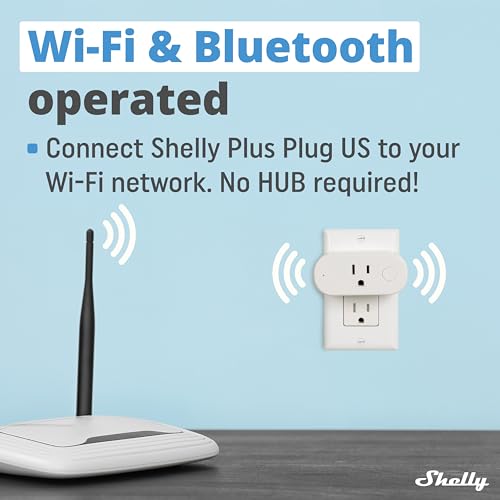
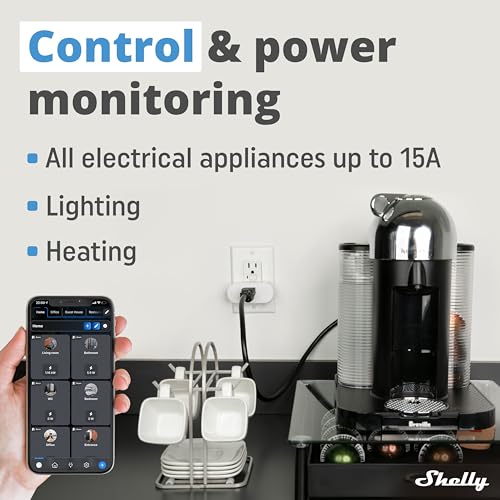
The most repeated praise is for the plug's energy monitoring, which owners use to track daily consumption, catch abnormal loads, and cut electricity costs, matching its supported energy-monitoring feature. Reviewers also highlight smooth Home Assistant integration, an integrated countdown timer for scheduled actions, and reliable performance even under sustained loads close to the plug's 1800W/15A rating. The breadth of connectivity options (Wi-Fi, Bluetooth, WebSocket, MQTT) and an open API for custom scripting come up repeatedly as reasons buyers prefer it over other smart plugs.
What to know before you buy
This model does not support Zigbee (Shelly sells separate models for that), so buyers wanting a Zigbee mesh device should look elsewhere in the lineup. One experienced reviewer who cross-checked readings against a meter found the reported voltage and current ran meaningfully higher than actual, so treat the in-app energy figures as a useful trend indicator rather than lab-grade precision. Another owner reported that the plug can lose local network reachability entirely when the internet route is down, even though other devices on the same Wi-Fi network stay reachable, which matters if you plan to control it purely over LAN during an outage. It also lacks USB charging ports and weather resistance, so it is an indoor-only, single-purpose plug.
Is the Shelly Smart Plug (US) worth it?
With a 1800W/15A load rating, overheat and overload protection, real energy monitoring, and integrations with Google Home, Alexa and Home Assistant, this plug is aimed squarely at automation-minded buyers rather than casual users. Sentiment from owners skews heavily positive, particularly among home-lab and DIY automation users who value its open API and scripting flexibility, making it a strong value pick for anyone who wants a plug that plays well with a broader smart home setup.
Frequently asked questions
Does the Shelly Smart Plug (US) support Zigbee?
No, this model does not support Zigbee. It connects over 2.4GHz Wi-Fi and Bluetooth.
Does it work with Home Assistant?
Yes, it integrates well with Home Assistant and also supports Google Home and Alexa.
Can it monitor energy usage accurately?
It includes real-time energy monitoring that is useful for tracking consumption trends, though at least one owner found its readings ran higher than a lab meter's actual measurements.
Does it work without an internet connection?
It can run local schedules, but one owner reported that without an active internet route, the plug can become unreachable even over the local Wi-Fi network, unlike some other smart home devices.
What is the maximum load it can handle?
It is rated for up to 1800W and 15A, with overheat and overload protection built in.