NodOn Zigbee Thermostatic Radiator Valve Review: A Local-First TRV With No App or Subscription
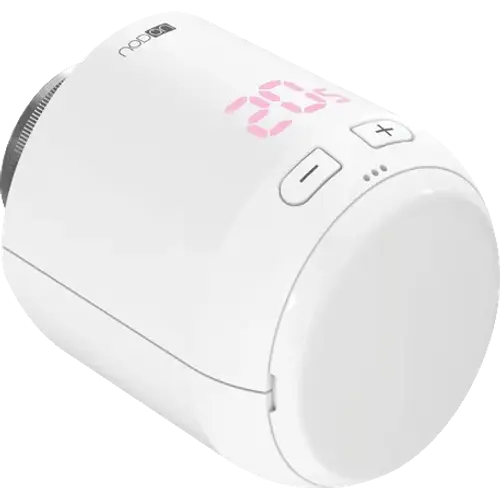
The NodOn Zigbee Thermostatic Radiator Valve (TRV-4-1-00) replaces a manual radiator head with a Zigbee 3.0 one that takes its orders from whatever coordinator you already run, with no NodOn app and no subscription. It covers the essentials well: an 8-28 degrees Celsius control range on the standard M30 x 1.5 mm thread, Danfoss RA, RAV and RAVL adapters in the box, open-window detection, a key lock, Boost and Off modes, over-the-air updates and Home Assistant support through Zigbee2MQTT or ZHA. The trade-off is that it is a plain end device: without a Zigbee coordinator it does nothing, it has no Matter or Apple Home path, and it does no schedule learning of its own, so the routines have to come from your hub. At the budget end of the category it is a sensible per-room pick for a home that is already on Zigbee.
- Zigbee and Home Assistant homes
- Room-by-room heating control
- No-subscription, local control
- Radiators with Danfoss fittings
One valve per radiator.
Buy on Amazon ItalyCheck pricePros
- Certified Zigbee 3.0 (2.4 GHz, +8 dBm) with no app, account or subscription
- Works with Home Assistant through Zigbee2MQTT or ZHA, and with Alexa and SmartThings
- Standard M30 x 1.5 mm thread with Danfoss RA, RAV and RAVL adapters included
- Open-window detection, a key lock, and Boost and Off modes on the device
- Built-in temperature sensor with a calibration offset, exposed to the hub
- Over-the-air firmware updates through the coordinator
- Two year warranty
Cons
- Needs a Zigbee coordinator; it has no Wi-Fi or Bluetooth and does not work alone
- No Matter and no Apple Home path
- No schedule learning or AI suggestions, the routines live in your hub
- No external temperature sensor is documented for this model
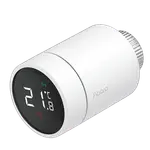
- The small segment display is limited next to pricier valves
- Runs on two AA batteries, rated for around two years
Who is the NodOn Zigbee Thermostatic Radiator Valve for?
This valve suits a home that already runs a Zigbee coordinator, whether that is a Home Assistant stick on ZHA or Zigbee2MQTT, a SmartThings hub, an Amazon Echo with a Zigbee radio, or one of the other gateways NodOn lists. It replaces the manual head on a radiator with the standard M30 x 1.5 mm thread and turns that radiator into its own heating zone, so each room follows its own setpoint instead of one thermostat deciding for the whole house. The three Danfoss adapters in the box (RA, RAV and RAVL) cover most European and UK fittings, and the valve must be paired to the network and calibrated once before it goes on the radiator.
What the valve offers
The basics are well covered. The head speaks Zigbee 3.0 at 2.4 GHz with a maximum radio power of +8 dBm and a 30 metre indoor range, it measures room temperature itself and exposes that reading to the hub, and it carries a local temperature calibration offset for the case where the radiator air reads warmer than the room. On the device there is a key lock that disables the buttons, open-window detection so the valve closes when a window is left open, Boost and Off modes reachable from the buttons, and over-the-air updates through the coordinator. Power comes from two AA/LR6 cells, rated for about two years, and NodOn backs the head with a two year warranty.
What to know before you buy
This is a Zigbee end device, so it does nothing on its own: it has no Wi-Fi, no Bluetooth and no app, and it needs a coordinator or gateway hosting a Zigbee network before it can be controlled. It is also a plain valve rather than a smart thermostat platform. There is no Matter radio and no Apple Home path, no schedule learning and no AI suggestions, so weekly programs and geofencing have to be built as automations in your hub from the entities the valve exposes. No external temperature sensor is documented for this model, the display is a small segment panel rather than a colour screen, and the anti-freeze behaviour of pricier heads is not a documented mode here.
Is the NodOn Zigbee Thermostatic Radiator Valve worth it?
For a Zigbee household it is good value. You get a certified Zigbee 3.0 valve with the standard thread and the three Danfoss adapters included, open-window detection, a key lock, Boost and Off modes, OTA updates and clean Home Assistant support through Zigbee2MQTT or ZHA, all with no proprietary app and no ongoing fee. What you give up against a flagship valve is polish and autonomy: a small segment display instead of a colour screen, no learning, no Matter or Apple Home, and a hub in the chain for every routine. If you already run a Zigbee network and want per-room control on a budget, this is a solid choice; if you want a self-contained thermostat with its own app, look elsewhere.
Frequently asked questions
Does the NodOn Zigbee Thermostatic Radiator Valve need a hub?
Yes. It is a Zigbee 3.0 end device with no Wi-Fi or Bluetooth, so it joins an existing Zigbee network and needs a compatible coordinator or gateway. NodOn lists Home Assistant, Jeedom, Zigbee2MQTT, WiziNote, Energeasy Connect, Otodo, Alexa, Edalso and Homey for this model.
Does it work with Home Assistant?
Yes. Zigbee2MQTT publishes a device page for the TRV-4-1-00, exposing child lock, climate, battery, valve position and the display controls, and the valve also pairs through ZHA as a climate entity with battery, heating-demand and setpoint-limit entities.
Will it fit my radiator?
It mounts on the standard M30 x 1.5 mm valve thread, and Danfoss RA, RAV and RAVL adapters are supplied in the box. When using the Danfoss RAV adapter, the RAV pin has to be inserted on the valve piston.
Does it need an app or a subscription?
No. There is no NodOn app and no ongoing fee: the valve is controlled from your Zigbee coordinator, and scheduling and other routines are built as automations in that platform.
Does it work with Apple Home or Matter?
No. The radio is Zigbee 3.0 only, with no Matter certification and no Apple Home path. Alexa and Samsung SmartThings are supported, along with Home Assistant.
How long do the batteries last?
NodOn rates the two AA/LR6 cells at a two year lifespan. The valve must be recalibrated each time the batteries are replaced, and rechargeable cells are not recommended.



![Bosch Smart radiator thermostat II [+M]](/img/item-types/radiator-valves/bosch-smart-radiator-thermostat-2-thumb.webp)