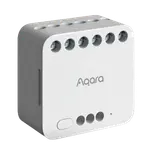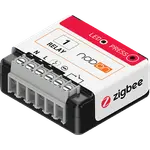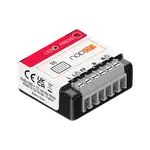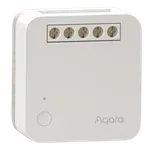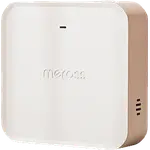
Meross Matter Smart DIY Switch Review: A 16A Relay That Disappears Into the Wiring
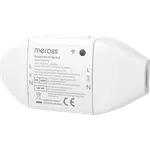
The Meross Matter Smart DIY Switch (MSS715MA) is a concealed relay for people who want to keep the light fitting, the wall plate and the appliance they already own and simply make the circuit smart. It is rated 16A and 3800W at 100-240V, which is unusually generous for a module this size and puts water heaters, ovens and electric heating inside its remit, and it measures what that circuit draws so the app can turn the switching into a running cost. Because it speaks Matter over 2.4GHz Wi-Fi, it lands in Apple Home, Alexa, Google Home, SmartThings and Home Assistant without a Meross bridge sitting in between, which is the single thing owners of the older non-Matter modules mention most often as the upgrade. The trade-offs are physical rather than functional: a tight terminal block with no pass-through for the earth conductor, and a scattering of reports about units giving up after a few months.
- Retrofitting existing wiring
- High-draw appliances
- Matter-first smart homes
- Per-circuit energy tracking
- Budget buyers
Pros
- Hides inside a junction box, ceiling rose or appliance, so the existing fittings stay
- 16A and 3800W at 100-240V, enough for water heaters, ovens and electric heating
- Matter over Wi-Fi brings it into Apple Home, Alexa, Google Home, SmartThings and Home Assistant with no Meross bridge in between
- Live power plus consumption history and cost estimates in the Meross app
- Setup is consistently described as quick, and owners report it holding a weak Wi-Fi signal
- Near-instant response to voice commands, according to owners
- Schedules, countdowns and sunrise or sunset routines that keep running while the network is offline
- Physical On/Off button and a status LED on the module itself
- Overheat protection and a PC V0 flame-retardant housing
- Over-the-air firmware updates from the Meross app
- Two-year manufacturer warranty, and owners describe replacements being sent without argument
Cons
- Small, closely spaced terminals with no pass-through for the earth conductor
- The lids do not close flush when the body is screwed down from the front
- Commissioning needs a Matter controller already in the home, and some owners found that step fiddly
- The energy readings are only in the Meross app; a Matter controller sees a plain on/off switch
- One owner measured no consumption reported below roughly 10 W
- Scattered reports of units failing after some weeks or months of use
- One owner reported overheating within 15 minutes on a 13A immersion heater
- Requires a neutral wire, so older two-wire boxes are out
- Switches the live wire only, with no potential-free dry contact for low-voltage circuits
- Single channel, so no interlock for a two-direction motor
- 2.4GHz Wi-Fi only, with no 5GHz band and no Zigbee, Thread or Z-Wave radio to extend a mesh
- Meross publishes no inductive or capacitive load ratings, no standby consumption and no weight
Who is the Meross Matter Smart DIY Switch for?
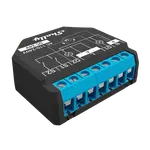
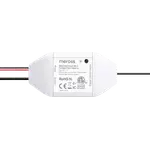
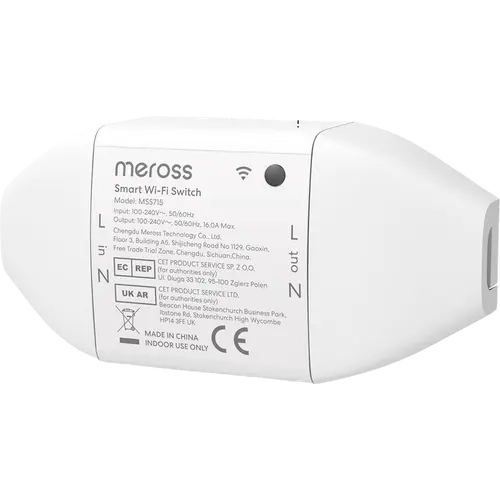
This is a module, not a switch you look at. At 96 x 47 x 24 mm it is meant to sit inside a junction box, a ceiling rose or the appliance's own housing, wired between the incoming supply and the load, so the room keeps the fittings it already has and gains app, voice and schedule control on top. The input block carries L, S in and N and the output block carries L out and N, so a neutral has to be present in the box: that is the compatibility question to settle before ordering. The other half of its audience is anyone who wants a number on a circuit. The metering reports live power and keeps consumption history in the Meross app, which is the difference between knowing an immersion heater is on and knowing what it costs to leave it on. Buyers describe using it for attic and ceiling lighting, a dining room chandelier, outdoor and gate lighting, table lamps and water heating, which is a fair map of what a single 16A channel is good for.
What buyers love
Two themes dominate. The first is that it is discreet: owners repeatedly frame it as a way to add smart control to equipment they did not want to replace, tucked out of sight rather than swapped in. The second is setup. Pairing is described as quick and untroubled, and several people who had previously bought cheaper modules from other brands single out the fact that this one needed no vendor gateway of its own, because the Matter commissioning uses the speaker or hub already in the house. Response time gets specific praise too, with owners noting the relay reacts almost instantly to a voice command, and more than one mentions it staying connected where the Wi-Fi signal is weak. Apple Home users are notably positive about how cleanly it slots in. When something has gone wrong, the recurring note is that Meross support answered quickly and replaced the unit.
What to know before you buy
The wiring end is where the criticism concentrates. The terminals are small and set close together, the cable entry sits near them, and there is no pass-through terminal for the earth conductor, so an installer running 2.5mm flex to an immersion heater has to be deliberate about stray strands and equal wire lengths. The lids also do not close flush if the body is screwed to a surface from the front, since it is designed to be closed from behind. On the software side, the metering lives in the Meross app: a Matter controller presents the device as a plain on/off switch, so automations built purely in Apple Home or Alexa will not see the power figures, and one owner measured nothing at all below roughly 10 W. There are scattered but real reliability complaints, from units that stopped responding after some weeks to one pair that never actually interrupted the circuit, and one owner reported the module overheating within a quarter of an hour on a 13A immersion heater despite the 16A rating, so a continuous high-current load deserves a conservative margin. Finally, the radio is 2.4GHz Wi-Fi only, and Meross publishes no inductive or capacitive load ratings, no standby figure and no weight.
Is the Meross Matter Smart DIY Switch worth it?
For a budget-tier module the specification is dense: 16A and 3800W of switching, metering, a physical button, overheat protection behind a PC V0 flame-retardant shell, over-the-air firmware updates and a two-year warranty, all in a body small enough to bury in a back box. Compared with a plain smart relay, the metering and the Matter commissioning are what you are paying the difference for, and both do the job owners expect. It is the wrong pick when the circuit needs a potential-free dry contact, two independent channels, an interlock for a motor, a DIN rail or a box without a neutral, and it is worth being cautious about parking it on a permanently loaded 16A appliance. Within its intended job, quietly retrofitting a wired circuit and telling you what that circuit costs, it is one of the better-equipped modules at the price.
Frequently asked questions
Does the Meross Matter Smart DIY Switch need a neutral wire?
Yes. The input block carries L, S in and N, and the listing states plainly that a neutral is required. A switch box wired with only a live loop will not work, so check the box before ordering.
Does the Meross Matter Smart DIY Switch need a hub?
It needs no Meross bridge of its own. It joins the house on 2.4GHz Wi-Fi and commissions into a Matter fabric, so the hub it does rely on is a Matter controller you most likely already own: a HomePod, an Apple TV, an Echo, a Google Nest speaker, a SmartThings hub or a Home Assistant install. Owners who had previously bought other budget relays single this out, because those needed a vendor gateway and this one does not.
How much load can it switch?
It is rated 16A and 3800W at 100-240V, 50/60Hz, and Meross positions it for high-draw resistive appliances such as water heaters, ovens, electric heaters and underfloor heating. Separate inductive and capacitive ratings are not published, so motors, transformers and LED drivers should be sized conservatively, and at least one owner reported the module running hot on a sustained 13A immersion heater load.
Where do the energy readings show up?
In the Meross app, which reports live power alongside consumption history and cost estimates. A Matter controller presents the module as a plain on/off switch, so automations written entirely in Apple Home or Alexa work from the switch state rather than the power figure. One owner also found that draws under roughly 10 W register as zero.
Does it work with Apple Home, Alexa, Google Home and Home Assistant?
Yes, all of them, and with SmartThings too. Matter is what carries it there, and because Matter is multi-admin the same module can be paired into several of those platforms at once rather than being locked to one. Meross also lists HomeKit directly; remote access away from home needs a HomePod, an Apple TV or an iPad acting as a home hub.
Can it act as a dry contact for a boiler or gate controller?
No. The output block is L out and N, so the relay switches the live wire through to the load rather than closing a potential-free contact. A boiler input, a gate controller or any low-voltage circuit needs a dry-contact module instead.