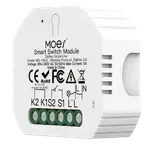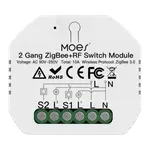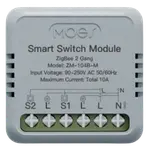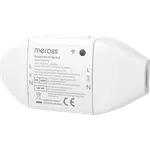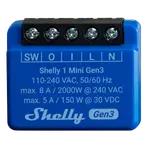

Moes ZigBee Smart Light Switch Module (No Neutral) Review: Two Channels Without a Neutral Wire
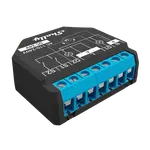
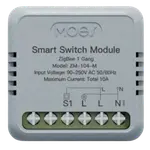
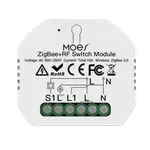
This Moes module is the no-neutral answer for older wiring: a Zigbee relay that installs behind an existing switch in a box that has no neutral wire, and still gives you two independently switched channels at up to 5 A each on 90-250 V AC. It works with Google Home, Alexa and Home Assistant through a Zigbee hub, mounts on a DIN rail as well as in a back box, and keeps the physical switch in play. What you give up is the extras: no energy monitoring, no Apple HomeKit or Matter, no Zigbee routing, and several specs the manufacturer does not document.
- Homes without a neutral wire
- Double switches and two-circuit rooms
- Zigbee and Home Assistant setups
- Keeping existing switch plates
Pros
- Installs without a neutral wire
- Two independent channels from one module
- Wide 90-250 V AC compatibility
- DIN rail mountable as well as back-box friendly
- Works with Google Home, Alexa and Home Assistant
- Keeps the existing switch and plate in use
- Low price
Cons
- Only 5 A per channel, resistive loads only
- Does not act as a Zigbee router
- No energy monitoring
- No Apple HomeKit, SmartThings, IFTTT or Matter support
- Requires a Zigbee hub, with no Wi-Fi or Bluetooth fallback
- No interlock or roller mode for motorised shutters
- Protection features, power-off memory, manual button and OTA support are not documented
Who is this module for?
Wall boxes without a neutral wire are the single most common reason a smart lighting project stalls, and this module exists for exactly that situation. It hides behind the switch you already have, so nothing about the room changes and the switch keeps working by hand, and it handles two circuits rather than one, which suits a double switch or a room with separate main and accent lighting. Control comes through a Zigbee hub, with Google Home, Alexa and Home Assistant supported.
What it handles
Two channels, each switching AC from 90 to 250 V at up to 5 A, in wet contact mode so the connected load is powered directly. Automations are supported through the integrated platforms, and DIN rail mounting means it can also be installed inside a panel rather than a back box. The 18 x 47 x 52 mm body is slim enough for most retrofit installs.
What to know before you buy
Each channel is limited to 5 A and resistive loads only, so inductive and capacitive loads and DC are all outside its scope. It does not act as a Zigbee router, so unlike many mains-powered Zigbee devices it will not extend your mesh. There is no energy monitoring. Platform support stops at Google Home, Alexa and Home Assistant: no Apple HomeKit, no SmartThings, no IFTTT, no Matter. A Zigbee hub is required, with no Wi-Fi or Bluetooth fallback. Undocumented for this model: maximum load power in watts, the four protection features (overheating, overvoltage, overcurrent, overpower), power-off memory, the presence of a manual button, and OTA update support. There is also no interlock or roller mode, so it should not be used for motorised shutters.
Is this module worth it?
It is cheap and it solves a specific wiring problem while covering two circuits, which is a better deal than buying two single-channel no-neutral relays. Set expectations accordingly: this is basic switching without metering, mesh routing or Apple support, and with more unstated specs than a well-documented brand-name module. On a Google Home, Alexa or Home Assistant setup with no neutral at the switch, it is a practical, low-cost fix.
Frequently asked questions
Does this module need a neutral wire?
No. It is designed for wall boxes without a neutral wire, which is what rules out most smart switches in older homes.
How many circuits can it control?
Two, independently, at up to 5 A each on AC from 90 to 250 V.
Does it work with Apple HomeKit?
No. Google Home, Alexa and Home Assistant are supported. Apple HomeKit, Samsung SmartThings, IFTTT and Matter are not.
Will it extend my Zigbee network?
No. Unlike some mains-powered Zigbee devices, this module does not act as a Zigbee router.
Can it drive a roller blind?
No. Interlock (roller or cover) mode is not supported, so it should not be used to drive a motor that needs two channels safely interlocked.