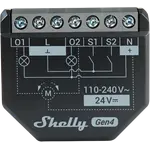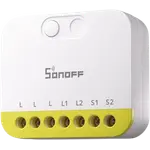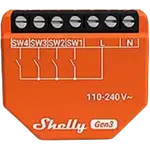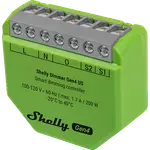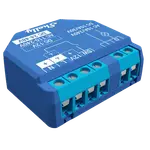
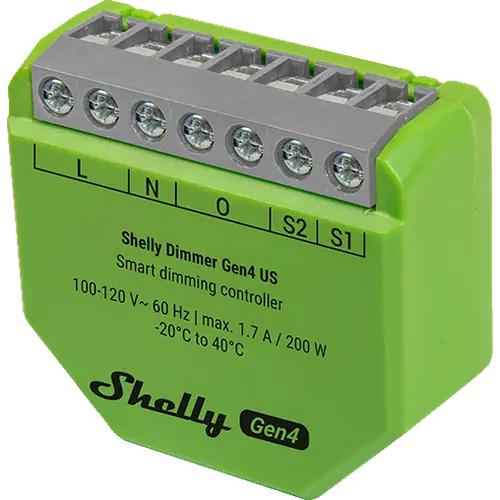


Shelly Dimmer Gen4 Review: A Concealed Trailing Edge Dimmer With Matter and Zigbee
The Shelly Dimmer Gen4 is a concealed dimming module that hides in the wall box behind an existing switch, so the faceplate never changes and the light gains brightness control, schedules and remote access. It is a trailing edge dimmer built for dimmable LED lamps and LED strips (up to 150 W) as well as incandescent, halogen and transformer loads (up to 200 W), and it carries four radios in one body: 2.4 GHz Wi-Fi, Bluetooth 5.0, Zigbee and Matter, with no hub needed unless you choose the Zigbee path. Power metering, detached input mode and on-device scripting make it a strong fit for anyone building automations rather than just adding an app to a lamp. The catch is the neutral wire, which this US model requires without exception, and the 200 W ceiling.
- Retrofit smart lighting
- Dimmable LED lamps and LED strips
- Home Assistant and DIY automation
- Matter households
One relay per circuit you automate.
Buy on Amazon USAPros
- Hides behind the existing switch, so the faceplate and wiring stay as they are
- Trailing edge dimming sized for dimmable LED lamps, LED strips and electronic transformers
- Four protocols in one unit: 2.4 GHz Wi-Fi, Bluetooth 5.0, Zigbee and Matter
- Matter certified, and works with Alexa, Google Home, Apple HomeKit, SmartThings and Home Assistant
- Power measurement built in, reporting voltage, current and consumption
- Deep configuration: detached input mode, restore-after-outage state, min/max brightness, gamma correction and night mode
- Advanced schedules, webhooks, KNX and up to ten on-device scripts, with local control and no hub required
- Doubles as a Zigbee repeater, a Bluetooth gateway and a Wi-Fi range extender
- Overheating, overvoltage, overcurrent and overpower protection, with a three year warranty
Cons
- A neutral wire is mandatory, which rules out switch boxes wired as a simple switch loop
- Output tops out at 200 W and 1.7 A, and at 150 W for dimmable LED lamps
- Dimming calibration must be rerun after a reset and after every change of load
- No Z-Wave and no Thread, and Wi-Fi is 2.4 GHz only
- Zigbee still needs a coordinator, and the profile is changed by a five press button sequence
- No DIN rail mount and no physical on/off button on the module itself
- No dry contact mode, since the output switches the mains live
Who is the Shelly Dimmer Gen4 for?
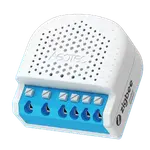
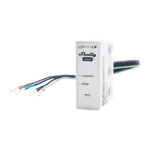
This is a module, not a switch: it measures 38.5 x 43.5 x 17 mm and weighs 24.3 g, so it disappears into the wall box behind the switch already there, or up at the fixture. That makes it the answer when the faceplate has to stay (a rental, a heritage plate, a multi-gang bank you do not want to rebuild) but the light still needs dimming, scheduling and voice control. Two switch or button inputs let the existing paddle or momentary buttons carry on driving the light, with single button and dual button dimming both supported. It suits anyone who wants the automation to live in the wall rather than in the bulb, and anyone whose ecosystem is undecided: Wi-Fi, Bluetooth, Zigbee and Matter are all in the same unit, so the same hardware works in an Amazon Alexa house, a Google Home house, an Apple Home house, a Samsung SmartThings house or a Home Assistant one.
What the Shelly Dimmer Gen4 offers
It is a trailing edge dimmer, which is the type dimmable LED lamps and electronic transformers actually want, and it is rated for dimmable LED lamps up to 150 W, incandescent bulbs and halogen lamps up to 200 W, iron-core transformers up to 200 VA and dimmable electronic transformers up to 200 W, all on a 1.7 A output circuit at 120 V. Matter certification is the headline connectivity feature and it is what carries the module into Apple Home and Samsung SmartThings without a bridge, while Home Assistant also has an official Shelly integration of its own. Choosing the Zigbee profile instead turns the module into a Zigbee repeater that strengthens the mesh around it, and in Wi-Fi mode it doubles as a Bluetooth gateway for Shelly BLU sensors and as a Wi-Fi range extender. On top of that sit the things a dimmer usually cannot do: power measurement reporting voltage, current and consumption in watts, a detached input mode that frees the physical switch to trigger scenes instead of the light, a configurable state to restore after a power cut, minimum and maximum brightness limits, gamma correction, night mode, warm-up for stubborn bulbs, advanced schedules, webhooks, KNX and up to ten on-device scripts. Four protections (overheating, overvoltage, overcurrent and overpower, plus undervoltage) sit behind all of it, and the warranty runs three years.
What to know before you buy
The neutral wire is the first thing to check, because this US model does not support wiring without a neutral line, and plenty of older switch boxes only carry a switch loop. Measure the box too: the module is small, but a fully populated gang box with thick conductors is a tight fit. The 200 W output and 1.7 A limit are generous for a room but not for a long run of LED strip or a large chandelier, and dimmable LED lamps specifically top out at 150 W. Automatic dimming calibration has to run on a new device, after a factory reset and after every change of load, so swapping bulbs means recalibrating. Matter is the default profile and Zigbee is reached with five presses of the control button, so switching protocols is a deliberate act rather than a menu item, and the Zigbee path still needs a coordinator. There is no Z-Wave and no Thread, Wi-Fi is 2.4 GHz only, and the module has no DIN rail mount and no physical on/off button of its own: the single control button handles the access point, factory reset, protocol switching and calibration. Because the output carries the dimmed live, there is no dry contact mode for isolated low voltage circuits.
Is the Shelly Dimmer Gen4 worth it?
For a retrofit it is hard to argue with. The alternative is usually replacing the switch, which means a new faceplate, a matching gang bank and often a hub; this keeps all of that and adds dimming, metering, local control and four protocols for a modest price. The value is highest for anyone who will use the depth, meaning scripts, webhooks, detached inputs, brightness limits and energy data, and lowest for anyone who wants a lamp to turn on at sunset and nothing more, since a smart bulb does that with no wiring at all. If your box has a neutral, your load sits inside 200 W, and you want a dimmer that will still fit your smart home after you change platforms, this is the module to buy.
Frequently asked questions
Does the Shelly Dimmer Gen4 need a neutral wire?
Yes. Shelly's own documentation for the US model states it does not support wiring without an N line, so the wall box has to carry a neutral. It draws less than 1.5 W itself and runs on 120 V at 60 Hz.
Does it need a hub?
Not for Wi-Fi, Bluetooth or Matter, where it works on its own with full local control. Only the Zigbee profile requires a hub, because a Zigbee end device needs a coordinator to join a network.
Which smart home platforms does it work with?
Amazon Alexa, Google Home, Apple HomeKit, Samsung SmartThings and Home Assistant. It is Matter certified, which is what carries it into Apple Home and SmartThings, and Home Assistant additionally has an official Shelly integration.
What kind of lights can it dim, and how much load does it handle?
It is a trailing edge dimmer rated for dimmable LED lamps up to 150 W, incandescent bulbs up to 200 W, halogen lamps up to 200 W, iron-core transformers with low voltage incandescent lamps up to 200 VA, and dimmable electronic transformers up to 200 W. The output circuit is rated at 1.7 A.
Can the wall switch still control the light after it is installed?
Yes. It has two switch or button inputs and supports both single button and dual button dimming, so the existing switch keeps working. You can also set the input to detached mode, which stops the switch driving the light and turns it into a trigger for scenes and automations instead.
Does it measure energy use?
Yes. It reports voltage, current and consumption in watts, so the circuit it controls can be monitored as well as dimmed.
What happens after a power cut?
The output state applied on power up is configurable, and restoring the last state before the outage is one of the available options.