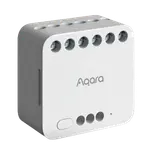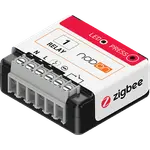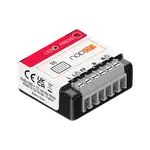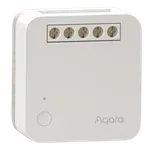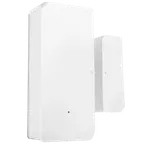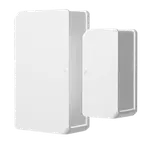


Sonoff MINI ONE PM (MINI-1GSP) Review: A 16A Matter Relay That Meters Solar in Both Directions
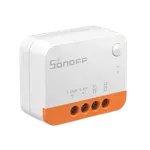
The Sonoff MINI ONE PM is a concealed single-channel relay that turns an ordinary wired switch into a Matter accessory over 2.4GHz Wi-Fi, with a 16A rating and metering that reads power flowing in either direction. That last part is the reason to pick it over a plain smart relay: it is aimed at balcony solar and other small PV setups, where the interesting number is how much a circuit sends back rather than how much it draws. Local control is a first-class path, not an afterthought, with a browser console on the local network, a year of energy history kept on the device, and HTTP (JSON-RPC), WebSocket and MQTT endpoints for Home Assistant, OpenHAB, ioBroker and Node-RED. It needs a neutral wire and it switches the live wire only, so low-voltage or potential-free circuits are outside its job description, but at this price tier the combination of Matter, bidirectional metering and open local APIs is unusually complete.
- Balcony solar and small PV setups
- Retrofitting existing wall switches
- Local-first and Home Assistant setups
- Per-circuit energy tracking
- Budget buyers
Pros
- Bidirectional energy metering, so it reads solar generation as well as consumption
- A year of energy history stored on the device, so records survive an outage
- Local web console on the LAN, no app or cloud account needed to control it
- Open HTTP (JSON-RPC), WebSocket and MQTT APIs for Home Assistant, OpenHAB, ioBroker and Node-RED
- Matter over Wi-Fi brings it into Alexa, Google Home, Apple Home, SmartThings and Home Assistant
- 16A rating at 100-240V from a module small enough for a standard back box
- Detached relay mode frees the wired switch to trigger scenes
- Configurable power-on state, plus a physical button on the module
- Overload, overheat, overcurrent, overvoltage and overpower cutoff
- OTA firmware updates
- Two-year warranty
Cons
- Requires a neutral wire, so it will not fit older two-wire switch boxes
- Switches the live wire only, with no dry contact for low-voltage or potential-free circuits
- Single channel, so no interlock for a two-direction motor
- 2.4GHz Wi-Fi only, with no 5GHz band
- No Zigbee, Thread, Z-Wave or RF radio, so it cannot extend a mesh
- Mounts inside an electrical box, not on a DIN rail
- The 16A figure is published as a resistive maximum, with no separate inductive or capacitive ratings
- Standby power consumption is not published
Who is the Sonoff MINI ONE PM for?
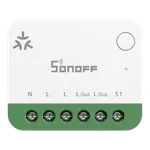
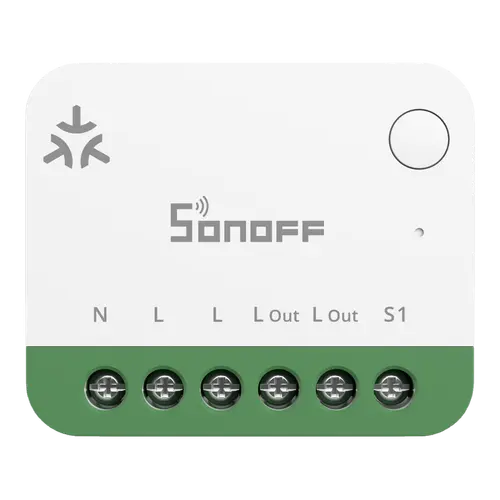
This is a concealed relay module, not a switch you look at: at 39.5 x 33 x 16.8 mm and 27.3g it is designed to sit inside the electrical box behind an existing wall switch, keeping the plate and the mechanical switch exactly where they are. The S1 terminal reads that wired switch, so the circuit keeps working normally after installation and gains app, voice and automation control on top. It is a single-channel device rated 16A at 100-240V, which covers a lighting circuit or a single appliance, and it requires a neutral wire, so it suits boxes wired with neutral rather than the older two-wire runs. The other half of its audience is anyone metering a circuit: the bidirectional measurement means it can sit on a balcony solar feed and report generation as well as consumption.
What stands out on paper
Three things separate it from a basic smart relay. First, the metering is bidirectional, so the energy figures are signed rather than absolute, and the device keeps a year of that history in its own storage, which survives an internet outage. Second, local control is a documented path rather than a workaround: a browser-based console reachable on the local network, plus HTTP (JSON-RPC), WebSocket and MQTT interfaces that Home Assistant, OpenHAB, ioBroker and Node-RED can drive directly. Third, it is a Matter accessory over Wi-Fi, which is what carries it into Alexa, Google Home, Apple Home, SmartThings and Home Assistant without a vendor hub in the middle. Around those, the practical extras are the ones that matter in a retrofit: detached relay mode, which frees the wired switch to trigger scenes instead of the load; configurable power-on state so the circuit comes back the way you want after an outage; a physical button on the module; OTA firmware updates; and protection that cuts the load when current, voltage, power or temperature passes its limit.
What to know before you buy
The neutral wire is the hard requirement, and it is the thing to check before ordering. Beyond that, the output is a switched live wire on the two L Out terminals, which are internally connected for wiring convenience and do not add capacity, so this is not a dry-contact module: a potential-free contact for a boiler, a gate controller or any low-voltage circuit needs a different device. It is a single channel, so there is no interlock behaviour for a two-direction motor, and it mounts inside an electrical box rather than on a DIN rail. On the radio side it is 2.4GHz Wi-Fi only, with no 5GHz, Zigbee, Thread, Z-Wave or RF, so it joins a mesh as a leaf and never extends one. One gap in the published data is worth knowing: Sonoff states the 16A figure as a maximum resistive load and does not publish separate inductive or capacitive ratings, so a motor, transformer or heavily capacitive load should be sized conservatively rather than assumed to reach 16A. Standby consumption is not published either.
Is the Sonoff MINI ONE PM worth it?
For a budget-tier module, the specification is dense: 16A switching, signed energy measurement, a year of on-device history, a local web console, three open API transports and Matter, all at a size that fits a standard back box. The comparison it invites is against a plain 16A smart relay, and the answer is that the metering is the upgrade, particularly if a circuit generates as well as consumes. It is not the right pick when the job needs a dry contact, two independent channels, a DIN rail, or a circuit without a neutral, and the missing inductive and capacitive ratings mean a demanding motor load deserves a second look at the datasheet. Within its intended job, retrofitting a wired switch on a metered circuit, it is a well-equipped and cheaply-bought module backed by a two-year warranty.
Frequently asked questions
Does the Sonoff MINI ONE PM need a neutral wire?
Yes. Sonoff's own product FAQ states the MINI-1GSP requires a neutral wire, and the module has dedicated N, L, L Out and S1 terminals. A switch box wired with only a live loop will not work.
Does the Sonoff MINI ONE PM need a hub?
No. It connects over 2.4GHz Wi-Fi and joins a Matter fabric directly, so it works with Alexa, Google Home, Apple Home, SmartThings and Home Assistant without a Sonoff bridge. A Matter controller such as a HomePod, an Apple TV, a Google or Echo speaker, a SmartThings hub or a Home Assistant install acts as the hub you already have.
What does bidirectional energy monitoring actually do?
It measures power flowing in either direction rather than a single absolute figure, which is what lets it sit on a balcony solar or other PV circuit and report generation separately from consumption. The device also keeps a year of that history in local storage, so the record stays intact through an internet outage.
Can the Sonoff MINI ONE PM be controlled without the cloud?
Yes. It exposes a browser-based console on the local network, and open HTTP (JSON-RPC), WebSocket and MQTT interfaces that Home Assistant, OpenHAB, ioBroker and Node-RED can drive directly. Matter control is local as well.
How much load can the Sonoff MINI ONE PM switch?
It is rated 16A at 100-240V, 50/60Hz, stated as a maximum resistive load. Sonoff does not publish separate inductive or capacitive ratings, so motors, transformers and LED drivers should be sized conservatively. The installation instructions also call for a 16A MCB or RCBO upstream of the module.
Does it have a dry contact output?
No. The two L Out terminals carry a switched live wire and are internally connected for wiring convenience only, so the contact is not potential-free. A boiler, gate controller or other low-voltage circuit needs a dry-contact module instead.