


Sonoff MINI ONE PM Zigbee Smart Switch Review: Metering Behind the Switch Plate, Without Leaving Zigbee
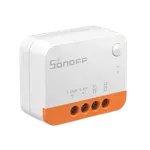
The Sonoff MINI ONE PM Zigbee Smart Switch is the metering version of Sonoff's concealed 16A relay: it hides in the wall box behind an existing switch, leaves the manual control working, and adds live voltage, current, power and energy readings on top of the on/off. Owners who already run a Zigbee coordinator describe pairing through Zigbee2MQTT as immediate and switching as instant, and they keep pointing at the same bonus, that the module relays for the mesh instead of hanging off it as an end device. Two physical prerequisites decide whether it fits at all: a neutral wire in the box and roughly 60 mm of depth, which is exactly what most UK light-switch back boxes do not have. Clear those and target Home Assistant, and this is one of the most capable modules at its budget tier.
- Homes already running a Zigbee network
- Home Assistant and Zigbee2MQTT setups
- Per-circuit energy tracking
- Balcony solar monitoring
- Retrofitting existing wall switches
Pros
- Bi-directional energy metering, so a solar circuit reports generation as well as consumption
- Live voltage, current and power readings, plus bill tracking with custom rates and time-of-use periods
- Up to a year of energy history kept on the device, so an outage does not lose the record
- 16A relay at 110-240V in a module small enough for an 86, EU or 120-type back box
- Pairs into Home Assistant through Zigbee2MQTT with no fuss, and responds instantly
- Acts as a Zigbee router, quoted at 180 m to the gateway and 250 m in Turbo mode
- Detach relay mode keeps smart bulbs powered while the wall switch still triggers them
- Overload, overcurrent, overvoltage and overheat cutoff with thresholds you set yourself
- Configurable power-on state plus a delayed power-on timer to stagger loads after an outage
- Bluetooth Proximity Mode covers control and setup when the gateway is offline
- Well-shrouded terminals, a physical button on the module and over-the-air firmware updates
- Two-year warranty
Cons
- A neutral wire is mandatory, which rules out most UK light-switch back boxes
- Wants around 60 mm of box depth, so shallow surface boxes need a different mounting spot
- Requires a Zigbee coordinator or gateway, there is no Wi-Fi radio on board
- The energy entities need Sonoff's setup script on ZHA, and an imported driver on SmartThings, until native support lands
- Terminals take only a few millimetres of conductor and there is no neutral pass-through for the load
- A metal back box behind a metal faceplate can attenuate the Zigbee signal
- One relay channel only, so a second circuit needs a second module
- No dry contact for low-voltage circuits and no DIN rail mount
- Apple Home and Matter arrive through a Sonoff Matter bridge rather than directly
- Sonoff publishes only the resistive rating, with no inductive or capacitive figures
- Standby power consumption is not published
Who is the Sonoff MINI ONE PM Zigbee Smart Switch for?
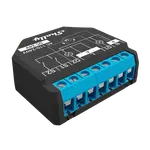
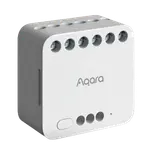
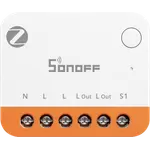
This is a concealed relay module rather than a switch you look at. At 39.5 x 33 x 16.8 mm and 27.3 g it is meant to sit inside the electrical box behind the plate that is already there, with the existing wired switch feeding its S1 terminal so the circuit keeps behaving normally after installation. It is a single channel rated 16A at 110-240V, it needs a neutral wire, and it carries no Wi-Fi radio, so a Zigbee coordinator or gateway is mandatory rather than optional. The jobs owners actually put it on say more about the audience than the category name does: a bathroom light wired to the same circuit as the extractor fan, which smart bulbs cannot handle at all; a pool pump driven from ioBroker; a server whose power draw someone wanted logged. The common thread is automating a circuit and knowing what it costs, not swapping a bulb.
What buyers love
The most repeated praise is how little friction there is on the software side: paired into Zigbee2MQTT it shows up in Home Assistant straight away, and owners describe switching commands as effectively instant and the power figures as updating almost as fast as the load changes. The metering itself is the reason most of them chose this version over a plain relay, and it goes further than a running total: real-time voltage, current and power, energy by day and by month, and bill tracking with custom rates and time-of-use periods, all kept on the device for up to a year so an internet outage does not punch a hole in the record. Because the measurement is bi-directional, a balcony solar circuit reports generation as a separate figure rather than as unexplained consumption. Several owners also note that the module doubles as a Zigbee router, quoted at 180 m to the gateway and 250 m with Turbo mode enabled, which they point out is unusual in this class and worth planning around if a few of them go in around the house. The rest is the small stuff that shows up once it is in your hand: it is smaller than people expect, the terminals are well shrouded, and the build quality and documentation get called top-notch more than once.
What to know before you buy
The neutral wire is the hard gate, and in the UK it is the review theme that dominates everything else: light-switch back boxes there usually carry only a live loop, and even where the wiring works the box is often too shallow for the 60 mm this module wants. The workaround owners settle on is to mount it in a ceiling rose or a loft junction box instead of behind the plate, and one of them warns that a metal back box behind a metal faceplate can attenuate the Zigbee signal enough to matter. The terminals are the other physical complaint: they accept only a few millimetres of conductor, live and neutral sit close together, and there is no dedicated neutral pass-through for the load, so a separate neutral joint has to be made. Give the wires a pull test before folding them into the box. On the software side, Zigbee2MQTT is the smooth route and everything appears at once; on ZHA the energy entities need the setup script Sonoff publishes until native support is merged, and SmartThings needs a driver imported for the same figures. More than one owner discovered that only after the unit was in the wall, so it belongs on the checklist rather than in the footnotes. Beyond that the limits are structural: one relay channel, so a second circuit needs a second module; the two L Out terminals switch mains live and are internally linked for convenience, so there is no dry contact for a low-voltage circuit; it mounts in a box rather than on a DIN rail; and Sonoff publishes only the resistive rating, leaving inductive and capacitive loads to be sized conservatively. Apple Home and Matter both arrive through a Sonoff Matter bridge such as the ZBBridge-U, iHost or eWeLink CUBE with a Sonoff Zigbee dongle, so budget for that hardware if the Apple ecosystem is the destination.
Is the Sonoff MINI ONE PM Zigbee Smart Switch worth it?
Judged as a component rather than a gadget, the value is easy to state: for very little money one small module turns an existing circuit into a Zigbee device, meters it in both directions, keeps a year of that history locally and strengthens the mesh while it does so. Owners rate it highly and the criticism is almost never about what it does once it is running, it is about getting it in: the neutral, the box depth, the terminal size, and the script the energy entities still need outside Zigbee2MQTT. Against its own family the choice is clean. The non-metering MINI ONE is the one to buy if consumption data is not the point, the Matter over Wi-Fi version suits a home with no Zigbee coordinator, and this is the one for a house that already runs Zigbee and wants the numbers. Check the box before ordering and it is a lot of capability for the tier.
Frequently asked questions
Does the Sonoff MINI ONE PM Zigbee Smart Switch need a hub?
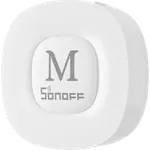
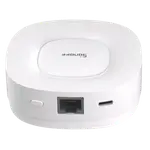
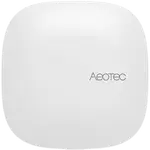
Yes. It speaks Zigbee 3.0 and has no Wi-Fi radio, so it has to join an existing Zigbee network through a coordinator: a Sonoff dongle, a Sonoff Zigbee bridge, NSPanel Pro or iHost, an Echo with a built-in Zigbee hub, or the Aeotec Smart Home Hub V3 for SmartThings. Proximity Mode over Bluetooth covers basic control and settings when the gateway is offline or the signal is unstable.
Does the Sonoff MINI ONE PM Zigbee Smart Switch need a neutral wire?
Yes. Sonoff's own product FAQ states it, and the module wires up with N, L, two internally linked L Out terminals for the load and S1 for the existing wall switch. This is the single most common installation blocker owners report, because a UK light-switch back box usually carries only a live loop; the usual fix is to mount the module at a ceiling rose or junction box where the neutral is present.
What does the energy monitoring actually measure?
Real-time voltage, current and power on the switched circuit, plus energy by day and by month and a running total, with electricity bills calculated from a currency and rate you set, including time-of-use periods. The measurement is bi-directional, so a balcony solar feed reports generation separately from consumption, and the device keeps up to a year of that history itself rather than depending on the cloud.
Does the Sonoff MINI ONE PM Zigbee Smart Switch work with Home Assistant?
Yes. Zigbee2MQTT supports this exact model and exposes the switch state, power, current, voltage, the daily, monthly and total energy counters, turbo mode, detach relay mode and overheat reporting, and owners describe it appearing immediately after pairing. On ZHA the same device pairs and switches, but the full entity set needs the setup script Sonoff publishes in its knowledge center until native support is merged.
Does the Sonoff MINI ONE PM Zigbee Smart Switch work with Apple Home?
Yes, through a Sonoff Matter bridge. The module is a Zigbee device and Apple Home has no Zigbee radio, so a ZBBridge-U, an iHost or eWeLink CUBE with a Sonoff Zigbee dongle republishes it into Matter, and it then appears in the Home app alongside the rest of the setup. Alexa, Google Home and SmartThings can also reach it the same way, or through eWeLink account linking.
How much load can the Sonoff MINI ONE PM Zigbee Smart Switch switch?
It is rated 16A at 110-240V, 50/60Hz, stated as a maximum resistive load, and Sonoff calls for a 16A MCB or RCBO upstream of the module. No separate inductive or capacitive rating is published, so motors, transformers and LED drivers should be sized conservatively rather than assumed to reach the full 16A.