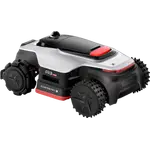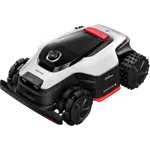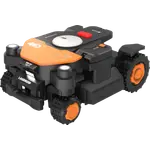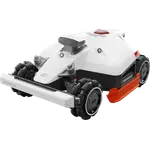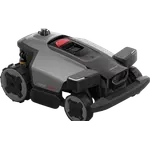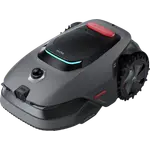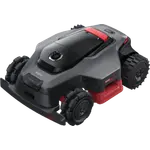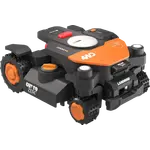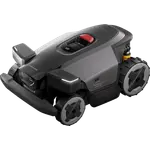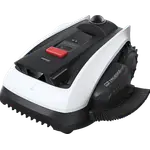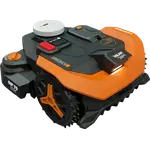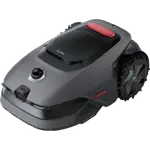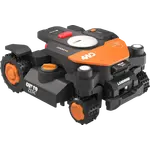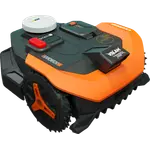


WORX Landroid Vision Cloud 4WD WR342 Review: All-Wheel Drive for Half an Acre, Without a Wire or a Mast
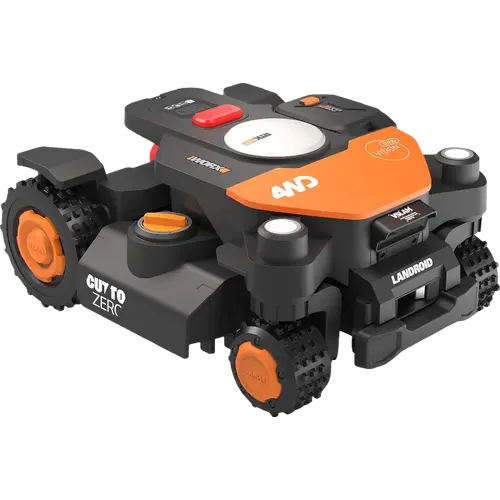
The Landroid Vision Cloud 4WD WR342 is the half-acre step of the WORX wire-free range, and what it buys over a flat-lawn robot is traction: four driven wheels on a terrain-adaptive chassis with real front-wheel steering, rated for slopes of 84% (about 40 degrees). Positioning comes from RTK corrections delivered over the internet and relayed to the mower by a RadioLink module in the charging station, with stereo-camera V-SLAM taking over under trees, so there is no cable to bury and no reference mast to plant with a clear view of the sky. The compromises are size-related rather than clever: an 8.7 in deck and roughly 41 minutes of mowing per charge mean this machine works by cutting little and often, and unlike the one-acre and acre-and-a-half models it has no cellular radio, so the charging station's Wi-Fi is what keeps it connected.
- Lawns up to half an acre
- Steep banks and uneven ground
- Gardens where an RTK mast is impractical
- Landscaped yards with raised borders
- Existing WORX PowerShare owners
Pros
- Rated for slopes up to 84% (40 degrees), well beyond most robot mowers
- All-wheel drive with a terrain-adaptive chassis and front-wheel steering
- Wire-free and antenna-free: cloud RTK needs no mast in the garden
- Stereo camera V-SLAM keeps the position where satellite coverage weakens
- AI vision treats anything that is not grass or leaves as an obstacle
- Cut-to-Zero offset module trims closer to fixed borders
- Unlimited zones with custom pathways, plus no-go areas drawn in the app
- Electronic cutting height set per zone, from 1.57 to 3.54 in
- Find My Landroid GPS tracking included, and it works with the mower switched off
- Swappable WORX PowerShare 20V battery and a 3 year warranty
- RadioLink module keeps the mower connected to its station across a large garden
- Alexa voice control through the official Landroid skill, plus Home Assistant via community integrations
Cons
- Narrow 8.7 in cutting deck for half an acre of lawn
- About 41 minutes of mowing per charge and 100 minutes to recharge
- No cellular radio, unlike the 1 acre and 1.5 acre models in the same line
- FiatLux headlights are sold separately, so night mowing costs extra
- No LiDAR, so deep shade falls back on the cameras
- 2.4 GHz Wi-Fi only, which the charging station still depends on
- No Apple Home, SmartThings or Matter support
- Scheduling is a fixed calendar; only a reactive rain delay, no forecast-aware mowing
- WORX publishes no IP weather-resistance rating for this model
- Obstacle crossing height and mowing capacity per hour are not published
Who is the Landroid Vision Cloud 4WD WR342 for?
This is the model for a mid-size garden that is awkward rather than large. Coverage is rated at half an acre, roughly 21,780 sq ft, which puts it between the quarter-acre entry models and the acre machines in the same family. What separates it from cheaper robots is what it can climb: four-wheel drive, a terrain-adaptive body that keeps all four wheels planted across ruts and raised borders, and true front-wheel steering rather than skid steering, for a slope rating of 84%, about 40 degrees. Entry-level mowers usually stop around 30% and two-wheel-drive machines around 50%. Setup asks less of the garden than most alternatives: there is no perimeter cable to peg or bury, and because the RTK corrections arrive over the cloud there is no reference antenna to mount anywhere. The boundary and the zones are created by the mower on its first run and then edited in the app.
What the Landroid Vision Cloud 4WD WR342 offers
Navigation is the headline. Cloud RTK gives the straight, evenly spaced lines these mowers are bought for, and when tree cover or a wall weakens the satellite fix, V-SLAM sensor fusion built on the stereo camera holds the position. The same camera drives obstacle recognition, and WORX's approach is to identify anything that is not grass or leaves rather than match a fixed list of objects. Edges are handled by Cut-to-Zero, an offset blade module that trims closer to fixed borders than a deck sitting between the wheels can reach, which is the most common shortcoming of robot mowers. Cutting height is set electronically from the app across the range between 1.57 and 3.54 in, and different zones can hold different heights, on a three-blade self-levelling disc spinning at 2400 rpm. Zones are unlimited, with custom pathways between them, and no-go areas are drawn in the app, with 19.7 ft of No-Go Tape and ten stakes in the box for the borders the camera cannot infer. The pack is a standard WORX PowerShare 20V 5 Ah battery, removable and shared with the rest of the tool range, so a worn cell after a few seasons is a cheap part rather than the end of the mower. Anti-theft is covered by the Find My Landroid module, included here, which locates the machine from the app even when it is switched off. The body carries a 3 year warranty, the deck is rated washable with a garden hose, and updates arrive over the air or over USB.
What to know before you buy
The deck is 8.7 in wide and the battery lasts about 41 minutes per charge against 100 minutes to refill it, which is modest for half an acre. The mower recharges and resumes where it left off, so the lawn does get cut, but the way to think about this machine is continuous light maintenance rather than a mowing session with an end time. Connectivity is the clearest difference from the larger models in the line: this one carries Wi-Fi, Bluetooth and the RadioLink to its charging station, but no cellular radio, so the station needs to sit within reach of a 2.4 GHz network, and there is no mobile data link to fall back on at the far end of a big garden. The FiatLux light module, which is what lets a camera-based mower keep working after dark, is standard on other models in the range and sold separately for this one, so night mowing is an extra purchase rather than something it does out of the box. There is no LiDAR either, so deep shade falls back on the cameras. Smart home support is narrow: the official Landroid skill brings Alexa voice control, phrased as requests to the skill rather than as native device commands, and Home Assistant is reachable through community integrations built on the WORX cloud, but Apple Home, SmartThings and Matter are not supported. Scheduling is a fixed calendar; the rain sensor triggers a delay on a session already under way, but nothing adjusts the mowing frequency to growth or a forecast. WORX also does not publish an IP rating, an obstacle-crossing height or a mowing capacity per hour for this model.
Is the Landroid Vision Cloud 4WD WR342 worth it?
It is a premium machine and it is priced like one, and the case for it rests almost entirely on terrain. Half an acre on flat, open grass is served by far cheaper robots; half an acre of banks, raised borders and shade is where the all-wheel-drive chassis, the 84% slope rating and the antenna-free RTK stop being a specification and start being the reason the mower works at all. Against its own siblings the trade is straightforward: the same navigation and the same edge trimming as the acre models, in a smaller coverage rating, without the cellular link and without the light module fitted. Where it is the wrong buy is a garden that has to be finished quickly, where a wider deck and a longer runtime matter more than traction, and a smart home run on Apple Home, SmartThings or Matter, where the Landroid app will remain the way it is controlled.
Frequently asked questions
Does the Landroid Vision Cloud 4WD WR342 need a perimeter wire or an RTK antenna?
Neither. There is no boundary cable to bury or peg, and the RTK corrections are delivered over the internet as a cloud service rather than from a reference antenna mounted in the garden. The mower maps the lawn itself with Vision AI on the first run, and the boundary and no-go areas are then edited in the app.
How steep a slope can it handle?
Up to 84%, which is about 40 degrees. It drives all four wheels on a terrain-adaptive chassis with front-wheel steering rather than skid steering, so it also copes with raised borders and transitions without tearing the turf. Slope ratings assume dry grass, so leave headroom on the steepest part of the garden.
How large a lawn is it rated for, and how long does it run?
Half an acre, roughly 21,780 sq ft. It cuts an 8.7 in path at heights between 1.57 and 3.54 in, runs for about 41 minutes on a charge and takes 100 minutes to recharge, then returns to where it stopped and carries on.
What is the difference between this model and the 1 acre WR344?
Coverage, runtime and connectivity. The WR342 is rated for half an acre and about 41 minutes per charge, the WR344 for a full acre and about 50 minutes. The larger model also adds a cellular link and ships with the FiatLux light module fitted, both of which are extras on this one. Navigation, the 84% slope rating, the 8.7 in deck and Cut-to-Zero edge trimming are the same.
Does it cut the lawn edges?
Yes. The Cut-to-Zero offset blade reaches past the wheels, so it trims closer to walls, fences and bed borders than a mower without edge cutting and leaves less to finish by hand with a string trimmer.
Which smart home platforms does it work with?
Alexa, through the official Landroid skill by Positec, which covers Landroid models with Wi-Fi, Find My Landroid or RadioLink made in or after 2016 and registered in the Landroid app. It is a conversational skill, so commands are phrased as requests to Landroid rather than as native device commands. Home Assistant is reachable through community HACS integrations written for the Landroid Vision and Vision Cloud line. Apple Home, SmartThings and Matter are not supported.
Can the battery be replaced?
Yes. It uses a WORX PowerShare 20V 5 Ah Li-ion pack (model WA3675) that the owner can remove and swap, and which fits the rest of the PowerShare tool range, so a worn battery after a few seasons is a cheap part rather than the end of the mower. The mower body carries a 3 year warranty, which excludes accessories and consumables.