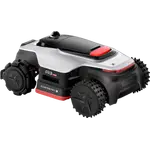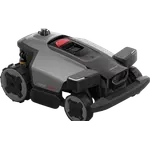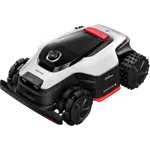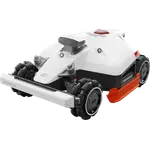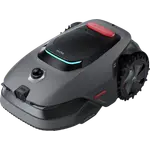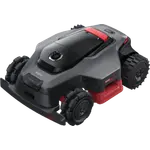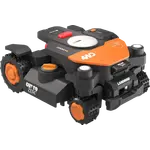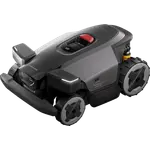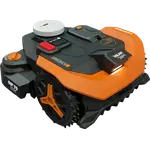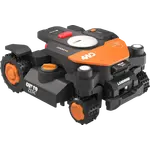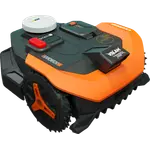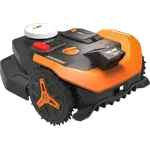
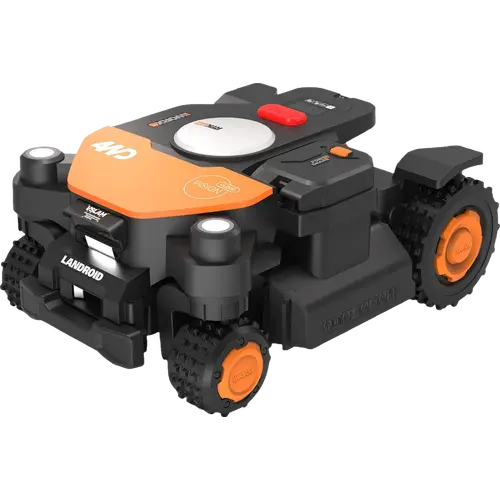


WORX Landroid Vision Cloud 4WD WR344 Review: An Acre of Steep Lawn, No Wire and No Antenna
The Landroid Vision Cloud 4WD WR344 is the top of the WORX wire-free line: an acre of coverage, four driven wheels on a terrain-adaptive chassis and a slope rating of 84% (40 degrees), which is where most robot mowers stop. Positioning comes from RTK corrections delivered over the internet rather than from a mast in the garden, with a stereo camera and V-SLAM taking over in shade, so there is nothing to bury and nothing to bolt down with a clear view of the sky. The 4G module is built in, which keeps the mower reachable and its GPS trackable at the far end of a large garden. The trade-off is a narrow 8.7 in deck and a 50 minute runtime against an acre of grass, so this machine works by mowing little and often rather than by finishing fast.
- Large lawns up to one acre
- Steep banks and uneven ground
- Gardens where an RTK mast is impractical
- Properties where Wi-Fi does not reach the lawn
- Existing WORX PowerShare owners
Pros
- Rated for slopes up to 84% (40 degrees), well beyond most robot mowers
- All-wheel drive with a terrain-adaptive chassis and front-wheel steering
- Wire-free and antenna-free: cloud RTK needs no mast in the garden
- Stereo camera V-SLAM keeps the position where satellite coverage weakens
- AI vision recognizes obstacles instead of bumping into them
- Cut-to-Zero offset module trims closer to fixed borders
- Built-in 4G with the first year of cellular service included
- Find My Landroid GPS tracking, geofence alerts and remote lock included
- FiatLux headlights included, so it keeps seeing after dark
- Swappable WORX PowerShare 20V battery and a 3 year warranty
- Alexa voice control through the official Landroid skill, plus Home Assistant via community integrations
- Electronic cutting height across seven positions, set per zone in the app
Cons
- Narrow 8.7 in cutting deck for an acre of lawn
- About 50 minutes of mowing per charge, so sessions are short and frequent
- No LiDAR, so deep shade falls back on the cameras
- 2.4 GHz Wi-Fi only, which the charging station still depends on
- No Apple Home, SmartThings or Matter support
- Scheduling is a fixed calendar; only a reactive rain delay, no forecast-aware mowing
- No audible alarm and no start-up PIN, only app-side lock and alerts
- WORX publishes no IP weather-resistance rating for this model
- Obstacle crossing height and mowing capacity per hour are not published
Who is the Landroid Vision Cloud 4WD WR344 for?
This is the model for a big, awkward garden rather than a flat rectangle. Four-wheel drive, a terrain-adaptive body that keeps all four wheels planted over ruts and raised borders, and true front-wheel steering give it a slope rating of 84%, roughly 40 degrees; entry-level mowers stop around 30% and mid-range two-wheel-drive machines around 50%. Coverage is rated at one acre, so it suits a property that would otherwise mean a ride-on or a landscaper. Setup asks less of the garden than most alternatives in its class: there is no perimeter cable to peg or bury, and because the RTK corrections arrive over the cloud there is no reference antenna to mount somewhere with an open view of the sky. The boundary and the zones live in the app, where they can be redrawn whenever the garden changes.
What the Landroid Vision Cloud 4WD offers
Navigation is the headline. Cloud RTK gives the straight, evenly spaced lines these mowers are bought for, and when tree cover or a wall weakens the satellite fix, V-SLAM sensor fusion built on the stereo camera keeps the position. The same camera drives obstacle recognition, so the mower identifies what is in front of it instead of simply bumping into it. Edges are handled by Cut-to-Zero, a 110 mm offset blade module that trims closer to fixed borders than a deck sitting between the wheels can reach, which is the single most common shortcoming of robot mowers. Cutting height is set electronically from the app across seven positions between 1.57 and 3.54 in, and different zones can hold different heights. The FiatLux light module is included on this model and switches on automatically after dark, which is what lets a camera-based mower keep working at night, when the lawn is out of the way anyway. Connectivity is unusually complete: Wi-Fi and Bluetooth plus a built-in 4G module with the first year of cellular service included, which is also what powers Find My Landroid, the GPS tracking that locates the machine even when it is switched off and pushes an alert if it leaves the mowing area. The pack is a standard WORX PowerShare 20V 5 Ah battery, removable and shared with the rest of the tool range, and the body carries a 3 year warranty.
What to know before you buy
The deck is 8.7 in wide and the battery lasts about 50 minutes per charge, which is modest for an acre. The mower recharges and resumes where it left off, so the lawn does get cut, but the way to think about this machine is continuous light maintenance rather than a mowing session with an end time. Wi-Fi is 2.4 GHz only, which is normal for the category and worth knowing when the charging station sits far from the router; the 4G link covers the mower itself but the station still needs the network. There is no LiDAR here, so the fallback in deep shade is the camera rather than a laser. Smart home support is narrow: the official Landroid skill brings Alexa voice control and Home Assistant is reachable through community integrations, but Apple Home, SmartThings and Matter are not supported, and this is not a mower that will sit in a Matter home alongside everything else. Scheduling is a fixed calendar rather than an adaptive one; the rain sensor triggers a delay on a session already under way, but nothing adjusts the mowing frequency to growth or a forecast. Anti-theft is app-side too: GPS tracking, a geofence alert and a remote lock, with no audible siren and no start-up PIN on the machine. WORX also does not publish an IP rating for this model, although the deck is documented as washable with a garden hose and must not be cleaned with a pressure washer.
Is the Landroid Vision Cloud 4WD WR344 worth it?
It is a premium machine and it is priced like one, but the combination it offers is genuinely uncommon: acre coverage, an 84% slope rating and antenna-free RTK in the same box, with the cellular module and the light already fitted rather than sold as extras. On a large, sloped, tree-shaded property that is a shorter list of compromises than most rivals can offer, and the swappable PowerShare pack plus the 3 year warranty make it cheaper to keep running over several seasons than a mower with a sealed battery. Where it is the wrong buy is a flat lawn, where the all-wheel-drive premium buys nothing, and a garden that needs to be finished quickly, where a wider deck and a longer runtime matter more than traction. Anyone whose smart home runs on Apple Home, SmartThings or Matter should also plan on the Landroid app being the way they control it.
Frequently asked questions
Does the Landroid Vision Cloud 4WD WR344 need a perimeter wire or an RTK antenna?
Neither. There is no boundary cable to bury or peg, and the RTK corrections are delivered over the internet as a cloud service rather than from a reference antenna mounted in the garden. The lawn is mapped by the mower with Vision AI, and the boundary and no-go areas are then edited in the app.
How steep a slope can it handle?
Up to 84%, which is about 40 degrees. It drives all four wheels on a terrain-adaptive chassis with front-wheel steering, so it also copes with raised borders and transitions. Slope ratings assume dry grass, so leave headroom on the steepest part of the garden.
How large a lawn is it rated for, and how long does it run?
One acre, roughly 43,560 sq ft. It cuts an 8.7 in path at heights between 1.57 and 3.54 in, runs for about 50 minutes on a charge and needs 60 minutes to recharge, then returns to where it stopped and carries on.
Does it cut the lawn edges?
Yes. The Cut-to-Zero module is a 110 mm offset blade that reaches past the wheels, so it trims closer to walls, fences and bed borders than a mower without edge cutting and leaves less to finish by hand with a string trimmer.
Which smart home platforms does it work with?
Alexa, through the official Landroid skill by Positec, which starts and stops mowing, sends the mower back to its base and reports status and battery level. Home Assistant is reachable through community HACS integrations built for the Landroid Vision and RTK mowers, which add controls, an RTK live map and diagnostics. Apple Home, SmartThings and Matter are not supported.
Does it need Wi-Fi, and what does the 4G do?
The mower joins a 2.4 GHz Wi-Fi network, and it also carries a built-in 4G module with the first year of cellular service included, renewable in the app afterwards. The cellular link keeps the mower reachable and its status flowing where Wi-Fi does not reach the far end of the garden, and it is what makes the Find My Landroid GPS tracking work once the machine leaves the property.
Can the battery be replaced?
Yes. It uses a WORX PowerShare 20V 5 Ah Li-ion pack (model WA3675) that the owner can remove and swap, and which is shared with the rest of the PowerShare tool range, so a worn battery after a few seasons is a cheap part rather than the end of the mower. The mower body carries a 3 year warranty and the battery pack 1 year.