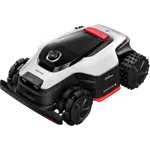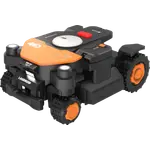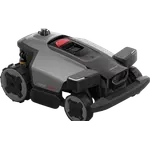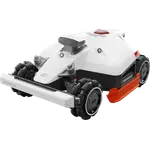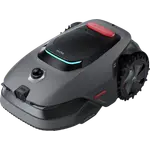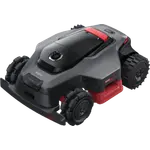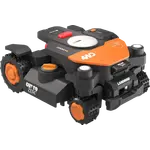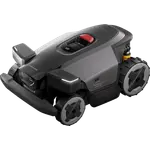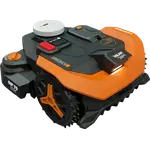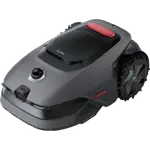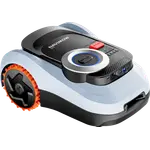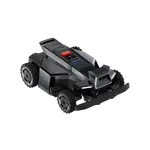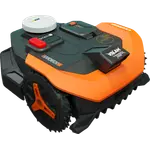


WORX Landroid Vision Cloud WR320 Review: Half-Acre Mowing With Cloud RTK and Nothing to Install in the Garden
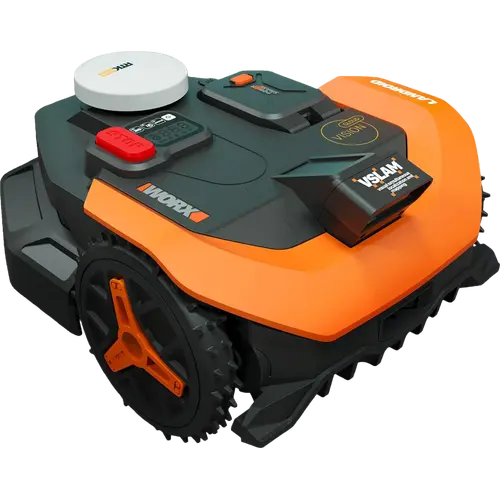
The Landroid Vision Cloud WR320 is the half-acre, two-wheel-drive entry point of the Worx camera-and-RTK line, and its whole argument is that nothing goes into the garden: no perimeter cable to peg down and no reference antenna to power, because the RTK corrections arrive over the internet and a stereo camera with V-SLAM keeps the mower on track where satellites drop out. It maps the lawn on its own, accepts unlimited zones and app-drawn no-go areas, sets its six cutting heights electronically and ships with the RadioLink module that carries the link past normal Wi-Fi range. The limits are physical rather than digital: two wheels and a 30% slope rating, no offset Cut to Zero blade in this box and no light module for night work. On a flat to gently rolling half-acre lawn it is the least expensive way into this navigation stack.
- Half-acre lawns
- Flat to gently rolling gardens
- Wire-free installations
- Home Assistant homes
Pros
- No perimeter wire and no reference antenna: the RTK corrections come from the cloud
- Vision AI obstacle avoidance that reacts to anything which is not grass or leaves
- V-SLAM sensor fusion keeps navigation going under trees and next to buildings
- Unlimited mowing zones, app-drawn no-go areas and electronic cutting height per zone
- RadioLink module included, extending the link beyond normal Wi-Fi coverage
- Swappable 20V PowerShare battery shared with the wider Worx cordless range
- IPX6 deck that can be washed down with a garden hose
- Alexa skill and community Home Assistant integrations for the Landroid cloud
- Three year manufacturer warranty
Cons
- Two-wheel drive with a 30% slope rating, well short of the all-wheel-drive models
- The Cut to Zero offset blade that trims right to the line is optional and not in this box
- No FiatLux light module, so the camera works best in daylight
- No 4G module, so the mower has to stay within Wi-Fi or RadioLink range to report in
- 2.4 GHz Wi-Fi only
- No Apple Home, SmartThings or Matter support
- 60 minute runtime spreads a half-acre lawn across several sessions
Who is the WORX Landroid Vision Cloud WR320 for?
This is the model for a lawn of about half an acre that is flat or gently rolling, and for anyone who does not want an installation day. Wire-free mowers are set up by letting the machine map the garden and then editing the boundary on a phone, so there is no cable to bury and no cable to repair after an aerator finds it. The WR320 goes one step further than most RTK mowers by leaving the reference antenna out too: the correction data comes from the Worx RTK Cloud, which removes the mast, its power supply and its need for an open view of the sky. What it is not built for is a steep garden. Two-wheel drive and a 30% gradient rating put banks, ruts and thick wet thatch in the territory of the all-wheel-drive models in the same line.
What the WR320 offers
Navigation is the headline. Centimetre-level RTK gives the straight, evenly spaced stripes these machines are bought for, and when trees or a wall block the satellites the stereo camera, inertial data and odometry take over instead of the mower wandering. The same camera drives obstacle avoidance that identifies anything that is not grass or leaves rather than matching a fixed list of objects, which is what keeps a hose, a toy or a sleeping hedgehog from going under the disc. The garden can be split into as many zones as it needs, with custom paths between them and no-go areas drawn around beds and ponds, and the six cutting heights between 1.57 and 3.54 in are set electronically from the app, per zone, without walking out to the mower. Practical details back it up: a RadioLink module in the box for gardens that outrun the router, an IPX6 deck that takes a garden hose, a 20V PowerShare pack that is shared with the rest of the Worx cordless range and can be swapped when it wears out, and a three year manufacturer warranty.
What to know before you buy
The trade-offs are clear on the spec sheet. The 30% slope ceiling is entry-level for this category, where all-wheel-drive machines reach far higher, and two-wheel drive is the reason. The Cut to Zero offset blade, which reaches past the wheels to trim right up to a fixed border, is optional across the Vision Cloud lineup and is not included with this SKU, so borders stay a job for a string trimmer unless the module is added later. The FiatLux light module is optional in the same way, and a camera-based mower without lights is a mower that does its best work in daylight. Connectivity is 2.4 GHz Wi-Fi with Bluetooth and RadioLink, not 4G, so the position it reports depends on staying in range rather than on a mobile network, and a 60 minute runtime means a half-acre lawn is covered across several sessions rather than in one pass. On the smart home side there is no Apple Home, SmartThings or Matter support.
Is the WORX Landroid Vision Cloud WR320 worth it?
It is worth it when the lawn matches the machine. Everything expensive about a modern robot mower, cloud RTK, a stereo camera, V-SLAM fallback, automatic mapping and unlimited zones, is present here, and the money saved against the rest of the line is saved on the physical extras rather than on the navigation: two driven wheels instead of four, no offset blade module, no light, no cellular radio. On a half-acre lawn without steep banks none of those four is a daily problem, and the ones that might become one, the blade module and the light, can be bought afterwards. On a steep or heavily bordered garden the 4WD models and the Cut to Zero variants of the same family are the honest answer instead.
Frequently asked questions
Does the WORX Landroid Vision Cloud WR320 need a perimeter wire or an antenna?
Neither. There is no boundary cable to install and no RTK reference antenna to mount in the garden. The mower maps the lawn itself with its stereo camera, the boundary is then edited in the app, and the RTK corrections are delivered to the mower over the internet.
How big a lawn can the WR320 mow, and how steep can it be?
Worx rates it for 21,780 sq ft, which is half an acre, and for a maximum gradient of 30%, about 17 degrees. That covers flat and gently rolling gardens; a steeper bank calls for one of the all-wheel-drive models in the same line.
Does the WR320 cut right up to the edge of the lawn?
It follows borders with its cameras and crosses ridable edges to reduce what is left standing, but the Cut to Zero offset blade module that reaches past the wheels to trim right to a fixed border is optional across the Vision Cloud lineup and is not included with this model.
Which smart home systems does the WR320 work with?
Alexa, through the official Landroid skill by Positec, which starts and stops mowing, sends the mower back to its base and reports status and battery level. Home Assistant is reached through the community HACS integrations built on the pyworxcloud library, which sign in with the Landroid app account and expose the mower as a lawn mower entity. There is no Apple Home, SmartThings or Matter support.
Can the battery be replaced, and how long does it run?
The 20V 5 Ah PowerShare pack lifts out from under the battery cover, so a worn battery is a spare part rather than the end of the mower, and the same pack fits the rest of the Worx PowerShare cordless tools. The listing declares about 60 minutes of mowing per charge, after which the mower returns to its station and resumes on its own.
Can the WR320 mow at night?
It can be scheduled at any hour, but it has no FiatLux light module, and a camera-based mower needs light to keep recognising obstacles after dark. The module is sold separately across the Vision Cloud lineup if night mowing matters.