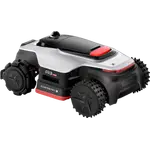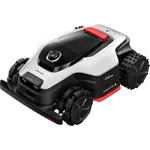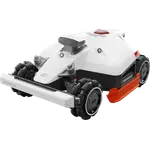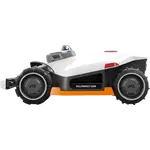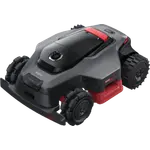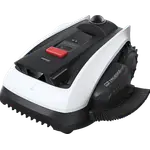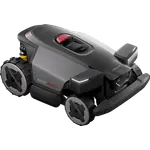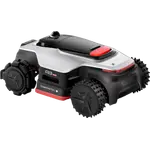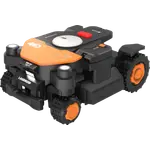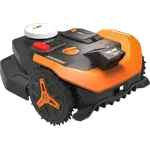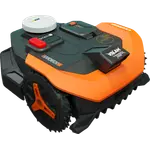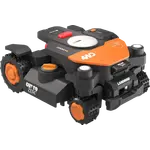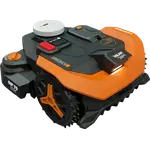
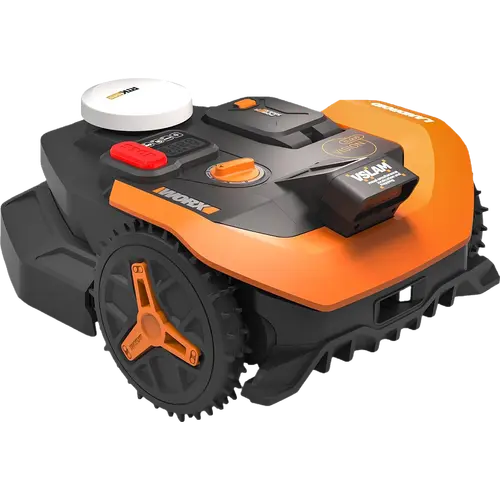


WORX Landroid Vision WO7144 Review: Cloud RTK and Vision Without an Antenna
The Landroid Vision WO7144 pairs cloud-delivered RTK with camera-based V-SLAM navigation, which means no boundary cable to bury and no reference antenna to mount in the garden. It is specified for lawns up to 10,890 sq ft, roughly a quarter acre, with an 8.7 in deck, Cut-to-Edge boundary mowing and a cutting range of 1.57 to 3.54 in. Two things set it apart from similarly priced rivals: it runs on WORX PowerShare batteries, so the pack is a shared, replaceable part rather than a sealed component, and it supports Alexa, Google Home and Home Assistant, which almost nothing else in this class does. The trade-off is terrain, because two-wheel drive and a 30% slope limit keep it on flat, even ground.
- Quarter-acre level lawns
- Home Assistant households
- Existing WORX PowerShare owners
- Gardens where an RTK mast is impractical
Pros
- Wire-free setup with cloud RTK, so no antenna mast and no boundary cable
- AI vision obstacle avoidance identifies obstacles instead of bumping them
- Cut-to-Edge mowing reaches the boundary rather than leaving a standing strip
- PowerShare battery is removable and shared with other WORX tools
- Alexa, Google Home and Home Assistant support, rare in this category
- Multi-zone mapping, no-go zones, scheduling and real-time tracking
- Rain sensor, lift and tilt detection, pet and child detection and emergency stop
- 3 year warranty
Cons
- Two-wheel drive and a 30% slope limit rule out banks and rough ground
- Narrow 8.7 in cutting deck makes sessions long on a full quarter acre
- No LiDAR, so navigation depends on cameras and cloud corrections
- Cloud RTK means positioning depends on an internet connection
- 2.4 GHz Wi-Fi only, which has to reach the far end of the garden
- Anti-theft features are not documented: no confirmed GPS tracking, PIN lock or alarm
- Weather resistance rating is not published for this model
- No Apple HomeKit, SmartThings or Matter support
Who is the Landroid Vision WO7144 for?
This is a mower for a flat, tidy suburban lawn of up to about a quarter acre. Positioning comes from a combination of cloud RTK, which supplies satellite corrections over the internet instead of from a local antenna mast, and camera-based V-SLAM that reads the surroundings. That removes the two most awkward parts of a robot mower install: there is no perimeter wire to peg or bury, and nothing has to be mounted with a clear view of the sky. The boundary lives in the app, where the lawn can be split into zones and no-go areas drawn around beds, ponds or a trampoline. Its 30% slope rating and two-wheel drive make level ground the assumption.
What the Landroid Vision offers
Beyond wire-free setup, three features stand out on the spec sheet. Cut-to-Edge means the deck reaches the boundary rather than leaving the standing strip along walls and beds that most robot mowers leave behind. AI vision obstacle avoidance identifies what is in front of the mower rather than simply bumping into it, which is what keeps a machine from pushing hoses, toys and garden waste around the lawn. And the battery is part of the WORX PowerShare system, so the pack can be removed and swapped by the owner; on a machine expected to last several seasons, a worn battery becomes a cheap part rather than the end of the mower. Safety coverage is complete for the category: rain sensor, lift and tilt detection, pet and child detection and a physical emergency stop. The integration list is unusually broad too, with Alexa, Google Home and Home Assistant all supported, alongside scheduling, real-time tracking in the app and automations. The body carries a 3 year warranty, at the long end for this class.
What to know before you buy
Terrain is the clearest limit. The Landroid Vision drives two wheels and is rated to a 30% slope, so banks, steep back gardens and rutted ground are outside its brief; all-wheel-drive rivals go to 80% and beyond. The 8.7 in cutting width is narrow, which stretches sessions on a lawn approaching its 10,890 sq ft rating. Navigation leans on cloud RTK, so the mower depends on an internet connection for corrections, and it joins 2.4 GHz Wi-Fi only, which means the signal has to reach the far end of the garden where the mower and station sit. There is no LiDAR here, so in heavy shade or at dusk the camera has less to work with than a laser-based system would. Anti-theft is also not documented for this model: neither GPS tracking, a PIN lock nor an alarm is confirmed in the specifications, which is worth checking if the mower will sit in an open front garden. Apple HomeKit, SmartThings and Matter are not supported.
Is the Landroid Vision WO7144 worth it?
It sits at the affordable end of wire-free mowing while still offering antenna-free RTK, edge cutting and a broad smart home feature set, which is a genuinely good combination for a flat quarter-acre lawn. The PowerShare battery and the 3 year warranty make it easier to live with over several seasons than models with sealed packs and one year cover. What you give up is capability on difficult ground and the speed of a wide deck, so if your lawn is sloped, uneven or much larger, an all-wheel-drive or LiDAR model is the better place to spend.
Frequently asked questions
Does the Landroid Vision WO7144 need a perimeter wire or an RTK antenna?
Neither. The boundary is created in the app rather than with a buried cable, and RTK corrections are delivered over the internet as a cloud service instead of from an antenna mounted in the garden.
How large a lawn can it mow?
It is rated for up to 10,890 sq ft, about a quarter acre, cutting an 8.7 in path at heights between 1.57 and 3.54 in.
Can the Landroid Vision handle slopes?
Up to 30%. It is a two-wheel-drive machine, so gentle rolls are fine but banks and steep back gardens need an all-wheel-drive mower.
Does it cut the lawn edges?
Yes. Cut-to-Edge lets the deck reach walls, fences and bed borders, which reduces the standing strip that mowers without edge cutting leave behind.
Can the battery be replaced?
Yes. It uses the WORX PowerShare battery system, so the pack is removable and interchangeable with other PowerShare tools rather than sealed inside the mower.
Does it work with Alexa, Google Home or Home Assistant?
All three are supported, which is unusual for a robot mower. Apple HomeKit, Samsung SmartThings and Matter are not.