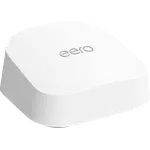
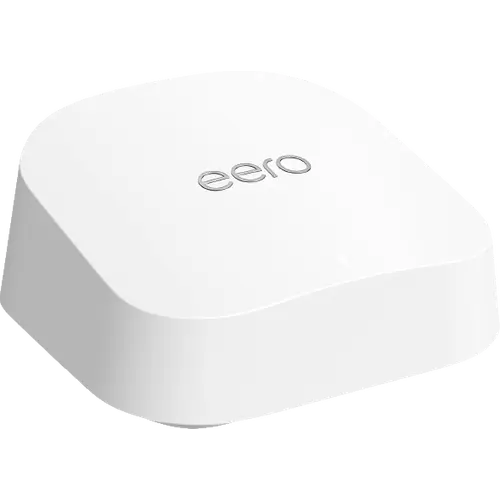
eero 7 Review: Dual-Band Wi-Fi 7 Mesh That Doubles as a Smart Home Hub
The eero 7 is Amazon's cheapest Wi-Fi 7 mesh node: dual-band BE5000, two auto-sensing 2.5 GbE ports, MLO, and a built-in Thread border router plus Matter and Zigbee controller. A single unit is rated for 2,000 square feet and 120 devices, and it joins every earlier eero generation. What it does not have is a 6 GHz radio, a web interface, USB storage or a VPN server, and content filtering, dynamic DNS and hotspot failover sit behind eero Plus. It is the set-and-forget pick when the internet plan is up to 2.5 Gbps and a separate smart home hub is something you would rather not buy.
- Internet plans up to 2.5 Gbps
- Apartments and smaller homes
- Thread and Matter smart homes
- Set-and-forget buyers
Pros
- Dual-band Wi-Fi 7 with MLO, rated BE5000, and up to 1.8 Gbps wireless
- Two auto-sensing 2.5 GbE ports for internet plans up to 2.5 Gbps
- Thread border router, Matter controller and Zigbee hub in the same box
- Joins an existing eero mesh alongside every earlier generation
- WPA3 encryption, a built-in firewall and a three-year warranty
- Rated for 120 connected devices and 2,000 square feet per unit
Cons
- No 6 GHz radio, so no Wi-Fi 6E band and no 320 MHz channels
- Content filtering, dynamic DNS, the IoT network and backup failover all need a paid subscription
- No web interface and no command line, so advanced tuning is limited to the app
- No USB data port, so no network drive, Samba shares or Time Machine backups
- No VPN client or server, and no link aggregation
Who is the eero 7 for?
This is the Wi-Fi 7 eero for a home whose internet plan is up to 2.5 Gbps and whose devices still live on 2.4 and 5 GHz. Dual-band BE5000 with Multi-Link Operation, two auto-sensing 2.5 GbE ports and a 120-device rating cover a typical apartment, condo or smaller house, and extra nodes extend the same TrueMesh network rather than replacing it.
It also runs the smart home side of the house. Thread border router, Matter controller and a Zigbee hub are built in, so locks, bulbs and sensors can commission without a separate bridge. Owners of older eero hardware are a natural audience, since an eero 7 drops into an existing mesh as a gateway or an extender.
What stands out on paper
Wi-Fi 7 without the 6 GHz tax is the pitch. BE5000 across 2.4 GHz (688 Mbps) and 5 GHz (4,324 Mbps, 240 MHz channels) plus MLO is the generation step; two 2.5 GbE auto-sensing ports mean the wired side can keep up with a 2.5 Gbps plan. Coverage is 2,000 square feet per unit, with a three-year warranty that matches the rest of the current eero Wi-Fi 7 line.
The software is the other half. TrueMesh, TrueRoam and TrueChannel steer clients and pick channels, WPA3 and a firewall are on by default, and profiles, scheduled pauses and instant pause live in the eero app for Android and iOS. Guest wifi is included. Setup is app-only, which is the point of the product rather than a missing page.
What to know before you buy
There is no 6 GHz radio, so there is no Wi-Fi 6E band and no 320 MHz channels. Compatible Wi-Fi 7 clients still get MLO on 2.4 and 5 GHz; anything that wanted a clean 6 GHz hop needs the Pro 7 or Max 7.
Control is limited. There is no web interface and no command line, the only USB connector is the 15 W charging inlet, and there is no VPN client or server. Content filtering, site blocking, dynamic DNS, a dedicated IoT SSID and hotspot failover all need a paid subscription. Profiles and pause controls do not.
Is the eero 7 worth it?
At the affordable Wi-Fi 7 tier, yes, if you are buying it for what it is. Dual-band Wi-Fi 7, multi-gig ports, a Thread and Matter hub and a three-year warranty is more than most mesh nodes at this level ship, and it mixes with every earlier eero. What you give up against the Pro 7 is the 6 GHz radio, faster Ethernet and a higher device rating.
What you give up against a configurable router is the tinkering, plus the recurring cost if you want filtering and failover. If the job is a faster, quieter network that also talks Thread and Matter, this is the eero that does it without a tri-band price.
Frequently asked questions
Does the eero 7 need a subscription?
No, the router works fully without one. Wi-Fi, the mesh, profiles, scheduled pauses, instant pause and the built-in firewall are all free. A paid subscription is only required for content filtering and site blocking, dynamic DNS, a separate IoT network and automatic failover to a backup hotspot.
Can the eero 7 act as a smart home hub?
Yes. It is a Thread border router and a Matter controller, and it includes a Zigbee hub, so Thread, Matter and Zigbee accessories can be commissioned into it instead of needing a separate bridge.
Does the eero 7 have a 6 GHz band?
No. It is dual-band Wi-Fi 7 on 2.4 GHz and 5 GHz only. There is no 6 GHz radio, so it is not a Wi-Fi 6E router. The eero Pro 7 and eero Max 7 add 6 GHz.
Does the eero 7 work with older eero units?
Yes. It is compatible with every previous eero generation and can join an existing eero network as a gateway or as an extender.
How fast is the eero 7?
It carries a BE5000 dual-band rating, roughly 5 Gbps aggregated across 2.4 GHz (688 Mbps) and 5 GHz (4,324 Mbps), and eero quotes up to 1.8 Gbps wireless and 2.3 Gbps wired. Its two auto-sensing 2.5 GbE ports support internet plans up to 2.5 Gbps.
Can you manage the eero 7 from a browser?
No. There is no web interface and no command line access. Setup and every network setting are handled through the eero app on Android or iOS.