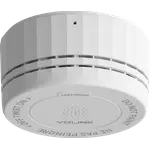



YoLink Photoelectric Smoke Alarm Review: LoRa Range and SMS Alerts for Outbuildings
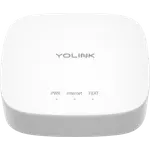
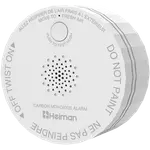
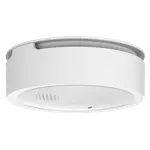
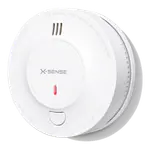
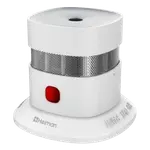
The YoLink YS7A12-UC is a smart smoke alarm built on LoRa rather than Wi-Fi or Zigbee, and that choice is the point: LoRa reaches far further than either, so a detector in a detached garage, barn, workshop or basement still reports to the hub. Detection is photoelectric, certified to UL 217 10th Edition and CAN/ULC S531, and alerts arrive by app, SMS and email through a YoLink hub, with self-test included and a five year battery. It detects smoke only, needs a YoLink hub, and there is no Google Home, HomeKit or Matter support.
- Outbuildings, garages and workshops
- Large properties
- SMS alerts while away
- Home Assistant setups
Pros
- LoRa gives far greater range than Wi-Fi or Zigbee, suiting outbuildings
- UL 217 10th Edition and CAN/ULC S531 certified photoelectric sensor
- Alerts by app, SMS and email through the hub
- Built-in self-test
- Five year battery life with low battery warnings
- Triggers smart home automations on a smoke event
- Works with Home Assistant and IFTTT
- Two year warranty
Cons
- Requires a YoLink hub, with no Wi-Fi, Zigbee, Z-Wave or Thread option
- Smoke detection only: no carbon monoxide sensor
- No Google Home, Apple HomeKit, SmartThings or Matter support
- No emergency light or pathlight
- Battery type is not documented
- Only worthwhile as part of a YoLink system
Who is the YoLink smoke alarm for?
It is for the building your Wi-Fi does not reach. LoRa is a long-range low-power radio, and YoLink's whole system is built on it, which makes this alarm viable in a detached garage, a shed with a workbench, a barn or a far corner of a basement, all places where a fire is both likely and unnoticed. The SMS and email alerting matters for the same reason: if the building is unoccupied, a phone notification is the only thing that will reach you. Home Assistant and IFTTT are supported, but not Alexa, which has no device type for smoke alarms outside Matter.
What it offers
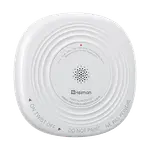
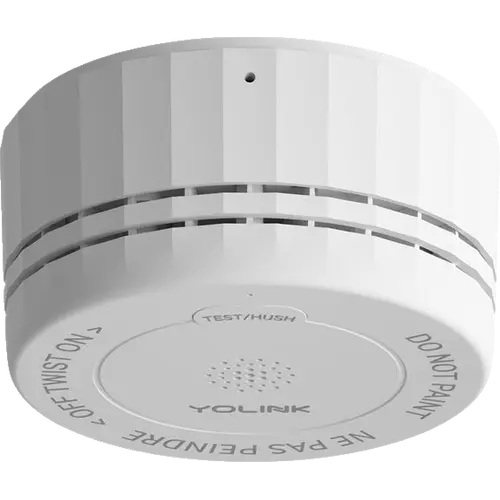
Photoelectric smoke detection, the type that responds better to smouldering fires, certified to UL 217 10th Edition and CAN/ULC S531, which are the current standards including improved cooking nuisance requirements. Alerts go out through the app, SMS and email via a YoLink hub, and the alarm can also trigger automations, so a smoke event can switch on lights or cut power to a circuit elsewhere. Self-test is built in, which is unusual and means the unit verifies itself rather than relying on you pressing the button. Battery life is five years, with low battery warnings, in a compact 71 x 71 x 38 mm body, and the warranty is two years.
What to know before you buy
A YoLink hub is required: LoRa is proprietary here and there is no Wi-Fi, Zigbee, Z-Wave or Thread option, so this only makes sense as part of a YoLink system. It detects smoke only, with no carbon monoxide sensor, so a separate CO alarm is still needed. Google Home, Apple HomeKit, SmartThings and Matter are all unsupported. There is no emergency light or pathlight, and the battery type is not documented, only the five year life.
Is the YoLink smoke alarm worth it?
For a standard bedroom it is unnecessary, since ordinary interconnected alarms cost less. Its value is entirely in range: if you need smoke detection somewhere Wi-Fi does not reach and running cable is impractical, LoRa solves a problem the alternatives cannot, and the SMS alerting means an alarm in an empty outbuilding actually reaches you. Buy it as part of a YoLink setup covering a larger property, not as a one-off detector.
Frequently asked questions
Why LoRa instead of Wi-Fi?
Range. LoRa reaches much further than Wi-Fi or Zigbee, so a detector in a detached garage, barn or distant basement still reaches the hub, which is the main reason to choose this alarm.
Does it need a hub?
Yes, a YoLink hub. There is no Wi-Fi or other radio, so it cannot work standalone as a connected device.
Does it detect carbon monoxide?
No. It is a photoelectric smoke alarm only, so a separate CO alarm is still required.
How will I know about an alarm when I am away?
Through app notifications, SMS and email sent via the YoLink hub, which is what makes it useful for unoccupied buildings.
Does it test itself?
Yes, self-test is built in, so the unit verifies its own operation rather than depending on manual button tests.