Winner

50% OFF
$39.99
$79.99
33% above its lowest price of the last 6 months ($29.99)

Full Smart Speakers comparison in 2026

We follow prices across the catalog and email you the best deals we find.
No spam. Unsubscribe in one click.
| Feature | Amazon Echo Dot (5th Gen) | Amazon Echo Studio | Winner |
|---|---|---|---|
| Price | $39.99 | $199.99 | Amazon Echo Dot (5th Gen) |
| Rating | 4.7 | 4.5 | Amazon Echo Dot (5th Gen) |
| Hub | Matter Bridge | Zigbee Coordinator, Thread Border Router, Matter Bridge | Amazon Echo Studio |
| Sensors | Motion, Temperature | None | Amazon Echo Dot (5th Gen) |
| Warranty | 90 days | 90 days | Tie |
| Connectivity | 2.4 GHz WiFi, 5 GHz WiFi, Bluetooth | 2.4 GHz WiFi, 5 GHz WiFi, Bluetooth | Tie |
| Integrations | Alexa, Home Assistant | Alexa, Home Assistant | Tie |
| Voice Assistant | Amazon Alexa | Amazon Alexa | Tie |
| Alerts | Glass breaking, Smoke/CO alarm | Glass breaking, Smoke/CO alarm | Tie |
The Amazon Echo Studio carries a Zigbee coordinator and a Thread border router on top of its Matter bridge, while the Amazon Echo Dot (5th Gen) only bridges Matter. If your smart home uses Zigbee or Thread, the Studio can run it and the Dot cannot.
The Amazon Echo Dot (5th Gen) senses motion and temperature for routines, and the Amazon Echo Studio has no sensors at all, so triggers based on someone entering the room or the room temperature are only available on the Dot.
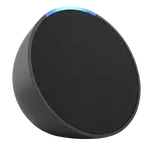
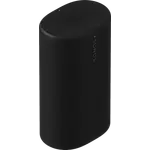
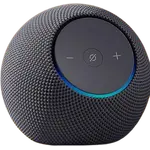
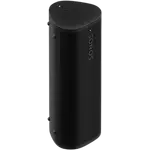
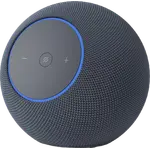
The Amazon Echo Dot (5th Gen) is a small puck you can tuck on a shelf, and the Amazon Echo Studio is a 3.5 kg music cabinet, which is why one is a background speaker and the other is meant to fill a room.
The Amazon Echo Studio has a 3.5 mm line-in for a turntable or another source, while the Amazon Echo Dot (5th Gen) has no audio input at all and streams over Bluetooth only.
The Amazon Echo Dot (5th Gen) is the affordable one, and buying several also unlocks multi-room audio and intercom.
The Amazon Echo Studio is a Zigbee coordinator and a Thread border router, so those devices pair to it directly.
The Amazon Echo Studio is the bigger, louder speaker built for music and for pairing with a Fire TV.
The Amazon Echo Dot (5th Gen) has a temperature sensor and the Amazon Echo Studio does not.
Only the Amazon Echo Studio has a 3.5 mm line-in, and the Dot has no wired audio input.
Owners of both Amazon speakers agree the setup is quick, and then they part ways. Amazon Echo Dot (5th Gen) owners are surprised by the sound from such a small puck, use it to run lights, plugs and cameras by voice, and like that it can extend an Eero mesh network and bridge Matter; their warnings are the Alexa-only platform, the missing audio-out jack, a subscription for glass-break and smoke listening, and occasional accidental wake-ups. Amazon Echo Studio owners go the other way and talk music, describing deep bass, a stereo pair that can substitute for a soundbar with a Fire TV and automatic room calibration, while flagging home theater dropouts and Alexa straining to hear at high volume. Both groups note the short warranty.
Every price change of both, in the same store, so the gap between the two lines is what one costs more than the other.
Loading price history...
For most rooms the Amazon Echo Dot (5th Gen). It is cheaper, better reviewed, adds motion and temperature sensing, and even bridges Matter. The Amazon Echo Studio is the stronger device only when the job is sound or when you need a full Zigbee and Thread hub.
Size and role. The Amazon Echo Dot (5th Gen) is a small, inexpensive speaker with extra sensors, and the Amazon Echo Studio is a large music-first speaker that also acts as a Zigbee coordinator and Thread border router.
Only partly. The Amazon Echo Dot (5th Gen) bridges Matter and can control many devices by voice, but it has no Zigbee coordinator and no Thread border router, both of which the Amazon Echo Studio has.
No. The Amazon Echo Dot (5th Gen) sounds full for its size, but the Amazon Echo Studio is a much larger speaker with far more output for a living room.
The Amazon Echo Dot (5th Gen), because it is small, has a temperature sensor and costs less, while the Amazon Echo Studio is oversized for a nightstand.
Anyone who wants the speaker to be the point: music in a large room, a stereo pair, or a Fire TV home theater, along with a built-in Zigbee coordinator, Thread border router and Matter bridge.
You are looking at two of them. The full table lines up all Speakers in the catalog with the same specs, so you can filter by what you need and sort by price or rating.