

Sonoff SNZB-02M AirGuard Review: The Cheap Zigbee Sensor That Finally Adds Air Pressure
The Sonoff SNZB-02M AirGuard is a compact Zigbee 3.0 sensor that adds barometric pressure to the usual temperature and humidity pair, and lets the app derive dew point and VPD on top. Owners repeatedly describe pairing as a two-minute, no-drama affair on Zigbee2MQTT or ZHA, with every entity populated straight away and readings that match their existing thermometers. The main catches are practical rather than technical: it needs a Zigbee hub, it has no display, it carries no weather rating, and it runs on the unusual CR2477 cell. It is a strong pick for Home Assistant users who want dew point or VPD data for a greenhouse, cellar or workshop automation.
- Home Assistant and Zigbee2MQTT users
- Greenhouse and grow-space monitoring
- Cellar and attic dew point automations
- Multi-room climate monitoring
One sensor per room you want to read.
Buy on Amazon USACheck pricePros
- Adds barometric pressure plus calculated dew point and VPD to the usual temperature and humidity
- Pairs with Zigbee2MQTT and ZHA in seconds with all entities populated
- Tight quoted accuracy of 0.2 C, 2 percent RH and 0.1 hPa
- Readings verified by owners against existing thermometers
- Solid build quality that feels above its price
- Magnetic mount with metal backplate, adhesive pad and screws included
- Rated for over 2 years on the included CR2477 cell
- Backed by a 2 year warranty
Cons
- Air pressure is not exposed on every platform, with SmartThings and Smart Life reported as missing it
- Requires a Zigbee hub, no Wi-Fi, Bluetooth or Thread
- Uses the uncommon CR2477 battery, and the lid can be stiff
- No display, readings live only in an app or dashboard
- No weather resistance rating, indoor use only
- Mounting backplate is orange with a visible tab
- Reports absolute pressure with no sea level correction
Who is the Sonoff SNZB-02M AirGuard for?
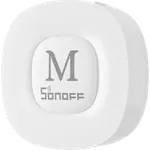
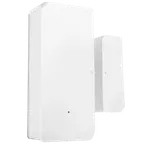
This is a hub-dependent Zigbee sensor for people running a local smart home who want more than a bare temperature reading. Alongside temperature and humidity it measures barometric pressure, and the app derives dew point and vapour pressure deficit from those values, which is the reason most buyers pick it over a cheaper two-sensor unit. Owners describe deploying it in greenhouses, garage workshops, basements, attics, wine cellars and sheltered garden spots, typically wiring it into an automation: a ceiling fan that starts when the workshop gets hot, a room-by-room HVAC nudge driven by whichever room is occupied, or a dew point calculation that decides when cellar ventilation should run. It is small and light, at 45 mm across and under 30 grams, and it sticks to a magnetic backplate that can be taped or screwed in place.
What buyers love
Pairing is the single most praised thing. Buyers who own a lot of Zigbee kit describe it being picked up by Zigbee2MQTT or ZHA within seconds of pulling the battery tab, arriving in Home Assistant with all its entities already populated and needing no custom quirks file, with several quoting setup times of under two minutes. Accuracy is the next theme: multiple owners cross-checked it against thermometers they already trusted and found the readings matched, and the quoted tolerances of a fifth of a degree Celsius, two percent relative humidity and a tenth of a hectopascal come up often as unusually tight for the price. The pressure channel itself is valued for spotting weather shifts before they arrive and, in growing spaces, for making VPD available as a plant-stress signal. Build quality gets consistent praise as feeling more solid than typical thin-walled budget sensors, and the magnetic mount is a recurring favourite because the sensor can be rotated or repositioned by hand with no fixings.
What to know before you buy
The most important caveat is that the pressure reading is not exposed by every platform. One owner found temperature and humidity worked on a SmartThings hub and on a Moes gateway through Smart Life, but the air pressure value simply did not appear, and reached for Home Assistant to get it. If barometric pressure is the reason you are buying, plan on a Zigbee2MQTT or ZHA setup, and note that at least one buyer had to update Zigbee2MQTT to its newest release before the device was fully supported. The battery is the other running complaint: the CR2477 is a thicker cell than the common CR2032 and is not something most people have spare, and one review describes the battery lid as stiff to open. Beyond that, there is no display, so readings only exist in an app or dashboard; there is no weather resistance rating, and although several owners run it outdoors under cover they note a sealed version would be welcome; and the included mounting plate is in Sonoff orange with a protruding tab, which a few buyers dislike enough to paint over. One owner also points out the firmware reports absolute pressure with no sea-level correction.
Is the Sonoff SNZB-02M AirGuard worth it?
For anyone already running a Zigbee coordinator, yes. It sits at the budget end of the sensor market while adding a barometer and the derived dew point and VPD figures that most rivals at this price omit, and the reviews are consistently positive about both the accuracy and how little effort it takes to get running. Buyers who want a screen, an outdoor-rated enclosure, a common coin cell, or a sensor that works without a hub should look elsewhere, and anyone whose platform is SmartThings rather than Home Assistant should be aware they may only get the temperature and humidity half of what they paid for.
Frequently asked questions
Does the Sonoff SNZB-02M need a hub?
Yes. It is a Zigbee 3.0 end device with no Wi-Fi or Bluetooth, so it needs a Zigbee coordinator such as a Sonoff Zigbee bridge, a Sonoff iHost, a Zigbee2MQTT or ZHA dongle, or an Echo with a built-in Zigbee hub.
Will the air pressure reading work on my platform?
Not always. Temperature and humidity are reported everywhere, but owners have found the barometric pressure value missing on a SmartThings hub and through the Smart Life app on a third-party gateway. Home Assistant via Zigbee2MQTT or ZHA is the setup buyers report full pressure support on, and Zigbee2MQTT may need updating to its latest version.
What are dew point and VPD, and does the sensor measure them directly?
No, they are calculated. The sensor measures temperature, humidity and air pressure, and the app derives dew point and vapour pressure deficit from those readings. VPD is particularly useful in greenhouses because it indicates actual plant stress better than raw temperature or humidity alone.
How long does the battery last and what type is it?
It runs on a single CR2477 lithium cell, which is included, and Sonoff rates it for over 2 years. Note the CR2477 is thicker than the common CR2032 and is harder to find as a spare.
Can it be used outdoors?
It is specified for indoor use with no weather resistance rating. Several owners do run it outside in sheltered spots such as under an eave or in a garden shed, but that is outside the stated specification.
Does it have a screen?
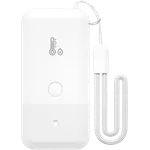
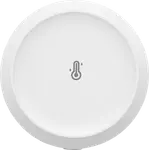
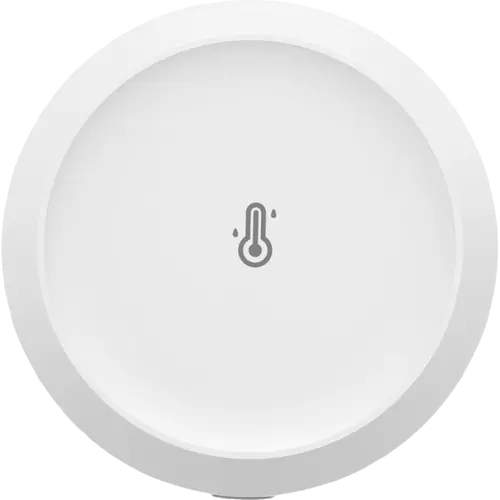
No. There is no display on the unit, just a thermometer icon on the top face. All readings are viewed in the connected app or smart home dashboard.