

Google Nest Learning Thermostat Review: The Self-Programming Classic That Still Holds Up
The Nest Learning Thermostat is for homeowners who want a thermostat that programs itself rather than one they have to configure by hand. Buyers consistently praise the straightforward app control, the auto-learning schedule, and the solid build quality across several color finishes, while the main friction points are an occasionally fiddly Wi-Fi reconnect and a setup that rewards (or requires) some basic HVAC wiring know-how. For most homes with a standard heating/cooling system, it remains a durable, well-integrated pick.
- Homeowners who want automatic, learning-based scheduling
- Google Home and Alexa households
- Buyers who want a metal-finish thermostat that matches home decor
- Multi-property owners standardizing on one thermostat brand
Pros
- Learns your routine and builds its own heating/cooling schedule automatically
- Auto-detects HVAC wiring and reports energy savings from learned schedules
- Works with Google Home, Alexa and Samsung SmartThings
- Multiple metal finishes with an included trim plate for a clean wall install
- Occupancy, humidity and ambient-light sensors support smarter automation
Cons
- No Apple HomeKit support
- 2.4GHz/5GHz Wi-Fi only, with occasional reports of dropped connections
- No touchscreen; detailed scheduling relies on the companion app
- No built-in air-quality, fire or intrusion alerts
- No voice control or built-in speaker on the device itself
Who is the Nest Learning Thermostat for?
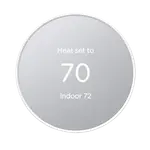
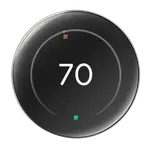
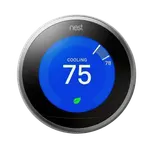
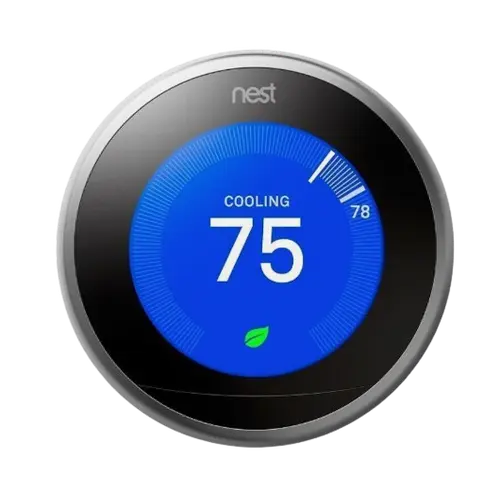
The Nest Learning Thermostat targets homeowners who want to set it and mostly forget it: instead of building a manual schedule, the thermostat observes when the house is occupied and how residents adjust the temperature, then builds its own schedule around that pattern. It ships in several finishes, including Stainless Steel, White, Black, Copper, Polished Steel, Brass and Mirror Black, so it doubles as a small decor choice on the wall. Built-in proximity, occupancy, humidity and ambient-light sensors feed that automation, and a temperature-alert feature flags unusual swings. It works with Google Home, Amazon Alexa and Samsung SmartThings, plus partial Home Assistant support (this 3rd generation has no Matter), so it slots into most mixed-ecosystem homes. Apple HomeKit is the one major gap, so HomeKit-only households should look elsewhere.
What buyers love
The recurring praise across reviews centers on how little day-to-day effort the thermostat demands once it is installed: it auto-detects the connected HVAC wiring, learns a routine within days, and can be checked or adjusted remotely from a phone. Several long-time owners mention buying multiple units for different properties after years of reliable service, and more than one review specifically calls out that the learning/auto-schedule behavior delivers noticeable energy savings without manual tweaking. The metal trim ring and overall build quality also come up often as feeling more premium than typical plastic thermostats, which lines up with the included trim plate and color-finish options in the spec sheet.
What to know before you buy
The most common complaint is Wi-Fi related: a handful of buyers report the thermostat dropping off the network after months of use and needing a fresh setup, and the item's spec sheet confirms Wi-Fi (2.4GHz and 5GHz) is the only wireless connection method, with no Z-Wave, Zigbee or Thread backup. Initial pairing to a Google/Nest account is also flagged by more than one reviewer as needing a couple of attempts before it sticks. On the hardware side, the display is a 2 inch screen without touch input, so all detailed scheduling happens in the companion app rather than on the device itself, and there is no built-in speaker or voice control. Buyers outside the US should also note that some reviewers ran into limited local warranty support when the unit was purchased through a US-based Amazon listing.
Is the Nest Learning Thermostat worth it?
Given its ecosystem support (Google Home, Alexa, SmartThings), auto-scheduling that reviewers say genuinely reduces energy use, and a 2 year warranty, the Nest Learning Thermostat holds up well against newer rivals despite lacking a touchscreen or air-quality alerts. It suits buyers who prioritize hands-off scheduling and broad smart home compatibility over the latest color touchscreen, and the consistently high ratings from a large pool of owners back up that it remains a dependable long-term pick for standard HVAC setups.
Frequently asked questions
Does the Nest Learning Thermostat work with Alexa and Google Home?
Yes. It integrates with both Google Home and Amazon Alexa, plus Samsung SmartThings. Matter never came to this generation, so there is no Apple Home support either, and Home Assistant support is only partial.
Does it have a touchscreen?
No. It has a 2 inch color LCD display for glanceable status, but scheduling and detailed settings are managed through the companion app rather than by touching the screen.
Does the Nest Learning Thermostat need extra sensors to work well?
Not necessarily. It includes built-in proximity/motion, occupancy, temperature, humidity and ambient-light sensors that power its auto-scheduling, and it also supports external temperature sensors if you want multi-room coverage.
Will it actually lower my energy bills?
The thermostat includes dedicated energy-savings features built around its learned schedule, and this matches what many buyers report: reduced manual thermostat adjustments and noticeable savings once the learning period settles in.
What connectivity does it use?
It connects over 2.4GHz and 5GHz Wi-Fi plus Bluetooth for setup. It does not support Z-Wave, Zigbee or Thread, so it relies entirely on your home Wi-Fi network.