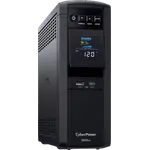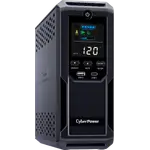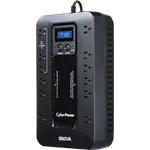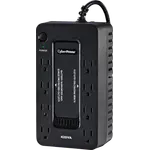
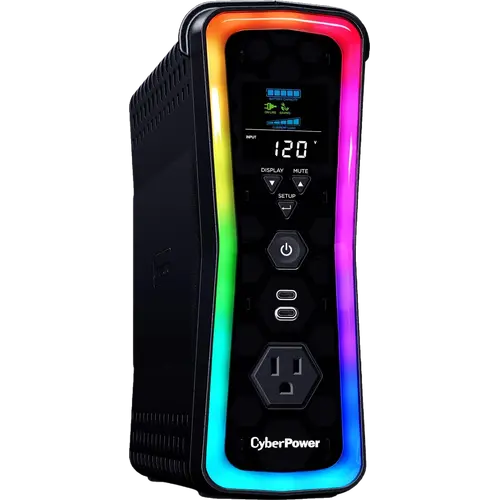


CyberPower GX150C2 Gaming UPS Review: 1000 W of Sine Wave Backup with an RGB Halo
The CyberPower GX150C2 is a 1500 VA / 1000 W tower UPS built for a high-end gaming PC and the gear around it: it puts out a true sine wave on battery, so active PFC power supplies stay happy, and its line-interactive design with Automatic Voltage Regulation corrects brownouts and overvoltage without draining the battery. It splits 13 NEMA 5-15R outlets into seven with battery backup and six surge-only, adds two USB-C charging ports and a color LCD, and reports over USB HID to a PC, a NAS or Home Assistant. The trade-offs are the usual lead-acid ones: it is heavy, needs about eight hours to recharge and runs only a couple of minutes at its full 1000 W.
- Gaming PCs with active PFC power supplies
- Streaming and gaming setups
- A monitor plus console on the same desk
- Home networks with a modem, router and NAS
Pros
- True sine wave output on battery, safe for active PFC power supplies
- 1000 W of line-interactive capacity with Automatic Voltage Regulation
- Seven battery backup outlets and six surge-only, two widely spaced
- Two USB-C charging ports (30 W shared) that work on battery
- Color LCD showing load, battery and input voltage
- USB HID port read by a PC, a NAS or Home Assistant through Network UPS Tools
- User-replaceable battery and a three-year warranty that covers it
- GreenPower high-efficiency design lowers the unit's own consumption
Cons
- Sealed lead-acid battery instead of LiFePO4
- Short runtime at full load, about 2.3 minutes
- About 8 hours to recharge after a full discharge
- No network management port or card slot, so no web, SNMP or phone monitoring
- No Wi-Fi or Bluetooth; monitoring is over USB only
- No Ethernet or coaxial data line surge protection
- No USB-A charging port and no external battery pack option
Who is the CyberPower GX150C2 Gaming UPS for?
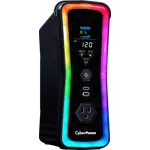
It is aimed at a gaming desk that cannot lose power mid-match: a high-draw PC with an active PFC power supply, a monitor, a console and the router. The 1000 W rating leaves room for a powerful rig under load, and the seven battery backup outlets cover the PC, the screen and the network gear, so the internet stays up after the computer is shut down. The RGB light halo and the color LCD are meant to sit beside the rig rather than hide under the desk, and the front USB-C ports keep a controller, a headset or a phone charged even during an outage.
What the CyberPower GX150C2 offers
The battery output is a true sine wave, which matters for power supplies with active PFC that can shut off or buzz on the stepped waveform of cheaper units. It is line-interactive with Automatic Voltage Regulation that corrects low and high mains voltage without switching to battery, and the transfer to battery takes about 8 ms. The 13 NEMA 5-15R outlets split into seven with battery backup and six surge-only, two of them widely spaced for oversized gaming power bricks, behind a 1445 joule surge rating. On the front sit two USB-C charging ports (30 W shared) that keep working on battery, plus a color LCD control panel showing system status, battery life, load and input voltage. A HID compliant USB port lets a PC or a NAS read the UPS and shut itself down cleanly, and CyberPower's free PowerPanel software handles that on Windows. GreenPower high-efficiency design keeps the unit's own consumption down.
What to know before you buy
The battery is sealed lead-acid, a pair of 12 V / 9 Ah cells with the RB1290X2 replacement cartridge, and a full recharge takes about 8 hours, so a 120 V North American outlet is required. CyberPower publishes about 9.2 minutes at half load and 2.3 minutes at the full 1000 W, so with a big gaming PC under load the budget is a few minutes to save and quit, not to ride out a long outage. There is no network management port, no card slot, no Wi-Fi or Bluetooth and no phone app: monitoring runs over the USB HID port. It also carries no Ethernet or coaxial data line protection, no USB-A charging port and no external battery pack connector, and at about 11 kg it is heavy to move once positioned.
Is the CyberPower GX150C2 worth it?
For a gaming setup that needs a true sine wave and more outlets than a plain network UPS, the GX150C2 covers the essentials of the 1000 W class: line-interactive AVR, an 8 ms transfer, seven battery-backed outlets, front USB-C charging, a user-replaceable battery and a three-year warranty that covers it. The gaming styling adds the RGB halo and the color LCD rather than more runtime, so a plain sine wave tower of the same capacity does the same job when looks do not matter, and a LiFePO4 unit lasts longer and recharges faster at a higher upfront cost.
Frequently asked questions
Is the CyberPower GX150C2 a pure sine wave UPS?
Yes. CyberPower lists the on-battery waveform as a sine wave, which makes it compatible with computer power supplies that use active power factor correction.
How long does the CyberPower GX150C2 run on battery?
CyberPower rates it at 9.2 minutes at half load (500 W) and 2.3 minutes at full load (1000 W). Lighter loads such as a modem, a router and a few network devices run much longer than the half-load figure suggests.
How many outlets does the CyberPower GX150C2 have?
Thirteen NEMA 5-15R outlets: seven with battery backup and surge protection and six with surge protection only, two of them widely spaced for large adapters, plus two USB-C charging ports on the front.
Does the CyberPower GX150C2 work with Home Assistant or a NAS?
Yes. It reports over a HID compliant USB port, which Network UPS Tools reads with its usbhid-ups driver, so Home Assistant's NUT integration and NAS units that support USB HID UPS monitoring can read its status and shut down safely before the battery runs out.
Can I replace the battery in the CyberPower GX150C2?
Yes. CyberPower lists the battery as user replaceable, using the RB1290X2 replacement cartridge that holds the two 12 V / 9 Ah sealed lead-acid cells.
Does the CyberPower GX150C2 have a network port or a phone app?
No. It has no network management port, no card slot and no Wi-Fi or Bluetooth, so monitoring runs over the USB HID port with PowerPanel on a connected computer. There is no phone app of its own.