Home Assistant Voice Review: A Voice Assistant That Can Run Entirely on Your Own Network
Home Assistant Voice is the answer for people who want voice control without sending their speech to a company's servers. Speech to text, the conversation agent and text to speech can all run locally against your own Home Assistant instance, with cloud versions of each available through a subscription if you want more capable processing. The privacy hardware is real rather than decorative: the mute switch physically cuts power to the microphone. It only works with Home Assistant, has no screen or camera, and connects over 2.4 GHz Wi-Fi.
- Home Assistant users
- Privacy-focused homes
- Local-only voice control
- Tinkerers and self-hosters
Pros
- Speech to text, conversation and text to speech can all run locally
- Cloud versions available per stage with a subscription, if local is not enough
- Mute switch physically cuts power to the microphone
- No camera at all
- Programmable buttons plus volume and play/pause controls
- Line out for connecting a better speaker
- Small and light at 84 x 84 x 21 mm and 96 g
- Low price
Cons
- Home Assistant only: no Alexa, Google Home, HomeKit or SmartThings
- Not a hub: no Zigbee, Thread border router or Matter bridge
- No screen and no display of any kind
- No voice match, so it cannot tell family members apart
- No temperature, humidity, motion or ambient light sensing
- 2.4 GHz Wi-Fi only, with no Ethernet and no 5 GHz
- Line out only, with no line in
- Warranty terms are not documented
Who is Home Assistant Voice for?
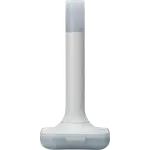
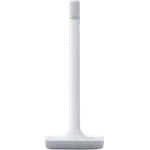
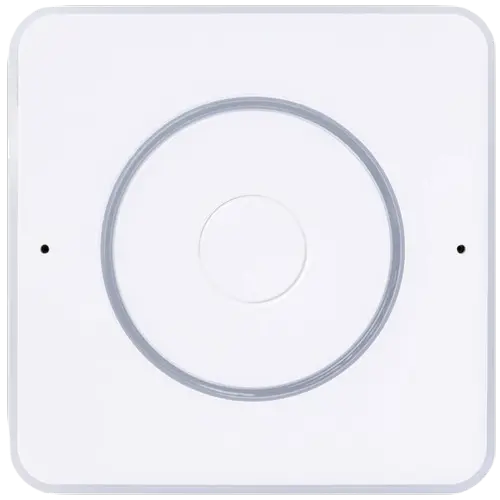
It is for people already running Home Assistant who want to talk to it. Mainstream smart speakers are the front end of a cloud service; this one is the front end of your own server, which changes both the privacy story and what the assistant can do, since it addresses your entities and automations directly rather than a vendor's device list. It is a small unit, 84 mm square and 96 g, designed to sit on a shelf or a desk in the room you want to control.
How the local voice stack works
All three parts of the voice pipeline exist in local form: speech to text turns your words into text on your own hardware, the conversation agent interprets the request, and text to speech generates the spoken reply. Nothing has to leave the house. Cloud versions of each stage are available with a subscription, which is the route to take when local models are not accurate enough or your server is not powerful enough, and the choice is yours per stage rather than all or nothing. On the device there are volume and play/pause controls plus programmable buttons, so common actions can be triggered without speaking at all, and a line out lets it feed an external speaker for better audio.
Privacy hardware
The mute switch is the detail that separates this from other assistants: it physically cuts power to the microphone rather than asking the software to ignore it. For an always-listening device in a bedroom or a home office, that is the difference between trusting a setting and trusting a circuit. There is also no camera at all, and no ambient light or motion sensing, so the device has no way to observe the room beyond hearing it.
What to know before you buy
Home Assistant is the only supported platform, by design: there is no Alexa, no Google Home, no Apple HomeKit and no SmartThings, so this is not a device to buy before you have a Home Assistant server running. It is not a hub either, with no Zigbee coordinator, no Thread border router and no Matter bridge. There is no screen, no camera, no built-in temperature or humidity sensing, and no voice match, so it will not tell family members apart. Wi-Fi is 2.4 GHz only, with no Ethernet port and no 5 GHz, and audio output is line out only rather than line in. Warranty terms are not documented.
Is Home Assistant Voice worth it?
It is cheap for a voice assistant, and cheaper still measured against what it replaces, which is a cloud service with an ongoing relationship to your speech. If you run Home Assistant and want voice control that keeps working when the internet is down and does not phone home, it is the most direct route there. If you do not run Home Assistant, there is nothing here for you, and if you want music playback and a polished assistant experience, a mainstream smart speaker will feel more finished.
Frequently asked questions
Does Home Assistant Voice work without the internet?
Yes, if you use the local pipeline. Speech to text, the conversation agent and text to speech all have local options that run against your own Home Assistant instance. Cloud versions of each are available with a subscription.
Does it work with Alexa or Google Home?
No. Home Assistant is the only supported platform.
How does the microphone mute work?
The mute switch physically cuts power to the microphone, rather than relying on software to stop listening.
Can it act as a Zigbee, Thread or Matter hub?
No. It is a voice device only, with no Zigbee coordinator, Thread border router or Matter bridge functionality.
Can I connect it to better speakers?
Yes. It has a line out, so it can feed an external speaker. There is no line in.