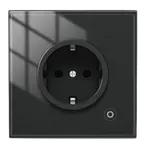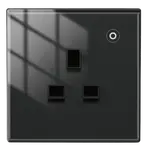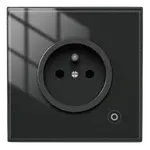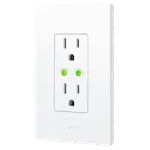
Moes WiFi Smart Wall Socket Glass (EU) Review: A 16 A In-Wall Socket With Energy Metering
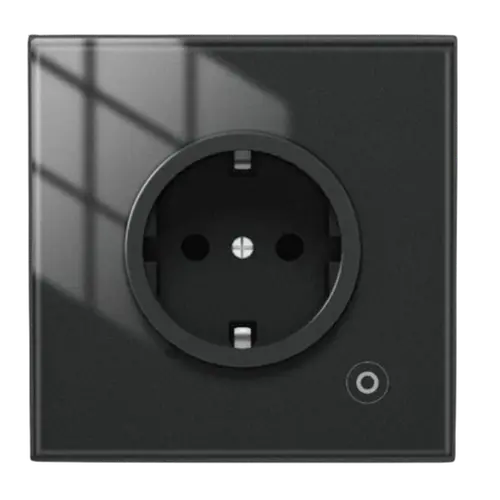
This Moes wall socket replaces a normal in-wall outlet with a smart one, so the appliance plugged into it can be switched and scheduled without a bulky adapter sticking out. The electrical rating is the strong part: 16 A and 3000 W across a wide 95-245 V range, which covers heavy loads that plug-in smart adapters usually cannot. It connects straight to 2.4 GHz Wi-Fi with no hub, reports energy consumption, and has a child lock. Platform support covers Google Home, Alexa and Home Assistant, but not Apple HomeKit or Matter. This is the Type C (European) version.
- European Type C sockets
- High-power appliances
- Energy usage tracking
- Google Home and Alexa homes
Pros
- 16 A and 3000 W rating, higher than most plug-in smart adapters
- Wide 95-245 V input range
- Energy monitoring on the connected appliance
- No hub required: connects directly to 2.4 GHz Wi-Fi
- Child lock and a physical on/off button
- Flush glass panel with nothing protruding
- Works with Google Home, Alexa and Home Assistant
- Low price
Cons
- Requires in-wall electrical installation
- No Apple HomeKit, SmartThings, IFTTT or Matter support
- No power-off memory, so it will not restore state after an outage
- No status LED
- Resistive loads only, with inductive and capacitive marked unsupported
- Protection features are not documented
- 2.4 GHz Wi-Fi only
- One year warranty
Who is this socket for?
Plug-in smart adapters are the easy way to make an appliance smart, but they protrude, they often block the second socket, and many are limited to 10 A or less. Replacing the socket itself solves all three problems: nothing sticks out, the glass panel looks deliberate rather than improvised, and the full 16 A rating stays available. It is the right approach for a spot you have already decided is permanent, like a heater, a washing machine corner or a bedside outlet. Wi-Fi means no hub, and control works through Google Home, Alexa or Home Assistant.
What it handles
The socket switches resistive loads up to 3000 W at 16 A, on AC from 95 to 245 V, which is a genuinely wide input range and enough headroom for demanding appliances. Energy monitoring reports what the connected device actually draws, which is how you find out that the old fridge or the electric heater is the reason for the bill. A physical on/off button keeps manual control available when the network is down, and a child lock stops the socket being switched by accident. Automations are supported through the connected platforms.
What to know before you buy
It is an in-wall device, so installation means working on mains wiring in a back box, and the plug format has to match: this is the Type C version, and Moes sells Type E and Type G variants for other regions. Only resistive loads are documented, with inductive and capacitive support marked as unsupported, so check before using it for motors or transformers. There is no Apple HomeKit, SmartThings, IFTTT or Matter support. Power-off memory is not available, so it will not restore the previous state after an outage, and there is no status LED. The four protection features (overheating, overvoltage, overcurrent, overpower) are not documented. It uses 2.4 GHz Wi-Fi only, and warranty is one year.
Is this Moes socket worth it?
It is cheap for an in-wall smart socket, and the 16 A rating plus energy metering are the two things worth paying for in this category. The compromises are documentation and ecosystem: several safety specs are unstated, and Apple households are excluded. For a Google Home, Alexa or Home Assistant setup where you want a permanent, tidy smart outlet on a European Type C socket, it does the job at a low price.
Frequently asked questions
Which plug format is this version?
Type C, the European format. Moes also makes Type E (French) and Type G (UK) versions of the same socket.
How much power can it switch?
Up to 3000 W at 16 A, on AC from 95 to 245 V, for resistive loads.
Does it need a hub?
No. It connects directly to 2.4 GHz Wi-Fi.
Does it work with Apple HomeKit?
No. Google Home, Alexa and Home Assistant are supported. Apple HomeKit, Samsung SmartThings, IFTTT and Matter are not.
Does it remember its state after a power cut?
No. Power-off memory is not supported on this model.