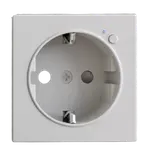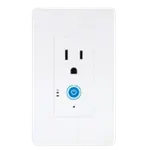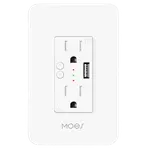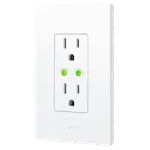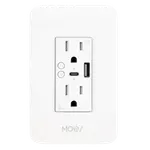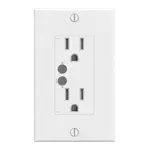
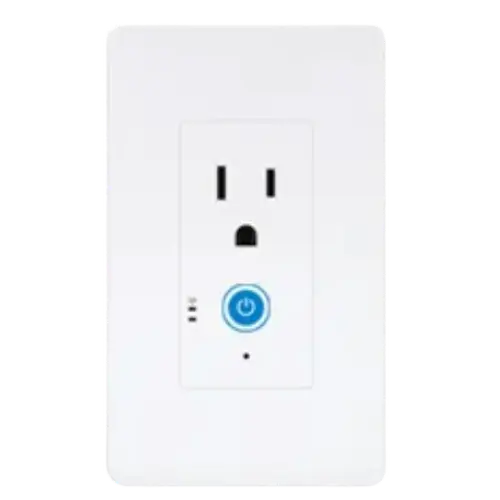
Sonoff Wi-Fi Smart In-Wall Outlet (IW100) Review: A 15 A Type B Socket With Energy Monitoring
The Sonoff IW100 swaps a standard North American wall outlet for a smart one, rated at 15 A and 1800 W on 120 V, with energy monitoring built in and overvoltage, overcurrent and overpower protection. Its integration list is the broadest in this price bracket, covering Google Home, Alexa, Samsung SmartThings, Home Assistant and IFTTT, and it needs no hub since it connects straight to 2.4 GHz Wi-Fi. Apple HomeKit and Matter are the notable absences, along with power-off memory and an on-device button.
- US Type B outlets
- Energy usage tracking
- Multi-platform smart homes
- Permanent smart outlets
Pros
- 15 A and 1800 W rating on 120 V
- Energy monitoring on the connected appliance
- Overvoltage, overcurrent and overpower protection
- Works with Google Home, Alexa, SmartThings, Home Assistant and IFTTT
- No hub required: direct 2.4 GHz Wi-Fi
- Status LED for at-a-glance state
- Two year warranty
- Low price
Cons
- No Apple HomeKit or Matter support
- No physical on/off button, so no manual control without the network
- No power-off memory after an outage
- No overheating protection
- Requires in-wall electrical installation
- Type B format only, for North American outlets
- Inductive and capacitive load support, child lock and LED adjustment are not documented
- 2.4 GHz Wi-Fi only
Who is the Sonoff IW100 for?
It is for someone who wants a specific outlet to be smart permanently, without a plug-in adapter blocking the second socket or hanging out of the wall. Being an in-wall device it keeps the full 15 A rating available, which is what a US circuit expects, and it looks like a normal outlet once fitted. The unusually wide platform support means it works whichever ecosystem you use, and the IFTTT and Home Assistant options make it usable in scripted setups as well as voice-controlled ones.
What it handles
Resistive loads up to 1800 W at 15 A on 120 V, which covers standard North American household appliances. Energy monitoring reports what the connected device consumes, turning the outlet into a measurement point for a specific appliance rather than the whole house. Safety coverage is better documented than many competitors: overvoltage, overcurrent and overpower protection are all present, each cutting power when the outlet detects a fault. A status LED shows what it is doing, and automations run through any of the supported platforms.
What to know before you buy
Installation means wiring it into a back box on mains power, and the format is Type B, so it is for North American style outlets specifically. Apple HomeKit and Matter are not supported. There is no power-off memory, so the outlet does not restore its previous state after an outage, and there is no on-device on/off button, which means no manual control if Wi-Fi is unavailable, an important difference from models that keep a physical button. Overheating protection specifically is not included, though the other three protections are. Inductive and capacitive load support is not documented, and neither is child lock or the ability to dim the status LED. Wi-Fi is 2.4 GHz only. On the plus side, the warranty is two years.
Is the Sonoff IW100 worth it?
It is inexpensive for an in-wall smart outlet with metering, and the two year warranty and broad platform support give it an edge over cheaper alternatives. The missing physical button is the compromise worth thinking about: if the outlet controls something you might need to switch when the network is down, look for a model that keeps a manual control. Otherwise, for a US home on Alexa, Google Home, SmartThings or Home Assistant, it is a solid, cheap way to make one outlet permanently smart.
Frequently asked questions
What load can the Sonoff IW100 handle?
Up to 1800 W at 15 A on 120 V, for resistive loads. Inductive and capacitive load support is not documented.
Does it work with Apple HomeKit?
No. Google Home, Alexa, Samsung SmartThings, Home Assistant and IFTTT are supported. Apple HomeKit and Matter are not.
Can I switch it by hand?
No. There is no on-device on/off button, so control depends on the app, a voice assistant or an automation.
Does it measure energy use?
Yes. Energy monitoring is built in, so you can see the consumption of whatever is plugged into it.
Which outlet format is it?
Type B, the North American three-pin format, with a single AC outlet.