

Fibaro Flood Sensor (Z-Wave) Review: A Compact, Hub-Friendly Leak Detector for Advanced Setups
The Fibaro Flood Sensor (Z-Wave) is built for owners who already run a Z-Wave or Home Assistant setup and want a compact, dependable leak, temperature and tilt sensor to plug into it. It shines on build quality, small size and battery life, with an optional wired backup power option, but its lack of Wi-Fi, Bluetooth, Zigbee, Thread or direct Alexa/Google Home/HomeKit support means it only makes sense inside an existing hub-based smart home.
- Z-Wave hub owners
- Home Assistant users
- Advanced automation builders
- Buyers who want a compact, hideable sensor
One sensor per water source: kitchen, bathroom, laundry.
Buy on Amazon USACheck pricePros
- Compact, easy-to-hide design
- Pairs reliably with Z-Wave hubs and Home Assistant
- Combined water-leak, temperature and tilt sensing in one device
- Long CR123A battery life with optional wired backup power
- On-device alert sound and light plus tamper alerts
Cons
- Requires a Z-Wave hub; no Wi-Fi, Bluetooth, Zigbee or Thread
- No native Alexa, Google Home, Apple HomeKit, IFTTT or Matter support
- No sensor cable/probe included
- Low-battery alerts are not a confirmed feature
- Not officially weather-resistance rated
Who is the Fibaro Flood Sensor (Z-Wave) for?
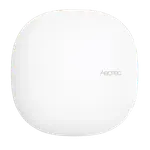
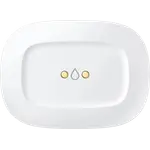
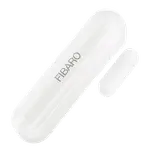
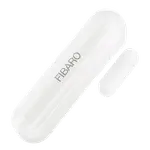
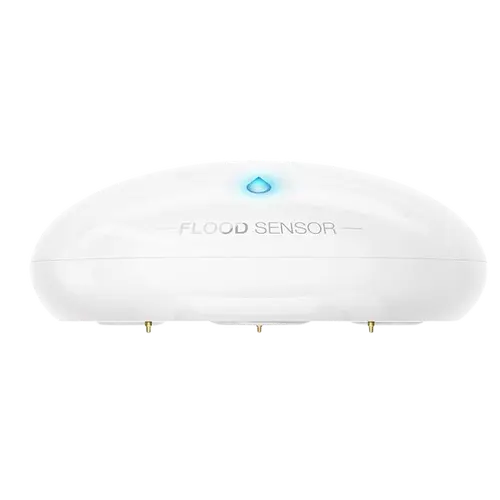
This sensor targets buyers who already have a Z-Wave controller or a Home Assistant instance running and want to extend it with leak detection. Owners across several third-party ecosystems (SmartThings, Home Assistant, Domoticz, Homey and Jeedom controllers all come up repeatedly) describe pairing it without drama, which fits its identity as a hub-first device with no built-in Wi-Fi or Bluetooth radio. Its compact 71 x 71 x 29.3 mm body and light 59g weight also make it easy to tuck under a sink, near a water heater or behind an appliance where a bulkier sensor would not fit as cleanly.
What buyers love
The most consistent praise is for how quick and painless setup is once a Z-Wave hub is in place: buyers describe pairing the sensor in seconds and getting reliable readings afterward. The built-in temperature sensor alongside water-leak detection is called out as a useful bonus, since it lets the same device also flag freeze risk near pipes, matching the freeze-temperature-alerts and temperature-alerts the spec sheet supports. Several owners also highlight the tilt sensor and tamper alerts as a nice extra layer of security, and battery life gets favorable mentions in line with the roughly 2-year CR123A runtime, with the optional external 12/24V wired connection appreciated by anyone who wants the battery to serve purely as backup power.
What to know before you buy
This is a hub-dependent device: there is no 2.4GHz or 5GHz Wi-Fi, no Bluetooth, no Zigbee and no Thread, so it only works through a Z-Wave controller, and it has no native Google Home, Alexa, Apple HomeKit, IFTTT or Matter integration listed, meaning any of those connections has to be bridged through the hub rather than the device itself (Home Assistant is the one integration it does support directly). A few reviewers ran into their smart-home platform misidentifying the sensor as a different device type or needing extra configuration to be recognized correctly, so it helps to check your specific hub's Fibaro compatibility first. There is no included sensor cable/probe, which a handful of buyers wished were bundled, and low battery alerts are not a confirmed feature, so keep manually checking battery status. A small number of buyers also received units with cosmetic scratches or batteries that arrived already low, which is worth checking for at unboxing.
Is the Fibaro Flood Sensor (Z-Wave) worth it?
For anyone already invested in a Z-Wave or Home Assistant smart home, this sensor is a well-regarded, compact way to add water-leak, temperature and tilt monitoring with a strong reputation for reliability and a multi-year battery life. It is a poor fit if you want something that works standalone over Wi-Fi or ties directly into Alexa, Google Home or HomeKit without a hub in between. Buyers weighing it against Wi-Fi-only alternatives should budget for the fact that the value here comes from deep hub integration rather than out-of-the-box voice assistant support.
Frequently asked questions
Does the Fibaro Flood Sensor (Z-Wave) work without a smart home hub?
No. It connects exclusively over Z-Wave and needs a Z-Wave hub or controller (such as a Fibaro Home Center or a Home Assistant setup with a Z-Wave adapter) to function; it has no Wi-Fi or Bluetooth radio of its own.
Does it work with Alexa, Google Home or Apple HomeKit?
Not natively. The spec sheet lists no direct integration with Google Home, Alexa, Apple HomeKit, IFTTT or Matter; Home Assistant is the integration it directly supports, and any voice-assistant connection would have to run through your Z-Wave hub's own bridge.
What kind of battery does it use and how long does it last?
It runs on a single CR123A battery rated for about 2 years, and can optionally be connected to a 12/24V DC power source so the battery becomes an emergency backup instead of the primary power supply.
Does it detect anything besides water leaks?
Yes. Besides water-leak detection, it includes a temperature sensor (with both general temperature alerts and freeze-temperature alerts) and a tilt sensor, plus tamper alerts if someone moves or interferes with the unit.
Is a sensor cable or probe included in the box?
No. The sensor-cable/probe is not included, so the built-in contacts on the unit itself are what detect moisture.