



Shelly Flood S Gen4 Review: A Puck-Sized Leak Sensor That Speaks Wi-Fi, Zigbee and Matter
The Shelly Flood S Gen4 is a compact, battery-powered water leak sensor built to slide flat under an appliance and still reach whichever smart home platform you run. It is Matter certified over Wi-Fi 6, speaks Zigbee 3.0 and Bluetooth 5 LE, carries an IP67 rating and runs about two years on a single CR123A cell, and its large triple-pad stainless-steel sensing surface is rated for clean and low-conductivity water that thinner probes can miss. The trade-off against pricier leak sensors is scope: there is no temperature sensor, so no freeze warning, and no extendable probe cable, so it only senses where the puck itself sits. For a cheap sensor that has to work in whatever ecosystem the house already uses, it is one of the most flexible options in the category.
- Matter and Zigbee households
- Under-appliance and under-sink placement
- Home Assistant and local-automation setups
- Budget buyers covering several rooms
- Outdoor rain-triggered automations
Pros
- Large triple-pad stainless-steel sensor rated for clean and low-conductivity water
- Matter certified over Wi-Fi 6, with Zigbee 3.0 and Bluetooth 5 LE as alternatives
- Works with Google Home, Apple Home, SmartThings and Home Assistant
- IP67 sealed housing rather than a splash-resistant one
- Slim 23 mm disc that fits under appliances and inside drip pans
- Built-in buzzer alarms locally even without a network
- Local automations, webhooks and MQTT keep it running without the cloud
- Rain Detection mode turns it into an outdoor automation trigger
- Low-battery warning below twenty percent charge
- About two years on one replaceable CR123A cell
- Three-year manufacturer warranty
Cons
- No temperature sensor, so no freeze or temperature alerts
- No probe cable included, so it only senses water that reaches the disc
- No Thread radio
- No tamper alerts
- Wi-Fi is 2.4 GHz only
- Flood state is polled every five seconds rather than continuously
- No scripting and no schedules on this model
Who is the Shelly Flood S Gen4 for?
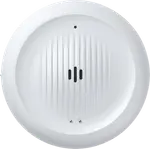
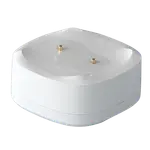
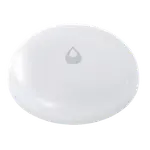
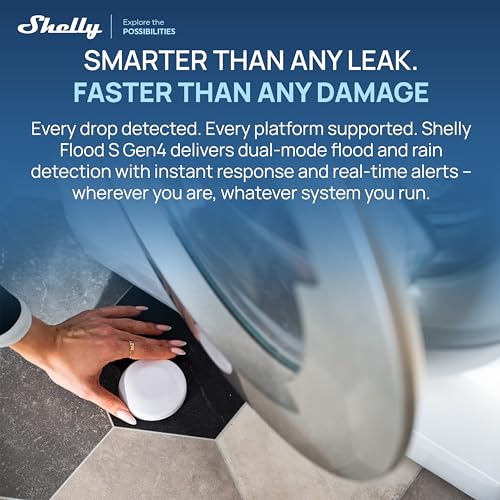
This is a sensor for people who want leak coverage in more than one spot without committing to a single ecosystem. It ships running Matter over Wi-Fi 6 by default, and five rapid presses of its button switch it to Zigbee 3.0 instead, so the same hardware can join a Matter fabric today and a Zigbee mesh later. On paper it works with Google Home, Apple Home, Samsung SmartThings and Home Assistant, with Apple Home and SmartThings arriving over Matter rather than through a separate profile; Alexa has no device type for leak sensors, so Shelly's Alexa skill can only expose it as a contact sensor. Physically it is a flat disc, 77 mm across and only 23 mm tall, which is the whole point: it goes under a washing machine, behind a toilet or inside a water heater drip pan, where a taller sensor would not fit.
What stands out on paper
The sensing surface is the headline. Instead of two small contacts, the underside carries three large stainless-steel pads, and Shelly rates the arrangement for clean and low-conductivity water such as condensation or distilled water, which is exactly the kind of slow drip that a low-conductivity probe can sit in without triggering. The IP67 rating means the housing is sealed against dust and immersion rather than merely splash-resistant, so it survives the puddle it is there to detect. Two operating modes broaden what it is good for: Flood Detection raises an alarm when water appears, while Rain Detection reports the same state change without the alarm, which turns the sensor into an outdoor trigger for pausing irrigation or closing a skylight. A built-in buzzer gives an audible warning right at the leak even if the network is down, three alarm profiles (Intense, Normal and Economic) let you trade alert frequency against battery drain, and local automations, ten webhooks and MQTT let it act on its own without cloud access. It also warns about its own battery, beeping once the charge drops below twenty percent, and Shelly backs it with a three-year warranty.
What to know before you buy
The Flood S Gen4 is a leak sensor and nothing more. There is no temperature sensor, which means no freeze alerts, and freeze protection is one of the main reasons people put a sensor next to a pipe in the first place. There is also no probe cable in the box, so unlike the larger Shelly Flood Gen4 it can only sense water that reaches the disc itself, and there is no tamper alert. On the radio side, Wi-Fi is 2.4 GHz only and there is no Thread, so a Thread-based mesh will not carry it. Two smaller details are worth knowing: the sensor polls its flood state every five seconds rather than continuously, a deliberate concession to battery life, and this model supports neither scripting nor schedules, which are features some other Shelly devices do offer.
Is the Shelly Flood S Gen4 worth it?
At the budget end of the category, most sensors ask you to pick an ecosystem and stay there. This one does not: Matter certification plus a Zigbee firmware option plus Bluetooth setup covers nearly every platform a house is likely to run, and the sealed IP67 body and two-year cell mean it can be placed and forgotten. The honest comparison is against sensors that add a temperature reading or an extendable probe for a little more money, because those two omissions are real and they are the reason to spend up. If what you need is several inexpensive, protocol-agnostic pucks that alarm locally and fire an automation to shut a valve, this is a strong pick.
Frequently asked questions
Does the Shelly Flood S Gen4 work with Apple Home, Alexa, Google Home and SmartThings?
Apple Home, Google Home and SmartThings, yes. It is Matter certified over Wi-Fi, which is how it reaches Apple Home and Samsung SmartThings, and Shelly lists the Google Smart Home Sensor State trait for it. Alexa is the exception: it has no device type for leak sensors, so Shelly's Alexa skill exposes it as a contact sensor rather than as a leak sensor. Home Assistant is supported too, both through the official Shelly integration and as a Matter device.
Does it detect freezing temperatures?
No. Water detection is the only sensor on board, so there are no temperature readings and no freeze alerts. If freeze protection is the reason you are buying, look at a sensor that lists a temperature sensor.
Can it use Zigbee instead of Wi-Fi?
Yes. It ships with Matter firmware running over Wi-Fi, and pressing the button five times rapidly switches it to Zigbee 3.0, or back. On Zigbee it joins through a Zigbee hub like any other end device, which is also the lower-power option.
What battery does it use and how long does it last?
One CR123A cell, included in the box, rated for roughly two years. The exact figure depends on the alarm profile you choose, since the Intense profile reports far more often than the Economic one, and on network conditions. The buzzer beeps to warn you once the charge falls below twenty percent.
What is Rain Detection mode for?
It reports water as a state change without sounding the flood alarm, which makes the sensor useful outdoors. Placed on a terrace or in a garden, that state change can pause irrigation, retract an awning or close a skylight through an automation, rather than treating rain as an emergency.
Can it shut off the water by itself?
Not on its own, but it can trigger the device that does. It runs local automation actions without needing cloud access, and it can drive a compatible smart water valve so the supply closes as soon as water is detected.
Can it survive being sat in water?
Yes. It is rated IP67, meaning the enclosure is dust-tight and protected against temporary immersion, not just against splashes, which is what you want from a device designed to end up in a puddle.